Some links in this guide are affiliate links, if you buy through them we may earn a small commission at no extra cost to you. Here’s our disclosure.
Quick Answer
To organize bathroom cabinets, work in order: empty everything out, purge expired and duplicate products, group what's left into zones by how often you use it, contain each zone in clear right-sized bins, and label every bin so the system stays organized on its own.
You open the bathroom cabinet to grab the good moisturizer and three travel-size bottles tip over, a stray hair tie falls behind the pipes, and you still can't find the one thing you actually came for. Bathroom cabinets have a way of becoming a landfill of half-used products, expired sunscreen, and backup shampoo you forgot you owned. The space under the sink is usually worse, a dark cave around the plumbing where bottles get lost and cleaning sprays slowly leak onto the shelf. It isn't that you're messy. Bathroom cabinets are awkward by design: deep, oddly shaped, split by pipes, and shared by everyone in the house. Every morning the clutter costs you a few frustrating minutes and a little peace of mind before you've even had coffee, and the mess quietly grows because there's no rule for where anything belongs. And if you've already reorganized this cabinet two or three times only to watch it slide back into chaos, the missing piece isn't another trip to the store or another set of matching bins.
How do you organize bathroom cabinets from scratch?
The secret to bathroom organization cabinets that actually stay tidy is to work in a fixed order: empty, purge, zone, contain, and label. Start by taking everything out, every bottle, tube, and box, so you can see the true volume of what you own and wipe down the shelves. Next, purge ruthlessly: toss anything expired, dried out, or unloved, plus duplicates you'll never finish. Most people clear a third of their products in this step alone. Then group what's left into categories, assign each category a zone, and only then buy containers, because now you know exactly what needs to fit. This order matters. When you contain first and sort later, you end up with pretty bins full of clutter, the clutter is just hidden. When you purge and zone first, the containers simply hold an already-good system in place, and the whole cabinet becomes easy to reset in five minutes. Set aside a single uninterrupted hour, and don't move on to the next shelf until the one in front of you is completely done.
How should you group items inside a bathroom cabinet?
Group by how often you reach for something and who uses it, not by product type. The items you touch every single day, toothpaste, face wash, the daily moisturizer, belong at the front of the most accessible shelf, right at eye or hand level. Backups and refills go up high or down low, out of the prime real estate you reach for half-asleep each morning. Give each person a defined zone if the cabinet is shared, so nobody's clutter creeps into anyone else's space and every morning routine has a lane. A simple, repeatable set of zones keeps the system obvious even to the people who didn't build it:
| Zone | What lives here | Best spot |
|---|---|---|
| Daily essentials | Toothpaste, cleanser, moisturizer, deodorant | Front, eye level |
| Hair & styling | Brushes, ties, dry shampoo, heat tools | Middle shelf, one bin |
| First aid & medicine | Bandages, pain relief, thermometer | High shelf, out of reach of kids |
| Backups & refills | Extra soap, cotton rounds, travel sizes | Top shelf or bottom |
| Cleaning supplies | Spray, sponges, gloves | Under the sink only |
When every category has a home, tidying stops being a decision and becomes a reflex, you're not thinking about where the dry shampoo goes, your hand already knows. Zoning also makes shortages obvious: when the backups bin looks thin, you know to restock before you run out mid-week, instead of discovering an empty bottle at the worst possible moment.
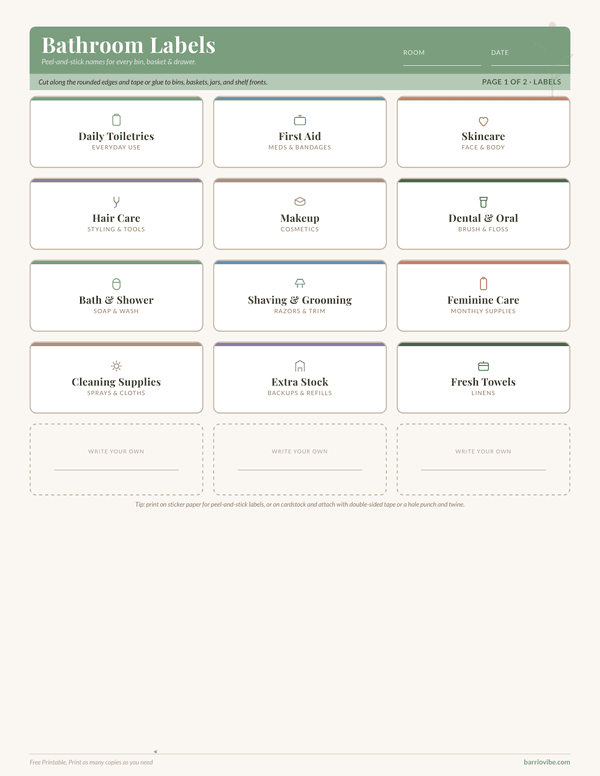
Bathroom Organization Labels + Zone Plan, Free Printable
Free printable bathroom organization labels for toiletries, first aid, skincare, and more, plus a small-bathroom zone plan to give every item a home.
What are the best containers for organizing bathroom cabinets?
Clear, stackable bins are the workhorses of any bathroom cabinet because you can see what's inside without pulling three containers out to check. Measure your shelf height and depth before buying anything, the single most common mistake is bins that are too tall to stack or too deep to reach the back of. Skip anything opaque or lidded for items you use daily, because every extra step is a reason the system quietly breaks down. A handful of container types cover almost every cabinet:
- Shallow clear bins for daily essentials, so everything is visible and grab-able in one motion.
- A turntable for deep corners, so back-row items spin to the front instead of getting stranded.
- Drawer dividers to stop small things, bobby pins, sample packets, from migrating into a jumble.
- A stack of quick-dry microfiber cloths kept nearby for fast shelf wipe-downs during your weekly reset.
You don't need to buy the whole store. A couple of clear divided trays and one turntable handle most bathrooms, and the goal is always the same: one motion to reach anything you need, and one motion to put it back.
How do you organize a deep cabinet or the space under the sink?
Build upward and pull forward, because deep cabinets waste most of their volume in dead vertical air and an unreachable back row. Add a stackable shelf riser or a two-tier expandable rack so you double your usable space and stop stacking bottles precariously on top of each other. Use a turntable in each back corner so nothing gets stranded behind the pipes, and slide labeled bins in like drawers so you can pull the whole group forward instead of digging blindly. Keep a leak-catching tray under any liquid cleaners so a slow drip never ruins the shelf below. Under the sink is its own puzzle thanks to the plumbing snaking through the middle, our full under-the-sink organization guide with free printable labels breaks that awkward cavity into a working system with tension rods and pull-out caddies. The rule everywhere in a deep cabinet is the same: if you have to move something to reach something else, the layout isn't finished yet.
How do you keep bathroom cabinets organized long term?
Label everything and give every item a return address, that's what turns a one-day cleanout into a system that survives real life. Labels do quiet but powerful work: they tell everyone in the house where things go, so the cabinet resets itself instead of relying on you to fix it every few days. Put a clear label on each bin and shelf zone, and the whole family can put things back correctly without asking you where anything lives. Do a two-minute reset once a week, restock what ran low, toss what emptied, and nudge anything that wandered back to its zone before the drift compounds. Twice a year, repeat the full empty-and-purge to catch expired products before they pile up again, a good habit to pair with the time change so you never forget. Keeping the counter clear helps too, since overflow from a cluttered counter is exactly what refills a cabinet; these bathroom countertop organization ideas keep the two surfaces from feeding each other's mess. The maintenance is small on purpose: a system that needs an hour every week won't last, but one that needs two minutes will.
What's the difference between organizing and just decluttering a cabinet?
Decluttering is removing what you don't need; organizing is giving what's left a permanent, obvious home, and a lasting bathroom cabinet needs both, in that order. Declutter alone and the cabinet looks great for a week, then slowly refills because nothing has an assigned spot to defend its space. Organize without decluttering first and you just spend money containerizing junk you should have tossed. The sequence that sticks is: purge down to what you truly use, sort the survivors into clear zones, contain each zone in a right-sized bin, and label so the system is self-explanatory to anyone who opens the door. That last label step is the difference between a cabinet that stays neat and one that drifts, because it removes the guesswork for everyone in the house. Print a set of labels, match them to your zones, and the cabinet will keep itself organized long after the initial motivation fades.
Bathroom Organization Labels + Zone Plan, Free Printable
Free printable bathroom organization labels for toiletries, first aid, skincare, and more, plus a small-bathroom zone plan to give every item a home.
Start with one shelf, work in order, and label as you go, you don't have to do the whole cabinet in one sitting for the system to take hold. A calm, functional bathroom cabinet isn't about owning less stuff or spending more on organizers, it's about giving everything you keep a clear place to live, so the space works for you every single morning instead of against you.
Frequently Asked Questions
How do you organize a bathroom cabinet on a budget?
Shop what you already own first: repurpose small boxes, jars, and baskets as dividers before buying anything. If you do buy, dollar-store clear bins and a single turntable cover most cabinets. The real savings come from purging duplicates so you stop rebuying products you already have.
What should you not store in a bathroom cabinet?
Avoid storing medications, backup razors, and anything heat-sensitive in a humid bathroom, since moisture and temperature swings degrade them faster. Keep medicine in a cooler, drier spot like a bedroom closet, and don't stash extra cleaning chemicals where kids can reach them under the sink.
How do I organize a bathroom cabinet with deep shelves?
Build upward with a stackable shelf riser to use the dead vertical space, add a turntable in each back corner so nothing gets stranded, and slide labeled bins in like drawers so you can pull a whole group forward instead of digging behind the front row.
How often should I reorganize my bathroom cabinets?
Do a quick two-minute reset weekly to restock, toss empties, and return wandering items to their zones. Then run a full empty-and-purge twice a year to clear expired products before they pile up. Small, frequent touch-ups prevent the big overwhelming cleanout.
Do printable labels really help keep cabinets organized?
Yes. Labels give every bin and zone a return address, so everyone in the house knows where things go without asking. That's what lets a cabinet reset itself instead of relying on you. Print, stick them on clear bins, and match each label to its zone.