Some links in this guide are affiliate links, if you buy through them we may earn a small commission at no extra cost to you. Here’s our disclosure.
Quick Answer
Botanical coloring pages are free printable line drawings of plants, leaves, flowers, and wreaths you fill in with color. They calm a busy mind because their soft, organic shapes have no single correct color, giving grown-ups creative freedom with none of the pressure. Print one at home and start in minutes.
Some evenings you just want to put the phone down and do something with your hands, but the options never quite fit. A puzzle takes over the whole table, knitting has a learning curve, and scrolling leaves you more wired than when you started. You remember loving to color as a kid, yet the pages you find online are either cartoon characters for toddlers or dense mandalas so intricate they feel like homework. What you actually want sits somewhere in the middle: something pretty and grown-up, plant-inspired and a little wild, detailed enough to hold your attention but not so fussy it stresses you out. You want it free, ready to print tonight, and nice enough that you would happily frame the result. If you have been hunting for exactly that and coming up short, you are not imagining the gap. It is real, and it is easy to close.
What are botanical coloring pages and why are they so relaxing?
Botanical coloring pages are printable line drawings of plants, leaves, flowers, wreaths, branches, and garden scenes, designed for you to fill in with color. Unlike busy geometric mandalas, botanical coloring pages follow the natural, flowing shapes of real foliage, which makes them feel calming rather than clinical. The relaxation comes from a few things at once. The repetitive motion of coloring inside soft, organic outlines quiets a racing mind, similar to the way doodling helps you focus. The subject matter is gentle and familiar, so there is no pressure to get it right. And because petals and leaves have no single correct color, you get creative freedom without any risk of a wrong answer. Studies on adult coloring point to lower anxiety after just 20 minutes. For most people, a botanical page hits the sweet spot: intricate enough to absorb your attention, open enough to feel like play.
What do you need to print botanical coloring pages at home?
Almost nothing, which is the best part. To print botanical coloring pages at home you need three things: a home printer, a few sheets of paper, and a free PDF like the one below. Any inkjet or laser printer works, since these are simple black-line drawings with no heavy ink coverage. Standard 8.5 by 11 inch copy paper is fine for markers-free coloring, but if you plan to use markers or watercolor, reach for heavier stock so the color does not bleed through. Here is a quick guide to matching paper to your coloring medium:
| Coloring medium | Best paper weight | Why |
|---|---|---|
| Colored pencils | 20 lb copy paper | Smooth, no bleed, prints fast |
| Gel pens | 24-28 lb paper | Slightly thicker resists denting |
| Fine-tip markers | 32 lb or cardstock | Stops ink bleeding to the back |
| Watercolor | 90 lb mixed-media | Absorbs water without buckling |
Set your printer to actual size, not fit to page, so the design keeps its proportions. Then print as many copies as you like.
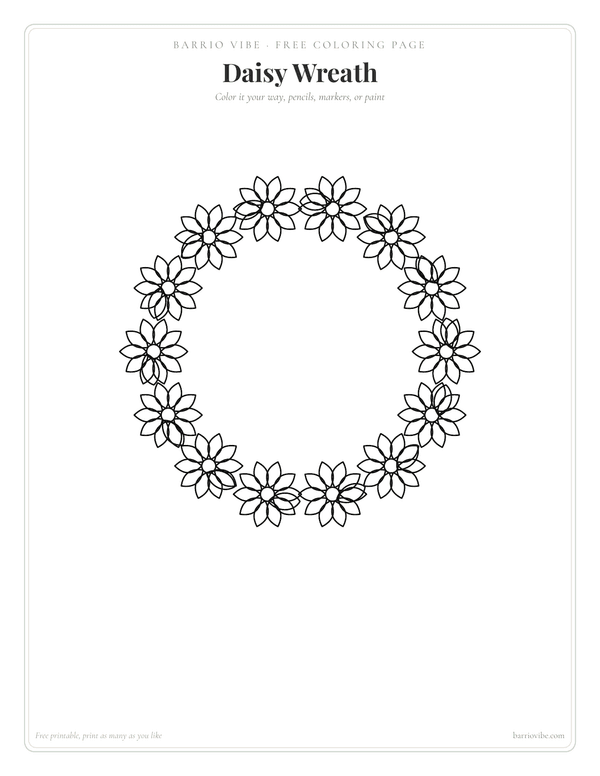
Daisy Wreath
A pretty daisy-wreath coloring page, a wreath of simple flowers and leaves to color.
Which coloring supplies work best for botanical designs?
Colored pencils are the most forgiving choice for botanical designs, because they let you layer greens and blend soft gradients into petals and leaves, which is exactly where flowers come to life. A basic set of 24 colors covers almost any garden palette, and you can build depth by pressing lightly first, then adding a second layer in the shadows. If you like crisp, saturated color, brush-tip markers fill larger leaf shapes quickly and give a modern, graphic look. Fine-liner pens are worth keeping nearby for adding tiny veins, dots, and texture once your base colors are down. When you are shopping, a mid-range set of artist-quality colored pencils makes a noticeable difference over the waxy classroom kind, since the pigment lays down smoother and blends without that chalky drag. Keep your supplies in a small caddy near where you like to sit, so coloring stays a grab-and-go habit instead of a project you have to set up.
How do you color botanical pages so they actually look finished?
Work from light to dark and from background to foreground, the same order a painter uses. Start by choosing a loose palette of three to five colors so the page feels cohesive instead of scattered. Lay down your lightest tones first across all the petals and leaves, then go back and deepen the areas that would naturally fall into shadow, near the center of a flower or where one leaf tucks behind another. This simple light-to-dark layering creates dimension that flat, single-pass coloring never achieves. Leave a thin sliver of white along the top edge of petals to suggest a highlight. For leaves, color along the direction they grow rather than scribbling side to side, which keeps the texture natural. Do not feel obligated to fill every white space; negative space can look intentional and clean. If you want more nature-themed pages to practice these techniques on, our free nature coloring pages collection is full of leaves, landscapes, and organic shapes.
What can you make with finished botanical coloring pages?
Plenty, and this is where the hobby pays you back. A finished botanical coloring page is essentially free wall art, so the simplest project is to trim it, pop it in an inexpensive frame, and hang a little gallery of your own work. Beyond framing, colored botanical pages make lovely handmade greeting cards when folded and trimmed, gift tags when cut small, or bookmarks when you color a tall narrow section. Many people laminate a favorite design to use as a placemat or a reusable dry-erase page for kids. You can also scan a completed page and use it as phone wallpaper or printed gift wrap for small presents. If you enjoy seasonal decor, a set of coordinating florals framed together makes an easy spring or summer display. Should you fall for one particular bloom, our printable daisy coloring pages give you a whole cheerful set to color and craft with.
How do you build a coloring habit that actually sticks?
Attach coloring to a time you already have rather than trying to carve out a brand-new slot. The habits that last are the ones anchored to an existing rhythm, so color for 15 minutes with your morning coffee, during a evening show, or right before bed as a wind-down. Keep a printed page and your pencils out and visible, because a coloring kit tucked in a drawer is a coloring kit you forget. Lower the bar for what counts: finishing one leaf is a win, and you do not have to complete a whole page in one sitting. Print a small stack of botanical coloring pages at once so you always have the next one ready and never lose momentum hunting for a new design. Give yourself permission to color imperfectly, since the point is the calm, not a gallery-ready result. Print the page below, keep it somewhere you will see it, and let a few quiet minutes become the part of the day you look forward to.
Daisy Wreath
A pretty daisy-wreath coloring page, a wreath of simple flowers and leaves to color.
Frequently Asked Questions
Are botanical coloring pages good for adults?
Yes. Botanical coloring pages are ideal for adults because their flowing, plant-based shapes are detailed enough to hold your focus but softer than dense geometric mandalas. The lack of a correct color makes them low-pressure, and research links 20 minutes of coloring to lower anxiety and a calmer, more focused mind.
What is the best paper for printing coloring pages?
Standard 20 lb copy paper works fine for colored pencils and gel pens. If you plan to use markers or watercolor, switch to heavier 32 lb cardstock or 90 lb mixed-media paper so the ink or water does not bleed through and buckle the sheet. Always print at actual size.
Do I need special software to print these coloring pages?
No. The pages download as a standard PDF that opens in any browser, phone, or free reader. Just open the file, choose print, set the scale to actual size rather than fit to page, and use any home inkjet or laser printer. No account or special app is required.
What supplies work best for botanical coloring pages?
Colored pencils are the most forgiving, since they layer and blend soft greens and petal gradients easily. A 24-color set covers most garden palettes. Brush-tip markers fill larger leaves quickly for a graphic look, and fine-liner pens add veins and texture once your base colors are down.
Can I color the same page more than once?
Absolutely. Because the pages are free printable PDFs, you can print as many copies as you like and try a new palette each time. Printing a small stack at once means you always have the next page ready, which makes it easier to keep coloring a regular, relaxing habit.