Some links in this guide are affiliate links, if you buy through them we may earn a small commission at no extra cost to you. Here’s our disclosure.
Quick Answer
To declutter and organize your home, declutter first and organize second. Sort every item into keep, donate, toss, or relocate one small zone at a time, then give what's left a labeled home based on how often you use it. Start with a high-traffic room for an early win, and protect it with a short daily reset.
You've cleaned the whole house and it still looks messy. The counters are wiped, the floors are vacuumed, and yet every surface is covered in stuff that doesn't have a home, mail, chargers, water bottles, the kids' half-finished projects. You open a closet to put one thing away and three things fall out. You've bought bins, watched the organizing shows, maybe filled a donation bag or two, but a month later the clutter has quietly crept back and you're standing in the same spot, wondering why nothing sticks. It's exhausting to feel like you're always tidying and never actually done. The truth is that a home doesn't get cluttered because you're messy or lazy, it gets cluttered because more comes in than goes out, and because most things never got assigned a place to live. You don't have a discipline problem; you have a system problem, and systems are fixable. Before you buy one more basket, it helps to understand what's really going on and to work in an order that actually holds.
What's the difference between decluttering and organizing?
Decluttering and organizing are two different jobs, and doing them in the right order is what makes the whole project stick. To declutter and organize effectively, you declutter first, pulling out everything you don't use, don't love, or don't have room for, and only then organize what remains. Organizing before you declutter is the most common mistake: you spend money on bins and labels to store things you should have released, so the clutter just looks tidier for a week. Decluttering is subtraction; it's the emotional, decision-heavy part. Organizing is arrangement; it's the satisfying, systematic part where everything left gets a designated home. When you separate the two, each gets easier. You're not deciding whether to keep the sweater and where to put it in the same exhausting breath. First you decide what stays, then you decide where it lives. That order is the difference between a reset that lasts and one that doesn't.
Where should you start when you declutter and organize your whole home?
Start with the space that frustrates you most on an ordinary day, usually the kitchen counter, the entryway, or the main bathroom, because an early win there builds momentum for the harder rooms. Resist the urge to begin with the garage, the attic, or a packed closet; those are high-volume, high-emotion zones that stall beginners for hours. Instead, pick one small, visible area you touch daily and finish it completely. A cleared counter or a tidy entry table resets your baseline and proves the process works. From there, move through the house in a deliberate order instead of drifting room to room:
- Main living areas (kitchen, living room, entryway), the spaces you and guests see most
- Bedrooms and bathrooms, personal, daily-use zones
- Closets, the pantry, and cabinets, behind-closed-doors storage
- Garage, attic, or basement, high-volume storage, saved for last
Working from the most-used rooms outward means the spaces you live in improve immediately, and by the time you reach the storage zones you've built the decision-making stamina those rooms demand. Cross each area off as you finish it, visible progress is what keeps you going when the enthusiasm of the first day fades.
How do you declutter a room without getting overwhelmed?
Break the room into small zones and give yourself only four decisions for every item: keep, donate, toss, or relocate. Overwhelm comes from treating a whole room as one giant task and from re-litigating each object endlessly. Zones shrink the job to something you can finish in fifteen or twenty minutes, and a fixed set of choices keeps you moving instead of deliberating. Set out four containers, a box for donations, a bag for trash, a bin for things that belong in another room, and a spot for keepers, then work one zone at a time.
| Zone to tackle | Sort each item into |
|---|---|
| Flat surfaces (counters, tables, dressers) | Keep · Donate · Toss · Relocate |
| Drawers and cabinets | Keep · Donate · Toss · Relocate |
| Closet and hanging storage | Keep · Donate · Toss · Relocate |
| Floor and under-furniture | Keep · Donate · Toss · Relocate |
Finish one zone before starting the next, and empty your donate and relocate bins the same day so nothing drifts back. Setting a timer for each zone helps, too, it caps the session so a quick sort doesn't quietly turn into a three-hour spiral of "should I keep this?" And if you hit a sentimental item you can't decide on, set it aside in a "decide later" box and keep moving; one hard object shouldn't stall the whole room. The free printable below gives you a zone-by-zone checklist with keep, donate, and toss columns for every room in the house.
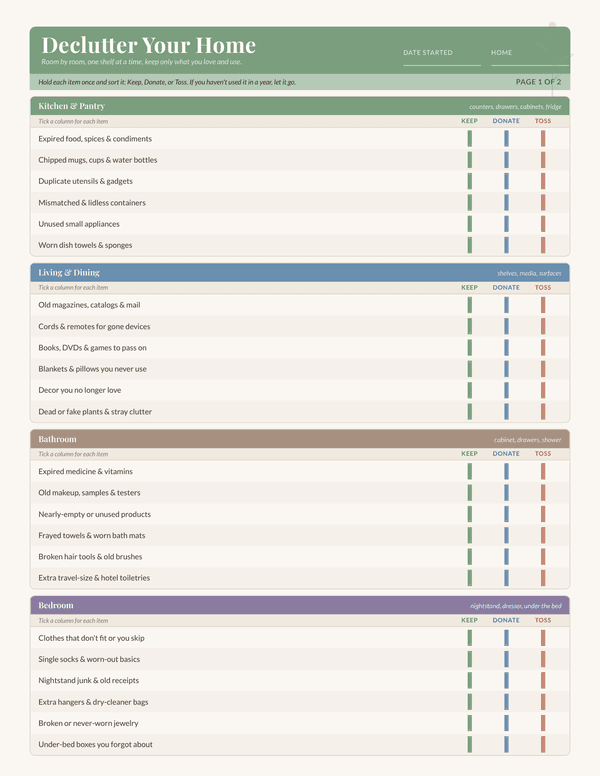
Declutter Your Home Checklist, Free Printable
A room-by-room decluttering checklist with Keep, Donate, and Toss columns plus twelve 20-minute declutter zones, so you can clear the clutter from your whole home one shelf at a time.
What's the best way to organize what you decided to keep?
Group like with like, store the things you use most within easy reach, and give every category a container with a clear label. Once you've decluttered, organizing is mostly grouping and containing. Gather everything of the same type, all the batteries, all the medicines, all the kids' art supplies, into one place so you stop buying duplicates you already own. Then assign each group a home based on how often you reach for it: daily items at eye level and arm's reach, occasional items up high or down low. Contain each category so it can't spread. Clear bins let you see what's inside without opening every one, and a simple label maker (or handwritten tags) turns any bin into an obvious, put-it-back-here home the whole family can follow. The goal isn't a magazine-perfect pantry, it's that everything has one logical place, so tidying becomes a two-minute reset instead of a fresh round of decisions.
How long does it take to declutter and organize a whole house?
Most whole-home resets take a few weeks of short, focused sessions rather than one exhausting weekend. Plan on roughly two to four weeks if you work in twenty-minute zones on weekdays and set aside a couple of longer weekend blocks for the bigger rooms. Speed depends on three things: how much you've accumulated, how quickly you make keep-or-let-go decisions, and whether you finish what you start. The fastest approach is also the least dramatic, one zone a day, fully completed, rather than pulling everything out of five rooms at once and running out of steam by lunch. A half-finished purge that lives in bags by the door for a month feels worse than never starting. If your schedule is tight, our declutter-your-home-in-a-weekend plan compresses the essentials into two days, while the room-by-room decluttering checklist lets you chip away one zone at a time on any timeline.
How do you keep your home decluttered once it's organized?
Keep it decluttered by controlling what comes in and doing a short daily reset. An organized home drifts back to clutter for two reasons: new things arrive faster than old things leave, and items don't get returned to their homes. You fix both with small, repeatable habits rather than another big purge:
- One in, one out, when a new pair of shoes or a toy comes in, one leaves
- A paper landing spot, sort mail daily so it never piles, since paper is where most clutter starts
- A ten-minute nightly reset, walk the main rooms and return stray items to their homes
- A seasonal checklist pass, catch the creep before it compounds
Because you've already given everything a home, the nightly reset is fast; there's no deciding, only returning. Maintenance is far lighter than the first big declutter, you're protecting the system you built, not rebuilding it. Get the whole family in on the returning habit, since a home only stays organized when everyone knows where things belong. Keep the checklist handy and run it whenever a room starts to slip.
Declutter Your Home Checklist, Free Printable
A room-by-room decluttering checklist with Keep, Donate, and Toss columns plus twelve 20-minute declutter zones, so you can clear the clutter from your whole home one shelf at a time.
A clutter-free home isn't the reward for one heroic weekend; it's the result of a good order and a few small habits repeated. Print it, work one zone at a time, and let the plan carry you from cluttered to calm, one finished space at a time.
Frequently Asked Questions
Should you declutter or organize first?
Always declutter first, then organize. Organizing before you declutter means buying bins to store things you should have let go of, so the clutter just looks neater for a week. Remove what you don't use or love, then give everything that's left a designated home.
What is the fastest way to declutter a messy house?
Work one small zone at a time and give every item just four choices: keep, donate, toss, or relocate. Finish one zone completely before starting the next, and empty your donate and trash bags the same day so nothing drifts back into the room.
In what order should you declutter your house?
Start with a high-traffic room like the kitchen or entryway for an early win, then move to bedrooms and bathrooms, then closets and cabinets, and save high-volume storage like the garage, attic, or basement for last once your decision-making stamina is strongest.
How do I stop my house from getting cluttered again?
Control what comes in with a one-in-one-out rule, sort mail daily so paper never piles, and do a ten-minute nightly reset returning stray items to their homes. Because everything already has a place, maintenance is fast, you're protecting the system, not rebuilding it.
How long does it take to declutter and organize a whole house?
Most whole-home resets take two to four weeks of short, focused sessions rather than one marathon weekend. Working in twenty-minute zones on weekdays plus a couple of longer weekend blocks keeps the project moving without burning out or leaving half-finished piles behind.