
Some links in this guide are affiliate links, if you buy through them we may earn a small commission at no extra cost to you. Here’s our disclosure.
Quick Answer
The best fine motor activities for toddlers are simple, playful tasks that build grip strength and the pincer grasp: dropping pom-poms into a cup, stacking blocks, peeling stickers, squishing playdough, and self-feeding with a spoon. Keep sessions to five or ten minutes, rotate a few favorites, and follow your child's lead.
Your toddler can climb the couch, sprint across the yard, and empty a cabinet in ten seconds flat, but hand them a crayon or a spoon and the whole thing seems to fall apart. Maybe the crayon gets a few frustrated scribbles before it's flung across the room. Maybe zipping a coat ends in tears, or half the yogurt lands on the floor instead of in their mouth. It's easy to wonder whether you should be doing something, and just as easy to feel like every "learning activity" on Pinterest needs a laminator, twelve supplies, and an hour of setup you simply don't have. You've probably also seen another kid the same age gripping a marker like a pro and quietly panicked. You are not behind, and your toddler is not either. Those small, wobbly hands are doing exactly what they're supposed to at this age, they just need low-pressure, everyday practice to get stronger, a little at a time. Here's what actually helps, without turning your kitchen into a preschool or adding one more thing to a day that's already full.
What are the best fine motor activities for toddlers?
The best fine motor activities for toddlers are simple, hands-on tasks that build grip strength and the pincer grasp, the thumb-and-finger pinch used for writing later. Toddlers between 1 and 3 learn fastest through repetition and play, not worksheets, so the winners use things you already own. Try dropping pom-poms into a cup, stacking blocks, tearing paper, peeling stickers off a sheet, pushing pipe cleaners through a colander, and squishing playdough. Feeding themselves with a spoon, turning board-book pages, and stacking measuring cups all count too. Each of these forces the small hand muscles to work in slightly different ways, pinching, twisting, poking, releasing, and transferring from one hand to the other. You don't need a themed bin, a lesson plan, or a schedule. Rotate three or four activities so they stay interesting, keep sessions to five or ten minutes, and follow your child's lead rather than a checklist of milestones. If they want to dump the same cup of pom-poms fifteen times in a row, let them, that repetition is the practice. Short, frequent, and playful beats long and structured every single time at this age.
Why do fine motor skills matter this early?
Fine motor skills matter early because they're the physical foundation for nearly everything a child does at school and in daily life, holding a pencil, using scissors, buttoning a shirt, zipping a backpack, and eating independently. These abilities don't appear on their own the day kindergarten starts; they're built slowly through years of small-muscle practice that begins in toddlerhood. When the tiny muscles in the hand, wrist, and fingers get regular, playful use, a child develops the strength, control, and hand-eye coordination that later make writing and self-care feel natural instead of exhausting. Toddlers who pinch, poke, stack, and scribble now tend to grip a crayon with far less frustration at age four. The reverse is also true: skipping this stage doesn't cause harm, but consistent early practice gives kids a real head start on confidence. The good news is that toddlers are wired to want this work, you just have to give them the chance and resist the urge to do it for them.
What everyday activities build fine motor skills?
The most effective fine motor activities for toddlers hide inside your normal routine, so they cost no extra time. Instead of setting up a separate "activity," hand your toddler small jobs during meals, bath, and cleanup. Below is a quick map of everyday moments and the skill each one strengthens:
| Everyday moment | Fine motor skill it builds |
|---|---|
| Self-feeding with a spoon or fork | Grip control, wrist rotation |
| Peeling and placing stickers | Pincer grasp, precision |
| Squeezing a bath sponge | Hand strength |
| Turning board-book pages | Finger isolation |
| Dropping snacks into a cup | Hand-eye coordination |
| Helping to zip and unzip bags | Two-hand coordination |
| Stacking cups or blocks | Release control, balance |
Weave two or three of these into the day and your toddler gets meaningful practice without a single printout or planned "lesson." For a bigger idea bank you can pull from any day, our roundup of everyday fine motor activities for little hands breaks even more of these down by skill. Consistency, not novelty, is what makes the difference.
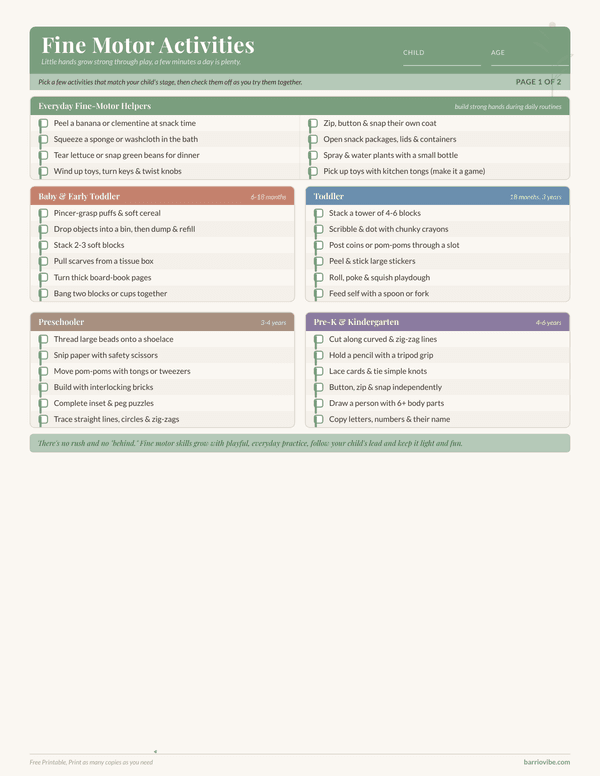
Fine Motor Activities Checklist, Free Printable
A free printable fine motor activities checklist with age-by-age play ideas for babies through kindergarten, plus a weekly practice tracker to check off pinching, cutting, drawing, threading, and self-care skills.
How much fine motor practice does a toddler need?
A few short sessions a day is plenty, think five to ten minutes at a time, several times daily, rather than one long block. Toddler attention spans are famously brief, usually two to five minutes per activity, so trying to hold them at a task longer than that backfires into frustration for both of you. The goal is frequency and variety, not duration. Woven into meals, bath, and play, those small pockets easily add up to 20 or 30 minutes of hand work across the day without ever feeling like a lesson. Watch for signs your child is done: tossing materials, looking away, or getting fussy means it's time to switch or stop. Push past that point and the activity stops being fun, which is the fastest way to make a toddler resist. Follow their interest, keep it light, and let them repeat the same favorite over and over, repetition is how those small muscles actually build strength.
What household items make the best fine motor tools?
Your kitchen and recycling bin are a better toddler supply closet than any store. Everyday items make excellent tools because they're free, familiar, and endlessly rotatable: clothespins for pinching, an empty wipes container for pushing scarves or ribbons through the slot, a muffin tin for sorting pom-poms, ice cube trays for transferring with a spoon, and dry pasta for threading onto a shoelace. Wooden clothespins clipped onto the rim of a bowl are a classic pincer-grip builder that toddlers love, and a sink full of measuring cups makes bath time do double duty. To keep the chaos manageable, corral each little activity into its own container, a set of clear stackable bins lets you prep three or four "invitations to play" ahead of time and swap them in without hunting for pieces, which is the single biggest reason these activities actually happen on busy days. Store them somewhere low so your toddler can help choose, and reset each bin at cleanup as its own tidying game. Always size-check for choking hazards and supervise closely, especially with small beads, pasta, or anything a curious mouth can reach.
How do you keep toddlers engaged (and track their progress)?
Keep engagement high by rotating a small set of activities rather than offering everything at once, novelty resets a toddler's interest, but too many choices overwhelm them. Put out just one or two options, let your child repeat a favorite as many times as they want, and quietly swap in something new when interest fades. Praise the effort and the trying, not the result, so a spilled pom-pom cup stays fun instead of feeling like failure. Sit alongside and model the motion once, then step back and let them struggle a little, that productive struggle is where the learning lives. Tracking helps too: checking off which skills your toddler is working on shows you their real progress and nudges you to introduce the next level, like moving from stacking to threading. As those hands get stronger and steadier, you can graduate to the trickier tasks in our guide to fine motor activities for preschoolers. Print the checklist below and keep it on the fridge as your gentle, no-pressure guide.
Fine Motor Activities Checklist, Free Printable
A free printable fine motor activities checklist with age-by-age play ideas for babies through kindergarten, plus a weekly practice tracker to check off pinching, cutting, drawing, threading, and self-care skills.
Start with one activity today, a spoon and a bowl of pom-poms is enough, and it takes thirty seconds to set up. Keep it short, keep it playful, and let those small hands do the work at their own pace. There's no test to pass and no schedule to fall behind on; some days you'll do three activities and some days none, and both are fine. What matters is that the practice is woven into ordinary moments so it keeps happening. Strong little fingers are built five wobbly minutes at a time.
Frequently Asked Questions
At what age should toddlers start fine motor activities?
Fine motor development begins in infancy, but purposeful play helps most from around 12 months on. Between ages 1 and 3, toddlers refine the pincer grasp and grip strength through everyday pinching, stacking, and self-feeding, so simple activities woven into daily routines are plenty at this stage.
What are examples of fine motor skills in toddlers?
Fine motor skills in toddlers include picking up small objects with thumb and finger, stacking blocks, turning board-book pages, holding a crayon, using a spoon, peeling stickers, and squeezing playdough. Each uses the small muscles of the hand, wrist, and fingers that later support writing and self-care.
How can I improve my toddler's fine motor skills at home?
Offer short, playful hand tasks using household items, clothespins, muffin tins, pom-poms, and dry pasta. Let your toddler self-feed, help with zippers, and turn pages. Keep sessions to five or ten minutes, rotate a few activities, and praise effort rather than the result to keep it fun.
Are worksheets good for toddler fine motor skills?
Not really. Toddlers learn fine motor skills through hands-on repetition and play, not paper worksheets, which suit older preschoolers better. A printable checklist to track skills and spark activity ideas is far more useful at this age than tracing sheets your toddler isn't ready for yet.
What are signs of a fine motor delay in toddlers?
Possible signs include consistently avoiding hand play, difficulty grasping small objects by age two, or not attempting to self-feed or stack. Every child develops on their own timeline, so brief lags are normal, but if you're concerned, mention it to your pediatrician, who can screen and reassure you.