Some links in this guide are affiliate links, if you buy through them we may earn a small commission at no extra cost to you. Here’s our disclosure.
Quick Answer
Flower mandala coloring pages are printable designs that arrange petals, leaves, and vines into a symmetrical circular pattern radiating from a center point. Filling in the small repeating sections works much like meditation, giving both kids and adults a calming, screen-free activity. Download the free PDF and print as many copies as you like.
By the time the day finally goes quiet, you want something that lets your mind off the hook. Not another screen, not another task, not one more thing that needs charging or supervising. Maybe you have thought about coloring, the way it used to absorb you completely as a kid, and even bought a book, only to find the pages felt either too babyish to bother with or so plain they bored you after five minutes. Or you went looking online for something prettier and more intricate, a floral design you could actually lose yourself in, and hit a wall of sign-up forms, watermarks, and files that never quite printed right. You are not asking for much: one genuinely beautiful page, ready to print at home, that a restless kid and a worn-out adult could both happily sit down with at the same table. It turns out that simple thing is surprisingly hard to find.
What are flower mandala coloring pages?
Flower mandala coloring pages are printable designs that arrange petals, blossoms, leaves, and curling vines into a symmetrical circular pattern that radiates out from a single center point. A mandala is a repeating geometric design built in concentric rings, and the floral version simply swaps abstract shapes for botanical ones: roses, daisies, lotus petals, and trailing stems. That structure is what sets them apart from an ordinary coloring book page. Instead of one large picture, you get dozens of small, balanced sections to fill in, which invites focus and rewards patience.
The floral theme makes them especially easy to love. Flowers are naturally symmetrical, so they fold into a mandala's ring structure without ever looking forced, and the finished result reads as elegant rather than childish. A young child can happily color the big outer petals while an adult disappears into the fine interior detail of the very same sheet. Whatever palette you land on, the completed page looks intentional and complete, which is a rare and satisfying thing.
Why is coloring a flower mandala so relaxing?
Coloring a flower mandala is relaxing because the repetitive, structured motion quiets the part of your brain that churns through worry and unfinished to-do lists. Psychologists often compare the effect to meditation: filling in small, predictable sections gives your mind a single, low-stakes point of focus, which lowers the mental chatter that fuels stress and makes it hard to wind down. The symmetry deepens the effect. Because the same petal shape repeats around the center, you settle into a rhythm, coloring one the way you colored the last, with no decision left to agonize over.
There is no plot to follow and no result to get right, so the activity asks nothing of you beyond the next small choice of color. For adults, that makes it a rare screen-free way to decompress that needs no skill, no setup, and almost no cleanup afterward. For children, the same structure channels restless energy into something contained and quiet, which is a small miracle on a long afternoon. Fifteen unhurried minutes with a flower mandala genuinely resets a frayed nervous system.
What is inside this free flower mandala coloring set?
This free printable centers on an intricate floral mandala, a full bloom built from concentric rings of petals, leaves, and delicate line detail, drawn at letter size with clean, bold outlines. It prints crisply on a home printer and leaves room for both broad strokes and fine work. Line weight matters more than people expect: outlines that are too thin frustrate younger colorers and bleed under markers, while these are spaced to hold up to pencils, crayons, and gel pens alike.
Here is what the single design offers, ring by ring, and who tends to enjoy each part most:
| Section | Detail level | Best for |
|---|---|---|
| Outer petal ring | Broad | Young kids, quick wins |
| Middle leaf-and-vine band | Medium | Teens, casual colorers |
| Fine interior center | Fine | Adults, slow relaxing detail |
Because the detail builds from the edges inward, one page can hold several people at once: hand it to a five-year-old for the outer petals and finish the center yourself later. Print one copy or a whole stack, and run off as many as you need so no one has to wait for a turn. The page is undated and non-seasonal, so it works just as well in July as in December, in a classroom, at a party table, or in a quiet living room after bedtime.
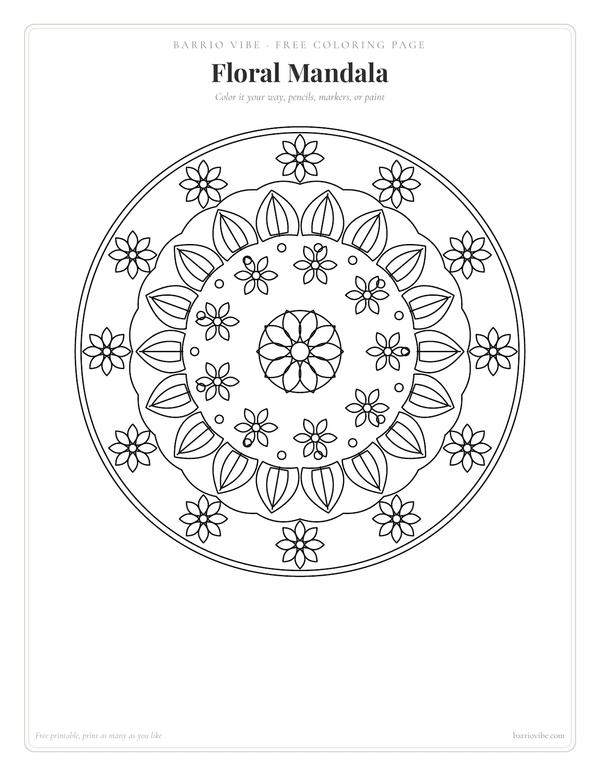
Floral Mandala
A calming floral mandala coloring page of layered daisies and petals, original line art to color.
What supplies work best for flower mandala coloring pages?
You need almost nothing to start: the printed page and something to color with. But because a flower mandala rewards fine detail, the tool you choose shapes the experience more than it would on a simple picture. For the small interior sections, a set of fine-tip gel pens or thin colored pencils lets you stay inside narrow lines without the color pooling or bleeding the way a fat marker can. A good box of artist-quality colored pencils is the one upgrade most people notice immediately, the softer cores lay down richer petals and blend for the kind of subtle shading that makes a bloom look almost real.
For younger children, washable markers or chunky crayons on the larger outer rings work best and wipe off little hands easily. Keep a small sharpener nearby if you are using pencils, since crisp points really do matter in the detailed centers. One more tip worth the thirty seconds it takes: if you plan to use markers, print on slightly heavier paper, 28 lb stock or light cardstock, so the color does not bleed through and the finished bloom is sturdy enough to frame or hang.
Who are flower mandala coloring pages good for?
These floral designs suit a wider range of people than almost any other printable coloring activity. The same sheet works across ages because a child can fill the large outer petals while an adult loses an hour in the fine interior detail, which makes it a genuine multi-generational activity at one table. They are a natural fit for a screen-free afternoon, a rainy day indoors, a long wait at a restaurant, or a quiet wind-down after the house finally goes still and you want to do something with your hands instead of your phone.
Finished pages double as free decor, too: frame a completed bloom for instant botanical wall art, or trim several into circles and string them together as a garland. If your crew wants more variety, our free flower coloring pages collection adds full botanical scenes and single blossoms for younger colorers, while the free printable mandala coloring pages library brings the same symmetrical, meditative style in geometric and non-floral themes. Between the three, there is a page for every mood, every age, and every quiet moment you want to fill.
How do you color a flower mandala for the best results?
The best-looking flower mandalas come from a little planning before you touch a single pen. Work from the center outward so your hand rests on uncolored paper instead of smudging finished sections, and rotate the page as you go rather than twisting your wrist into odd angles. Choose a small palette first, three or four colors that repeat around the rings, because a mandala's symmetry looks most striking when the color echoes it, and unlimited colors tend to read as busy rather than calm.
A soft pink-and-green combination feels classically floral, but a bold sunset palette of coral, gold, and plum is just as lovely, and a cool scheme of blues and purples turns the same bloom serene. Color the same petal shape in each ring the same shade to let the underlying pattern shine, then save a metallic or white gel pen for tiny highlights at the very end. And do not feel you have to finish in one sitting. Mandalas are forgiving, and setting one aside to return to later is part of the calm they offer.
Floral Mandala
A calming floral mandala coloring page of layered daisies and petals, original line art to color.
Keep a page or two printed and within reach, and let the pattern do the quiet work of settling your mind. Whether you hand one to a restless kid, sit down with it yourself after the dishes are done, or set out a bowl of colored pencils for guests, these flower mandala coloring pages ask nothing of you but a few unhurried minutes and a handful of colors. A calmer afternoon, it turns out, is often just one sheet of paper away.
Frequently Asked Questions
Are these flower mandala coloring pages free to print?
Yes. The printable is a free PDF with no email sign-up required. Download it once and print as many copies as you like at home on standard letter-size paper, so every person at the table can have their own bloom without waiting for a turn.
Are flower mandala coloring pages good for kids or adults?
Both. The same sheet works across ages because a child can color the large outer petals while an adult fills in the fine interior detail. The symmetrical pattern means there is no wrong way to do it, so younger colorers stay confident and older ones stay absorbed.
What should I use to color a flower mandala?
Fine-tip gel pens or thin colored pencils work best for the small interior sections, while washable markers or chunky crayons suit the larger outer rings for young children. A soft-core set of artist colored pencils blends beautifully for realistic petal shading.
What paper is best for printing coloring pages?
Standard printer paper is fine for pencils and crayons. If you plan to use markers or gel pens, print on heavier 28 lb stock or light cardstock so the color does not bleed through and the finished page is sturdy enough to frame or turn into decor.
How do you color a mandala so it looks its best?
Work from the center outward to avoid smudging, rotate the page instead of your wrist, and pick a small palette of three or four colors that repeat around the rings. Coloring the same petal shape in each ring the same shade lets the symmetry shine, with metallic accents added last.