Some links in this guide are affiliate links, if you buy through them we may earn a small commission at no extra cost to you. Here’s our disclosure.
Quick Answer
Kaleidoscope coloring pages are printable designs built from one motif mirrored around a center point, creating a symmetrical, radial pattern like a real kaleidoscope. The repeating wedges make them calming to fill in. Download the free printable PDF, pick a small palette, and color for relaxation or with your kids.
You finally carve out twenty quiet minutes, pour the coffee, and sit down to color something, and the page in front of you fights you the whole way. Half the free coloring pages online are flimsy cartoon printouts that feel like they were made for a five-year-old, and the other half are so dense and chaotic that they leave you more frazzled than the day already did. The lines are lopsided, the symmetry is slightly off, and no matter which colors you reach for, the finished sheet never looks as satisfying as the ones you keep scrolling past on Pinterest. Maybe you wanted something the kids could do alongside you, and it turned into three abandoned pages and a pile of uncapped markers. Coloring is supposed to quiet your mind, not hand you one more thing that does not quite work. If that is the loop you keep landing in, you are not imagining it.
What are kaleidoscope coloring pages?
Kaleidoscope coloring pages are printable designs built from a single motif that is repeated and mirrored around a center point, the same way a real kaleidoscope splits and multiplies one small image into a perfectly symmetrical burst. Every wedge of the circle matches its neighbors, so the whole page reads as one balanced pattern radiating outward instead of a random scatter of shapes. That radial symmetry is exactly what makes kaleidoscope coloring pages so satisfying to fill in: because the design repeats in predictable segments, coloring becomes a calm, almost meditative rhythm rather than a guessing game about what goes where.
Most kaleidoscope designs sit somewhere between a soft mandala and a busy geometric print, detailed enough to hold your attention for a good while, yet organized enough that you always know what comes next. That makes them unusually flexible. You can color one purely to unwind after the house goes quiet, frame the finished piece as free wall art, or hand a copy to a child so everyone at the table works the same design in their own colors. Whatever palette you choose, the built-in symmetry means the result looks intentional and complete.
Why are kaleidoscope coloring pages so relaxing?
Kaleidoscope coloring pages calm you down because the repeating symmetry gives your brain a simple, low-stakes pattern to follow, and that gentle focus is what quiets the mental chatter that fuels stress. Psychologists who study art and anxiety often point to repetitive, structured creative tasks as one of the fastest ways to drop into a flow state, the same reason knitting, gardening, and doodling feel soothing. With a kaleidoscope design, you are not inventing anything or making high-pressure choices; you are filling in a pre-set grid of matching wedges, one small segment at a time.
Each completed section delivers a little hit of visible progress, which keeps you engaged without any pressure to perform. The symmetry helps in another quiet way too: small mistakes tend to disappear into the overall pattern, so there is no perfectionism trap waiting to trip you up. There is no plot to follow and no outcome to get right, only the next small choice of color. Twenty unhurried minutes with a page like this works a lot like a short meditation. Your shoulders drop, your breathing slows, and the running to-do list finally goes quiet for a while, which is exactly what a full day tends to run short on.
What is the difference between kaleidoscope, mandala, and geometric coloring pages?
The difference comes down to how each pattern is built. A mandala radiates in concentric rings from the center and often carries a calm, symbolic feel, while a kaleidoscope page mirrors one motif across repeating wedges, giving it that fractured, jewel-like look. Geometric pages lean harder on straight lines, grids, and hard-edged shapes, with less emphasis on a single glowing center. In practice the three overlap constantly, and plenty of kaleidoscope designs are really symmetrical mandalas with sharper, mirrored segments, so you do not have to pick a camp.
If you love the radial calm of a kaleidoscope, you will probably enjoy our free printable mandala coloring pages for their concentric, ring-by-ring flow that builds gently from the middle out. And if you prefer crisp lines and repeating structure, the free geometric mandala coloring pages scratch the same itch with a more angular, tessellated grid. The truth is that most people who like one of these styles end up liking all three. Print one of each, color them on different evenings, and you will quickly learn which kind of symmetry your brain finds most soothing to sink into.
How do you color a kaleidoscope page so it looks balanced?
Choose your colors before you pick up a pencil, then repeat that same palette across every matching wedge, because that single habit is what makes a kaleidoscope page look intentional instead of muddy. Since the design is symmetrical, your color choices should be too: whatever color a shape gets in one segment, its twin in the next segment should usually get as well. Work from the center outward in rings so the pattern builds evenly and your hand never smudges a finished area. If you are not sure where to begin, pick a small palette of three to five colors and give each one a clear role.
| Palette approach | Best for | How it works |
|---|---|---|
| Rainbow rotation | A vibrant, playful look | Cycle warm to cool colors outward, ring by ring |
| Two-color mirror | Fast, foolproof symmetry | Alternate just two colors across matching wedges |
| Warm center, cool edge | A glowing, dimensional feel | Warm tones in the middle, cool tones toward the rim |
| Monochrome shades | A calm, elegant finish | One color from light to dark as you move out |
Fill in a few matching segments, step back to check the pattern is reading evenly, and you will see the whole design start to click into place.
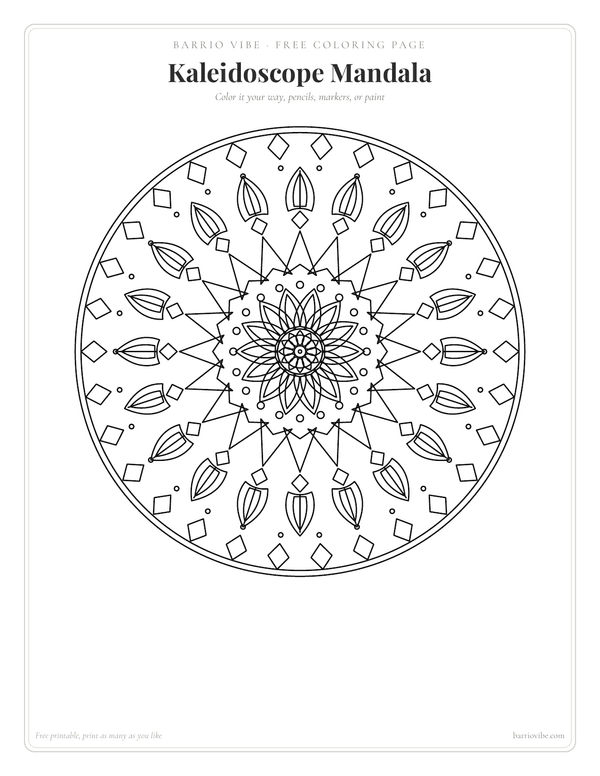
Kaleidoscope Mandala
An intricate original kaleidoscope mandala coloring page for adults and older kids, clean line art to print and color.
What supplies work best for coloring intricate kaleidoscope pages?
Fine-tipped tools work best, because kaleidoscope pages pack a lot of small, repeating segments that a chunky marker will overrun in a single stroke. Reach for colored pencils, thin gel pens, or a set of fine-tip markers so you can stay inside the narrow wedges and keep the mirrored symmetry crisp. A good set of fine-liner pens in a wide range of colors makes a real difference here, since the slim nib lets you fill tight interior sections and add detail without bleeding into the next segment. Beyond the tools themselves, a few small choices keep the finished page clean and frame-worthy:
- Print on heavier paper (28 lb stock or light cardstock) so markers do not bleed through.
- Slip a scrap sheet under your page to protect the table from ink.
- Sharpen colored pencils often so your lines stay thin in the tight centers.
- Lock in your palette before you start, then repeat it faithfully across matching wedges.
- Work from the center outward so your hand never rests on freshly laid ink.
With the right tools and a planned palette, even the most detailed kaleidoscope fills in smoothly, and the symmetry does most of the design work for you.
Are kaleidoscope coloring pages good for kids too?
Yes, kaleidoscope coloring pages work beautifully for kids, as long as you match the detail level to their age. The repeating structure actually helps children, because the mirrored wedges quietly teach patterns, symmetry, and color matching without ever feeling like a lesson. Younger kids can color each large outer section any color they like and still end up with something that looks finished and proud-worthy, while older children enjoy the real challenge of keeping a palette consistent across every segment of the page.
Coloring together also turns these pages into a low-cost, rainy-day activity that keeps a wide age range busy at one table. Print the same design a few times so everyone has their own copy, then compare how different each version looks once the colors go on, it is a small, screen-free lesson in how much palette changes a pattern. The activity builds focus and fine-motor control, and it gives you a genuinely quiet shared moment that asks for no batteries and almost no cleanup. Keep a folder of printed pages ready by the crayons, and a calm afternoon is only ever one print away.
Kaleidoscope Mandala
An intricate original kaleidoscope mandala coloring page for adults and older kids, clean line art to print and color.
Keep the printable somewhere easy to reach, pick a palette before you start, and let the symmetry do the deciding. A few unhurried minutes of coloring is one of the simplest ways to reset a busy day.
Frequently Asked Questions
What is a kaleidoscope coloring page?
A kaleidoscope coloring page is a printable design built from a single motif that is repeated and mirrored around a center point, forming a symmetrical, radial pattern. Like a real kaleidoscope, every wedge matches its neighbors, so the finished page reads as one balanced, jewel-like burst of shapes.
Are kaleidoscope coloring pages good for adults?
Yes. The intricate, repeating segments give adults a low-stakes pattern to focus on, which works much like a short meditation. Filling in matching wedges quiets mental chatter and lowers stress, and the built-in symmetry hides small mistakes, so there is no perfectionism pressure while you unwind.
What is the difference between a kaleidoscope and a mandala coloring page?
A mandala radiates in concentric rings from the center, while a kaleidoscope mirrors one motif across repeating wedges for a fractured, jewel-like look. The two overlap often, and many kaleidoscope designs are simply symmetrical mandalas with sharper, mirrored segments rather than soft, ring-by-ring detail.
What is the best way to color a kaleidoscope page?
Pick a small palette of three to five colors before you start, then repeat that palette across every matching wedge so the symmetry holds. Work from the center outward in rings to build the pattern evenly and keep your hand off freshly laid ink. Consistency is what makes it look intentional.
What supplies work best for kaleidoscope coloring pages?
Fine-tipped tools work best because the segments are small. Use colored pencils, thin gel pens, or fine-tip markers to stay inside narrow wedges and keep lines crisp. If you color with markers, print on heavier paper (28 lb stock or light cardstock) so the ink does not bleed through.