Some links in this guide are affiliate links, if you buy through them we may earn a small commission at no extra cost to you. Here’s our disclosure.
Quick Answer
The best kitchen organizing hacks follow one rule: store things where you use them and keep everything visible. Divide the kitchen into zones, use risers and clear bins to bring items forward, decant pantry staples into labeled containers, and give every drawer dividers so nothing floats loose.
You open a cabinet to grab one pan and three lids slide out. The pantry has two half-open bags of rice because you couldn't see the first one behind the cereal boxes. Every drawer is a jumble of gadgets you have to dig through to find the one spatula you actually reach for. If your kitchen looks tidy enough on the surface but fights you every single time you cook, you already know the real frustration: the space isn't short on storage, it's short on a system. Things get shoved wherever they fit, nothing is labeled, and "putting it away" just means cramming it back onto the pile, so the clutter creeps back a day after you've straightened up. The good news is that a kitchen that actually works isn't about buying more organizers or having a bigger footprint. It comes down to a handful of repeatable kitchen organizing hacks that make every item easy to find, reach, and put back.
What are the best kitchen organizing hacks that actually work?
The best kitchen organizing hacks all share one principle, store things where you use them, and keep every item visible. Start by dividing your kitchen into zones: a prep zone near your main counter, a cooking zone by the stove, a baking zone, and a food-storage zone across the pantry and fridge. Put each item in the zone where you actually reach for it, so pots live by the stove and mixing bowls live by the prep counter. Next, pull everything forward, turntables and pull-out bins bring hidden items to the front so nothing disappears behind a wall of cans. Finally, label the front of every bin and shelf. These three moves (zone, contain, label) do more than any single gadget, because they change how the whole space functions instead of just neatening one drawer for a week.
| Zone | What lives here |
|---|---|
| Prep | Cutting boards, knives, mixing bowls, measuring cups |
| Cooking | Pots, pans, cooking utensils, oils and everyday spices |
| Baking | Flour, sugar, sheet pans, mixer, baking tools |
| Food storage | Pantry staples, canned goods, snacks, containers |
| Daily grab | Mugs, glasses, plates, coffee and tea |
How do you organize kitchen cabinets so you can find everything?
Organize kitchen cabinets by grouping like items together and using the vertical space you're currently wasting. Most cabinets are half empty air above a single layer of stuff, add a shelf riser or two and you instantly double your usable surface, so short items stop hiding behind tall ones. Store plates and bowls near the dishwasher for faster unloading, and keep everyday dishes at eye level while banishing the once-a-year platters to the highest shelf. Corral pot lids in a vertical rack or a tension-rod divider so they stand upright instead of avalanching every time you open the door. For the cabinet under the sink, a two-tier turntable and a slim caddy turn an awkward, pipe-crowded space into something you can actually see into. The goal is simple: every item should be reachable without moving three other things first.
How should you organize a pantry to reduce food waste?
Organize a pantry to cut food waste by decanting staples into clear, airtight containers and labeling every one with its contents and a date. When you can see exactly how much pasta, rice, or flour you have, you stop buying duplicates and you use older items before they expire. Group the pantry by category, baking, breakfast, snacks, canned goods, grains, and give each category its own bin so restocking is a five-second glance instead of an inventory hunt. Put the food you reach for daily at eye level and the backups up high. Add a small "eat me first" bin at the front for items nearing their date, and you'll rescue food that used to get pushed to the back and forgotten. Labels are what make the whole system hold, because everyone in the house can see where things go and actually return them there.
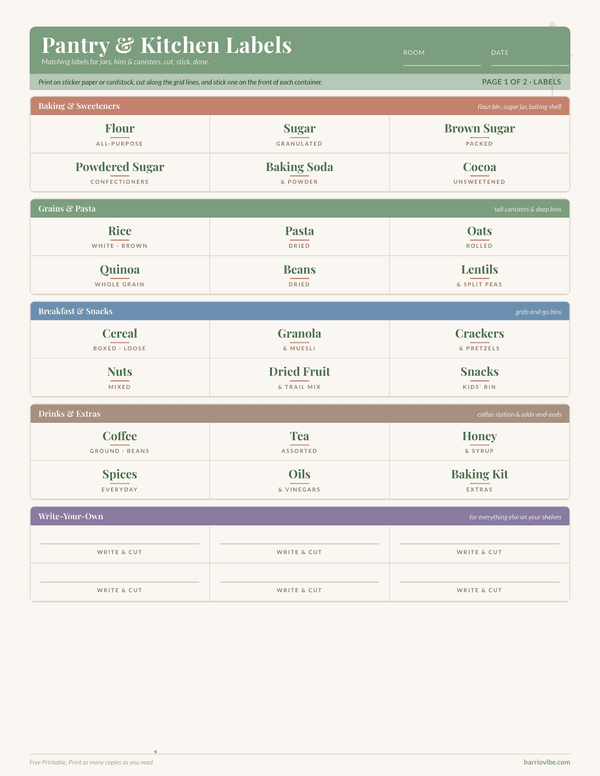
Pantry & Kitchen Labels, Free Printable
A free printable set of pantry and kitchen labels for jars, bins, and canisters, plus a cabinet zone map to plan where everything goes. Print on sticker paper or cardstock, cut, and stick.
What's the smartest way to organize kitchen drawers?
The smartest way to organize kitchen drawers is to give every category its own compartment so nothing floats loose. Start by emptying each drawer completely, then sort the contents into keep, relocate, and donate piles, most people find at least a few duplicate peelers and gadgets they've never used. Add adjustable drawer dividers or a set of narrow trays to create dedicated lanes for utensils, wraps, and small tools, so items stop sliding into one tangled heap every time you open and close. Keep your busiest drawer, the one by the stove or prep area, reserved for only the tools you use daily, and move seldom-used gadgets to a lower or farther drawer. Store knives in an in-drawer knife block to free counter space and protect the blades. A drawer you can scan at a glance is a drawer you'll actually keep organized.
How do you keep the counters clear in a small kitchen?
Keep counters clear by treating flat surfaces as prime real estate that only earns a spot for daily-use items. The coffee maker and knife block can stay; the blender you use twice a month should live in a cabinet. Move anything you can off the counter and onto the walls, a magnetic knife strip, a hanging rail for utensils, and a small shelf reclaim square footage without a renovation. Corral the few items that must stay out onto a single tray so they read as one intentional grouping instead of scattered clutter. Deal with the paper pile-up by giving mail and school forms a designated bin somewhere off the counter entirely. If you're working with a genuinely tight footprint, these small kitchen organization ideas go deeper on squeezing storage out of narrow cabinets, cart gaps, and the backs of doors.
How do you keep a kitchen organized once it's done?
Keep a kitchen organized by building tiny maintenance habits, because even the best kitchen organizing hacks fall apart without a little upkeep and clear labels that survive other people. Do a two-minute reset each night, clear the counters, run the dishwasher, and put strays back in their zone, so you never wake up to yesterday's mess. Once a season, pull everything from one cabinet or the pantry, wipe it down, toss expired food, and re-sort; this catches drift before it becomes chaos. The one purchase genuinely worth making is a set of clear stackable bins and a simple label maker, because a labeled home for every item is what stops the pile from rebuilding. When the pantry and cabinets are labeled, everyone in the house knows where things belong. For the full container-and-label walkthrough, our guide on how to organize a pantry with printable labels pairs perfectly with the sheet below.
Pantry & Kitchen Labels, Free Printable
A free printable set of pantry and kitchen labels for jars, bins, and canisters, plus a cabinet zone map to plan where everything goes. Print on sticker paper or cardstock, cut, and stick.
Print the labels, decant your staples, and put everything back in its zone. A kitchen that stays organized isn't the one with the most gadgets, it's the one where every item has a labeled home you'll actually use.
Frequently Asked Questions
How do I organize my kitchen with no pantry?
Turn a tall cabinet or a section of open shelving into your pantry zone. Group food by category in clear bins, add shelf risers to double vertical space, and label the front of each bin. A rolling cart in a gap gives you extra canned-goods and snack storage.
What is the first step to organizing a messy kitchen?
Start by emptying one zone at a time and sorting everything into keep, relocate, and donate piles. Decluttering duplicates and unused gadgets first means you're only organizing what you actually use, which makes every later step faster and keeps the system from rebuilding.
How do I organize my kitchen cabinets cheaply?
Use inexpensive shelf risers, turntables, and tension rods to divide space, and repurpose boxes or baskets you already own as bins. The highest-value cheap upgrade is labeling: a printable label sheet gives every shelf and bin a home so items get returned correctly.
How should I organize pantry containers?
Decant staples like flour, rice, pasta, sugar, and cereal into clear airtight containers so you can see quantities at a glance. Label each with contents and a date, group them by category, and keep daily items at eye level with backups stored up high.
How do I keep my kitchen organized long-term?
Do a two-minute nightly reset, clear counters, run the dishwasher, return strays to their zone, and re-sort one cabinet or the pantry each season. Clear labels are what make it last, because everyone in the house can see where items belong and put them back.