Some links in this guide are affiliate links, if you buy through them we may earn a small commission at no extra cost to you. Here’s our disclosure.
Quick Answer
To set up a laundry detergent station, gather detergent, softener, pods, stain remover, and dryer sheets into one zone near the washer, decant them into uniform lidded containers on a drip-catching tray, and label each one. Good laundry room organization for detergent means every product has a visible, refillable home.
You open the cabinet above the washer and it all comes tumbling, a half-empty jug of detergent, a crusted-over softener cap, three different stain sprays, and a box of dryer sheets tipped on its side. Pods roll to the back where you can't reach them. The measuring cap has gone missing again, so you're eyeballing pours and either wasting detergent or shorting the load. Every time you do laundry you're rummaging first, and the clutter makes a chore you already dread feel heavier than it is. Maybe you've wiped up a sticky detergent ring more than once, or found a slow-leaking bottle you didn't notice for weeks. The space is small, the products are many, and nothing has a real home. If your detergent situation is a jumble of bottles and guesswork, you're not disorganized, you just never set the space up to work for you.
How do you set up a laundry detergent station?
Start by clearing the surface above or beside your washer, then gather every laundry product into one place so you can see what you actually have. The core of laundry room organization detergent clutter is corralling everything, detergent, fabric softener, stain remover, pods, dryer sheets, and a scoop, into a single dedicated zone within arm's reach of the machine. Wipe the shelf, toss anything expired or empty, and decant your main detergent into a lidded dispenser with a spout so you stop wrestling a heavy jug over the drum. Move pods into a clear lidded jar that keeps moisture and curious kids out, and stand your bottles on a small tray that catches drips before they harden into rings. Keep the products you reach for every load, detergent, pods, stain spray, front and center, and tuck the once-a-month items like washing machine cleaner or bleach toward the edges. Finally, label each container so anyone in the house can find and refill it. Set the station up once and laundry becomes grab, measure, pour, no digging, no guessing, every item in an obvious, visible home.
What supplies do you need for a detergent station?
You need surprisingly little, a few uniform containers, a tray, and labels. The goal is to retire flimsy original packaging in favor of wipeable containers that fit your shelf and match your family's products. Here's a simple starter kit that covers almost any laundry room:
| Item | What it holds | Why it helps |
|---|---|---|
| Detergent dispenser | Liquid or powder detergent | Spout or scoop replaces the heavy, drippy jug |
| Clear lidded jar | Laundry pods | Keeps pods dry and out of reach; you see the count at a glance |
| Pump or pour bottle | Fabric softener | Matches the set and stops crusted caps |
| Small caddy | Stain sprays and sticks | Corrals pretreaters in one grab-and-go bin |
| Catch tray | Bottles and dispensers | Traps sticky drips so the shelf stays clean |
| Scoop or measure | Detergent dose | Tie or clip it on so it never wanders |
| Waterproof labels | Every container | Makes the whole station usable by anyone |
Match container sizes to your shelf depth before you buy anything, a beautiful jar that won't fit behind the cabinet door helps no one. Start with what you use daily and add backups later.
How should you label your detergent containers?
Label every container with its contents and, ideally, its dose. Clear labels are what turn a nice-looking shelf into a system anyone can use, your partner, your teen, a weekend babysitter, without texting you to ask where the softener went. Use waterproof labels so steam and the occasional splash don't peel them, and keep the wording plain: "Detergent," "Fabric Softener," "Stain Remover," "Pods," "Dryer Sheets." If you've decanted into unmarked containers, add the fill line or the per-load dose right on the label ("1 cap per load") so no one over-pours and wastes product. Apply each label to the front of the container at eye level and center it for that calm, uniform look, and consider a smaller companion label listing what each product is best for, softener for towels, delicate wash for wool, so the guesswork disappears entirely. A ready-made printable label set makes this effortless, you get a coordinated, matched look in minutes instead of hunting for a label maker or scrawling on painter's tape. Print, cut, stick, and the whole station suddenly reads as intentional. Grab the free label set built for exactly this station below.
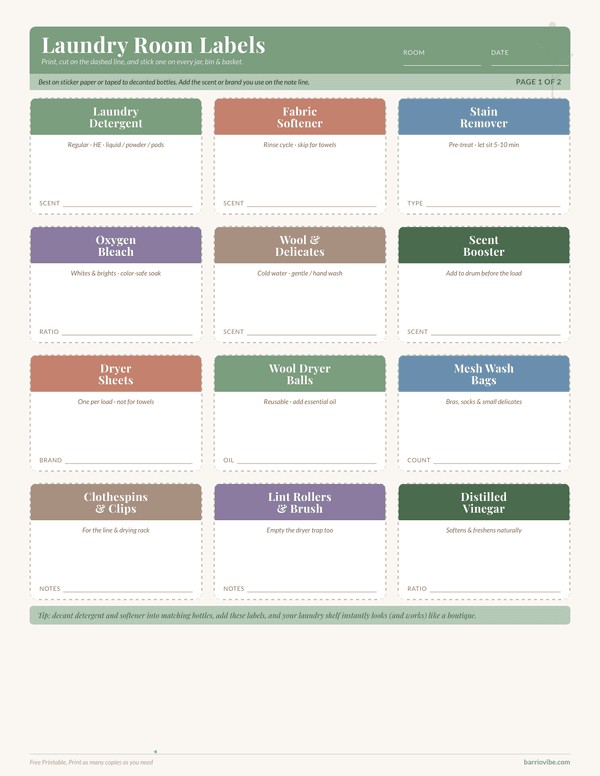
Laundry Room Labels + Routine, Free Printable
A free printable set of laundry room labels for detergent, fabric softener, stain remover and delicates, plus a weekly laundry routine card with a stain quick guide and wash-temperature cheat sheet.
Where should you put a detergent station in a small laundry room?
Put it within arm's reach of the washer and build upward when counter space is short. In a closet or apartment-sized laundry room, the best detergent station lives on a floating shelf directly above the machines, or on a slim rolling cart wedged into the gap beside them. If you have a cabinet, dedicate one shelf to detergent products and nothing else so the zone stays honest. No shelf at all? A tension rod with S-hooks, or an over-the-door organizer, turns a blank wall or the back of the door into real storage. The rules stay simple: keep daily-use items, detergent, pods, stain spray, at eye level, push backups and bulk refills up high or down low, and never stack so deep that you can't see the back row. Leave a few inches of clear surface for setting a full jug down while you pour, and hang frequently grabbed tools like a stain stick or lint brush on a hook rather than burying them in a bin. For tight footprints, our guide to laundry room organization ideas shows how to fit a full station onto a single shelf. The less you have to move to start a load, the more the station actually gets used.
How do you keep a detergent station organized long term?
Refill in place and run a two-minute reset each week, and the station stays effortless for good. The habit that keeps it working is refilling containers the moment they run low instead of parking the new jug on the counter "just for now", that one shortcut is exactly how the clutter creeps back in. Store bulk backups in a labeled bin somewhere else so the station itself only ever holds what's actively in use. A set of clear stackable bins earns its small cost here: they let you spot a product running out before you're mid-load without it, they corral loose bits like dryer sheets and stray clips, and they pull out like little drawers so nothing disappears into the back. Once a week, wipe the catch tray, straighten any crooked labels, and toss the empties. When you're ready to tackle the rest of the room, our laundry room storage ideas cover shelving, drying, and sorting beyond the detergent zone. Set a recurring reminder if you need one; the reset is quick enough that it never becomes another chore. Maintain the station, and it keeps maintaining your laundry routine in return.
What routine pairs best with a detergent station?
Pair your station with a simple sort-and-run rhythm so the organized space genuinely saves you time instead of just looking tidy. A clean detergent zone only pays off if loads move through it smoothly, so set a three-bin sorting system nearby, lights, darks, and delicates, plus a small "stain first" spot where pretreated items wait beside the machine. Decide on wash days that fit your actual week; many people run one load a day, or batch two to three loads on set days. Keep a dose reminder or the printable label cues visible so measuring stays automatic, keep the scoop tied to the detergent, empty the lint trap after every dry cycle, and restock softener and sheets during your weekly reset. It also helps to hang a small "what needs washing when" note nearby, sheets weekly, towels twice a week, workout clothes right away, so nobody has to remember the schedule. With products labeled, sorting handled, and a light routine in place, laundry stops being a hunt-and-guess chore and becomes a few quiet, repeatable minutes. Print the label set, build your station once, and let the system carry the rest of the week.
Laundry Room Labels + Routine, Free Printable
A free printable set of laundry room labels for detergent, fabric softener, stain remover and delicates, plus a weekly laundry routine card with a stain quick guide and wash-temperature cheat sheet.
Frequently Asked Questions
What should be in a laundry detergent station?
A complete station holds your everyday laundry products in one place: liquid or powder detergent in a lidded dispenser, pods in a clear jar, fabric softener, stain remover, dryer sheets, and a scoop, all sitting on a drip-catching tray and clearly labeled so anyone can use it.
How do you organize detergent in a small laundry room?
Build upward. Put a floating shelf or slim rolling cart within arm's reach of the washer, keep daily-use products at eye level, and move backups high or low. Use an over-the-door organizer or a tension rod with hooks when you have no counter or shelf space.
Should you decant laundry detergent into another container?
Decanting into a lidded dispenser with a spout makes pouring easier, stops drips and crusted caps, and looks tidier. It's optional, the bigger wins are grouping products together and labeling them. If you decant, add the per-load dose to the label so no one over-pours.
How do I label my detergent containers?
Use waterproof labels so steam and splashes don't peel them, and keep wording simple: Detergent, Fabric Softener, Stain Remover, Pods, Dryer Sheets. Add the dose when you decant. A printable label set gives every container a matched, coordinated look in minutes, just print, cut, and stick.
Where should you keep laundry pods?
Store pods in a clear, lidded jar rather than their original bag or tub. The lid keeps humidity out so they don't clump, the clear sides let you see when you're running low, and keeping it up high or latched puts the pods safely out of young children's reach.