Some links in this guide are affiliate links, if you buy through them we may earn a small commission at no extra cost to you. Here’s our disclosure.
Quick Answer
The best bedroom organizing ideas give every item a specific home so tidying becomes putting things back, not deciding where things go. Clear all surfaces, keep only sleep and clothing items, assign zones (bed, nightstand, dresser, closet), add contained storage to each, and finish with a 60-second nightly reset.
Your bedroom is supposed to be the one room that resets you at the end of the day, and instead it has quietly become the room that stresses you out. The chair has a mountain of clothes that are neither clean nor dirty. The nightstand is a graveyard of water glasses, chargers, and lip balm. There is a basket of "I'll deal with this later" on the floor that has been there since spring. You make the bed some mornings, and it still somehow looks cluttered. The frustrating part is that you have organized this room before, more than once, and it never sticks. Within a week or two, the surfaces fill back up and the floor sprouts piles again. It is not that you are messy or lazy. It is that the room has no system telling each thing where it belongs, so everything ends up everywhere.
What are the best bedroom organizing ideas that actually last?
The best bedroom organizing ideas share one trait: they give every item a specific home so tidying becomes putting things back, not deciding where things go. Start by clearing every surface completely, then only return what truly belongs in a bedroom, sleep, clothing, and a few personal items. Everything else (mail, dishes, kids' toys) leaves the room for good. Next, assign zones: a sleep zone around the bed, a dressing zone by the closet and dresser, and a surface zone for nightstands. Add contained storage to each, bins in the closet, drawer dividers in the dresser, a small tray on the nightstand, so clutter has a boundary. Finally, build a 60-second nightly reset that returns stray items to their zones. Lasting bedroom organizing ideas are not about buying more; they are about deciding, once, where each category lives, then making the return trip effortless.
How do you organize a bedroom step by step, zone by zone?
Organize a bedroom by working through it in zones rather than trying to fix the whole room at once, which is what makes past attempts collapse. Tackle one zone per session, even 20 minutes each, and the room comes together without a single exhausting marathon. Here is the zone-by-zone breakdown this free printable plan walks you through:
| Zone | What to do | Storage that helps |
|---|---|---|
| Sleep zone (bed) | Make the bed daily, cut throw pillows to what you use | Under-bed bins for spare linens |
| Nightstand & surfaces | Clear to essentials, add a small tray | Tray, drawer, charging cubby |
| Dresser & clothing | Fold by category, use dividers | Drawer dividers, bins |
| Closet | Sort keep/donate, group by type | Matching hangers, shelf bins |
| Floor & corners | Remove "later" piles, give the chair a job | Hamper, one landing basket |
| Reset zone (door) | Do a nightly 60-second tidy | Hooks, catch-all tray |
Work top to bottom, left to right, and finish one zone before moving on so you always see progress.
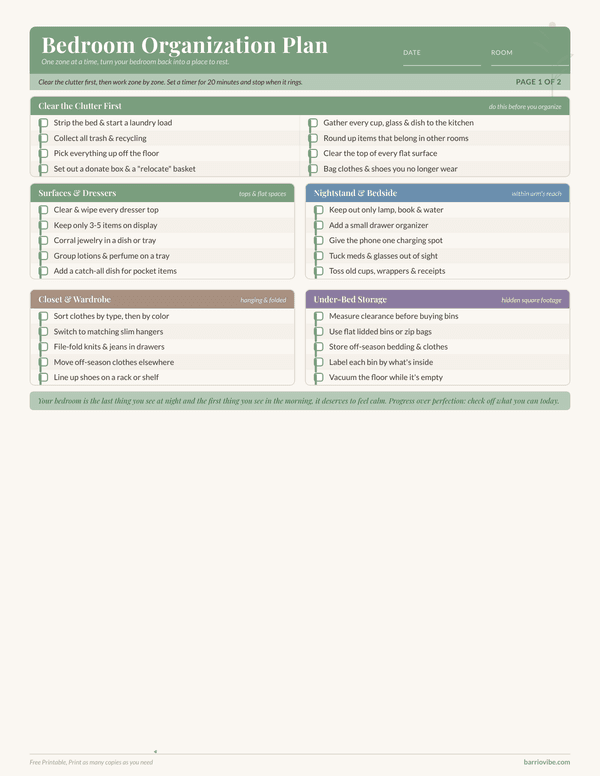
Bedroom Organization Plan, Free Printable
A free printable bedroom organization plan with zone-by-zone checklists for surfaces, nightstand, closet, drawers, and under-bed storage, plus nightly and weekly reset routines to keep your bedroom tidy for good.
How do you organize a small bedroom with limited space?
In a small bedroom, organize vertically and underneath first, because floor space is your scarcest resource and the walls and under-bed area are almost always wasted. Raise the bed on risers or choose a frame with drawers to reclaim a whole hidden zone for off-season clothes, extra bedding, and shoes. Mount hooks and a slim shelf behind the door and above the nightstand to move chargers, books, and jewelry off surfaces. Swap a bulky dresser for a taller, narrower one so you store the same amount on a smaller footprint. Keep only the furniture that earns its place, a chair that collects clothes is costing you square footage. For deeper, room-specific tactics, our guide to small bedroom organization breaks down layout tricks for tight rooms. The rule for small spaces: every item should either hang, stack, or tuck away, never simply sit out.
What is the fastest way to clear nightstand and surface clutter?
Clear surface clutter by giving every flat surface a strict, defined purpose and a container that enforces it. Nightstands and dresser tops attract clutter because they are convenient and unassigned, so the moment you land something there, more follows. Fix it by deciding what each surface is allowed to hold, a lamp, a book, a small tray for glasses and a charger, and removing everything else to its real home. A single tray or catch-all dish does most of the work: it corrals the small stuff into one intentional spot instead of a scatter. For a full system, our nightstand and surface organization guide covers exactly what belongs within arm's reach of the bed. Then protect it with a nightly sweep, anything that migrated onto a surface goes back before you sleep. Clear surfaces are less about cleaning and more about refusing to let a flat space become a default dumping ground.
What storage products actually help organize a bedroom?
The storage that helps most is whatever makes returning an item faster than dropping it, which usually means contained, visible, and matched to a zone. In the closet and under the bed, a set of clear storage bins does the heavy lifting, you can see what is inside without unstacking, so off-season clothes and spare linens stay sorted instead of becoming an avalanche. Inside the dresser, drawer dividers turn one chaotic drawer into tidy lanes for socks, underwear, and folded tees. On the nightstand, a small tray or drawer insert is enough. Skip anything decorative that does not also contain something. The trap with bedroom organizing is buying products before you have decided your zones, which just adds prettier clutter. Choose your zones first, purge what does not belong, and only then buy containers sized to what actually remains. Function before flair, every time.
How do you keep your bedroom organized long-term?
Keep a bedroom organized with a short daily reset and one weekly touch-up, so small messes never compound into another full reorganization. The daily habit is a 60-second nightly sweep: put stray clothes in the hamper or away, clear the nightstand to its tray, and set out tomorrow's essentials. That single minute is what keeps the surfaces you just cleared from filling back up. Once a week, spend ten minutes on a reset, change the sheets, empty the "landing" basket, and return anything that drifted in from other rooms. Tie both habits to something you already do, like brushing your teeth, so they happen without willpower. If clutter is your real struggle, pairing this with a broader system like a room-by-room declutter keeps the whole home from feeding your bedroom. Long-term order is not about a perfect room; it is about a fast, repeatable return trip that you actually do.
Bedroom Organization Plan, Free Printable
A free printable bedroom organization plan with zone-by-zone checklists for surfaces, nightstand, closet, drawers, and under-bed storage, plus nightly and weekly reset routines to keep your bedroom tidy for good.
Pin the plan inside your closet door, work one zone at a time, and let the nightly reset do the maintaining. A calm, organized bedroom is built one small return trip at a time.
Frequently Asked Questions
Where do I start when organizing a messy bedroom?
Start by clearing every surface completely, then return only what truly belongs in a bedroom, sleep and clothing items. Everything else leaves the room. Once surfaces are empty, assign zones and add storage. Starting with a full clear-off gives you a clean baseline instead of shuffling clutter around.
How do I organize a bedroom with no closet?
Use vertical and under-bed space to replace the missing closet. Add a freestanding wardrobe or a garment rack, raise the bed on risers for under-bed bins, and mount hooks and slim shelves on the walls and behind the door. Group clothes by type so the open storage still reads as tidy.
How can I keep my nightstand from getting cluttered?
Give the nightstand a strict purpose, a lamp, a book, and one small tray for a charger and glasses, and remove everything else to its real home. The tray corrals small items into one intentional spot, and a nightly sweep returns anything that migrated back before you sleep.
What should you not keep in a bedroom?
Keep out anything unrelated to sleep or dressing: mail and paperwork, dishes and glasses, work items, exercise gear, and kids' toys. These belong in other rooms and are the main reason surfaces refill. A bedroom stays calm when it only holds sleep, clothing, and a few personal items.
How long does it take to organize a bedroom?
Working zone by zone, most bedrooms come together in about two to three hours total, but you never have to do it all at once. Tackle one zone per 20-minute session (nightstand, dresser, closet, floor) across a few days, and the room organizes itself without a single exhausting marathon.