Some links in this guide are affiliate links, if you buy through them we may earn a small commission at no extra cost to you. Here’s our disclosure.
Quick Answer
A free printable crafts list keeps kids' craft ideas in one place: each idea, the supplies it needs, and how much mess to expect, sorted by no-prep, low-prep, and project crafts. Group them by what you already own so you can scan one page, pick, and go without searching every time.
It always starts the same way. The rain sets in, or the afternoon stretches out with nothing planned, and a small voice announces that they are bored. So you open a browser, type "crafts for kids," and forty tabs later you are drowning in projects that need pipe cleaners you do not own, googly eyes you threw out last spring, and a level of patience you ran out of at lunch. You pin a dozen ideas you will never find again. You buy supplies that get used once. And the next time boredom strikes, you are right back at the same blank search bar, starting from zero. The problem was never a shortage of craft ideas, the internet has endless ideas. The problem is that ideas scattered across a hundred tabs are not a plan. What you actually need is one simple list you can glance at and go.
What should be on a free printable crafts list for kids?
A good list of free printable crafts should give you three things at a glance: the craft idea, the supplies it needs, and roughly how much mess or time to expect, so you can match the project to the afternoon you actually have. Sort ideas into no-prep (crayons, paper, tape), low-prep (a few common supplies), and project crafts (paint, glue, drying time). Group them by what you already own, not by what looks impressive online, so a "yes" is always a few feet away in a drawer. Include a mix of quick fifteen-minute activities for a bored moment and longer ones for a rainy afternoon, plus a couple of no-mess options for the days you have zero energy for cleanup. The whole point of putting it on paper is to remove the decision: instead of searching and second-guessing every time, you scan one page and pick. Keep the list somewhere central, the fridge, the craft drawer, the inside of a cabinet door, so it works the moment you need it. That is exactly what the Preschool Crafts Idea Planner is built to hold.
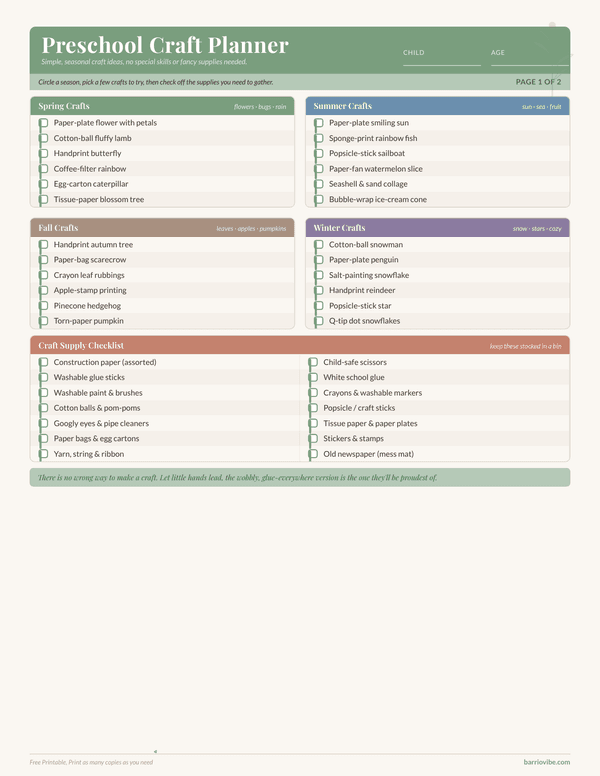
Preschool Crafts Idea Planner, Free Printable
A free printable preschool crafts planner with seasonal craft ideas, a craft supply checklist, and a weekly craft planner to organize easy at-home crafts for kids.
How do you plan a week of kids' crafts without buying anything new?
Start by shopping your own house before you shop a store. Nearly every classic kids' craft runs on supplies you already have: paper, crayons, washable glue, scissors, tape, paper plates, cotton balls, and the recycling bin. Do a quick five-minute inventory, write down what you actually own, and let that list drive the week's plan, one craft per day, each built only from what is on hand. Paper-plate animals, crayon-resist watercolor, cotton-ball snow scenes, cardboard-tube binoculars, and torn-paper collages cost nothing extra and lean on materials most kitchens already hold. When you plan around your existing supplies instead of a shopping list, you skip the store run, the spending, and the guilt of another half-used bag of pom-poms. Save one dedicated "buy" for the week, maybe a pack of construction paper, and build everything else around it. Assign each craft to a day so the week has a rhythm instead of a scramble, and pencil in a backup no-prep idea beside each one for the days a plan falls apart. A week of free printable crafts is less about buying and more about seeing what you already have with fresh eyes.
What are the easiest crafts to keep a preschooler busy?
The easiest crafts for a preschooler are open-ended ones with no "right" result, the process matters more than the product at this age. Think sticker sheets, contact-paper collages (peel the backing, hand over torn tissue paper, let them press), do-a-dot marker pages, cutting practice on old magazines, and gluing shapes into whatever they imagine. These win because there is no wrong way to do them, which means far less frustration and far fewer meltdowns over a project that "looks wrong." Set up the materials, give a loose prompt, and then step back, resist the urge to "fix" their work, because the freedom is the point. For toddlers and threes, keep sessions to ten or fifteen minutes and expect them to wander off, that is normal, not failure. Lay down a wipeable mat or an old towel first, and dress them in a smock or an old t-shirt so the mess never becomes the reason you say no. If you want a deeper bank of these by developmental stage, our guide to easy preschool craft ideas breaks them down further. Simple, forgiving, and repeatable beats elaborate every single time.
How do you organize craft supplies so crafting is actually easy?
Keep supplies visible, sorted, and low enough for little hands to reach, because a craft you have to dig for is a craft that does not happen. The fastest fix is a set of clear stackable storage bins, one per category: paper, coloring tools, glue and tape, and "bits" (pom-poms, stickers, googly eyes). Clear sides mean kids can see what is inside without dumping everything out, and a quick label on each keeps cleanup obvious enough that they can do it themselves. Store the messy or choke-hazard supplies up high and the safe, everyday ones down low, so independent crafting stays safe. Keep one grab-and-go caddy stocked with the daily basics, crayons, paper, safety scissors, glue stick, so the answer to "can we do a craft?" is always yes, right now. Do a quick supply audit every couple of months to toss dried-out markers and refill what ran low, so you are never mid-project when you discover the glue is empty. When supplies have a home, setup drops from ten minutes to one, and that is the difference between crafting weekly and crafting never.
Which crafts work best by season?
Match crafts to the season and you will never run out of fresh, timely ideas, the calendar does the brainstorming for you. Seasonal themes also make crafts feel special without any extra effort, they connect naturally to what kids are already noticing outside, and they double as easy holiday decorations and keepsakes you will actually want to keep. Best of all, nature hands you free supplies as the year turns: leaves in fall, flowers in spring, pinecones in winter. Here is a quick starting map you can build a year of free printable crafts around:
| Season | Easy craft ideas | Mostly-on-hand supplies |
|---|---|---|
| Spring | Paper flowers, handprint butterflies, seed collages | Construction paper, paint, glue |
| Summer | Paper-plate suns, salt-painting, nature collages | Paper plates, watercolors, tape |
| Fall | Leaf rubbings, paper pumpkins, torn-paper trees | Crayons, fallen leaves, scrap paper |
| Winter | Cotton-ball snowmen, paper snowflakes, cardboard ornaments | Cotton balls, white paper, string |
Rotate the list as the weather turns and keep a few evergreen no-prep crafts in reserve for the days nothing themed appeals. For a full seasonal deep-dive, our summer preschool craft ideas guide expands this into a whole warm-weather plan you can print and follow.
How do you keep finished crafts from taking over the house?
Decide in advance what happens to a finished craft, and the paper pile stops multiplying. The simplest system is a three-way sort: display a few current favorites, save a small keepsake box of the truly special ones, and let the rest go without guilt after a short display window. Hang the "display" pieces on a length of twine with clips, rotate them weekly, and photograph anything sentimental before it is recycled, a digital folder holds a thousand masterpieces and takes up no shelf space. Give each child one shoebox-sized keepsake bin per year; when it is full, it is time to curate together. A few favorites also make thoughtful, no-cost gifts, mail a painting to grandparents or turn a drawing into a card, which gives the work a purpose beyond the recycling bin. This turns "where do I put this?" from a daily stressor into a quick, kind ritual, and it keeps crafting fun instead of turning your fridge into an archive. A crafts habit only lasts when the output has somewhere to go.
Preschool Crafts Idea Planner, Free Printable
A free printable preschool crafts planner with seasonal craft ideas, a craft supply checklist, and a weekly craft planner to organize easy at-home crafts for kids.
Print the planner, keep it wherever you keep the crayons, and let one glance replace the endless search. Fill in a few ideas while you are thinking about it, jot the supplies you already own, and the next boredom emergency is already solved. The best craft afternoons are the ones you did not have to plan from scratch.
Frequently Asked Questions
What are some easy crafts to do at home with kids?
The easiest at-home crafts use supplies you already own: paper-plate animals, cotton-ball snowmen, crayon-resist watercolor, torn-paper collages, and cardboard-tube binoculars. Pick open-ended, no-wrong-answer projects for young kids, keep sessions short, and match the craft to how much mess and time your afternoon can handle.
What crafts can I do with a 3-year-old?
Three-year-olds do best with process-focused crafts that have no right result: sticker sheets, contact-paper collages, do-a-dot markers, cutting practice on old magazines, and gluing shapes. Keep sessions to about ten or fifteen minutes, expect them to wander off, and focus on the doing rather than the finished product.
How do I organize kids' craft supplies?
Sort supplies into clear labeled bins by category, paper, coloring tools, glue and tape, and small bits, and keep them visible and low enough for kids to reach. Store messy or choke-hazard items up high, and stock one grab-and-go caddy with everyday basics so setup takes one minute, not ten.
What should I do with all my kids' finished crafts?
Use a three-way sort: display a few current favorites on a clip line, save the truly special ones in a small yearly keepsake box, and recycle the rest without guilt after a short display window. Photograph sentimental pieces before they go so a digital folder holds the memories.
Do I need to buy special supplies to do crafts with kids?
No. Most classic kids' crafts run on things you already have: paper, crayons, washable glue, scissors, tape, paper plates, cotton balls, and the recycling bin. Do a quick supply inventory, plan crafts around what you own, and save just one small purchase per week if anything at all.