Some links in this guide are affiliate links, if you buy through them we may earn a small commission at no extra cost to you. Here’s our disclosure.
Quick Answer
To organize kitchen cabinets, group like items together and give each group a fixed zone based on where you use it, dishes by the dishwasher, pots by the stove, food storage by the prep counter. Add shelf risers, turntables, and clear labeled bins, then label the shelves so the system stays put.
You open the cabinet for a measuring cup and three lids slide out, a stack of mismatched containers shifts, and the thing you actually wanted is somewhere behind the crockpot you use twice a year. Every cabinet has become a game of stacking, digging, and hoping nothing falls on your foot. You wipe the counters and the kitchen looks fine, until someone opens a door and the illusion collapses. The frustrating part is that you have tried before. You pulled everything out one Saturday, put it all back neater, and within a month it had drifted right back to chaos. It is not that you are messy or that you own too much (though you might). It is that the cabinets were never given a system, a reason for each thing to have a home and to stay in it. That is the whole difference between a kitchen that looks organized once and one that stays organized.
How do you organize kitchen cabinets so they actually stay that way?
Start by grouping like with like, then assign every group a fixed zone based on where you use it, that logic is what makes the order stick. The reason most kitchen organizer cabinets projects fail is that people chase neatness instead of a rule: they stack things prettily, but nothing has a defined home, so it all drifts back within weeks. Work one cabinet at a time so the job never overwhelms you. Empty it, wipe it out, and sort what comes out into three piles, keep, relocate, and donate, being honest about duplicate spatulas and gadgets you never actually reach for. Then put back only what belongs in that zone: everyday dishes near the dishwasher, cooking tools near the stove, food storage near the counter where you pack lunches. A quick tip that keeps the reset honest: do not automatically put everything back, anything that did not earn its zone goes to the relocate or donate pile, because a cabinet with a little breathing room is far easier to keep neat than one packed to the door. When each item has an obvious home tied to how you truly cook, resetting the cabinet takes seconds instead of another lost afternoon. Systems stick; tidying alone does not.
Where should everything go? A zone-by-zone cabinet plan
Assign zones by proximity to where each task happens, that single rule prevents the daily back-and-forth that quietly wears a system down. The items you touch every day belong in the easiest-to-reach cabinets, roughly between shoulder and knee height, while rarely used pieces go high or deep where reaching is a chore. Map your kitchen into working zones like this:
| Cabinet zone | What lives here |
|---|---|
| Near the stove | Pots, pans, cooking utensils, oils, everyday spices |
| Near the sink/dishwasher | Plates, bowls, glasses, mugs, the daily dishes |
| Near the prep counter | Cutting boards, mixing bowls, knives, measuring tools |
| Food storage cabinet | Containers with lids nested, wraps, baking supplies |
| Upper/high cabinets | Serving platters, seasonal bakeware, specialty gadgets |
| Under-sink | Cleaning supplies, trash bags, dish soap, sponges |
Notice that nothing is placed for looks alone, each zone shortens the number of steps between grabbing an item and using it. If two zones compete for the same prime cabinet, give it to whichever task you do most often; the loser can move one cabinet over without much cost. Once your zones are set, label the shelf edges or the front of each bin so the plan survives other people putting the dishes away. The zones do the heavy lifting; the labels keep the whole household honest.
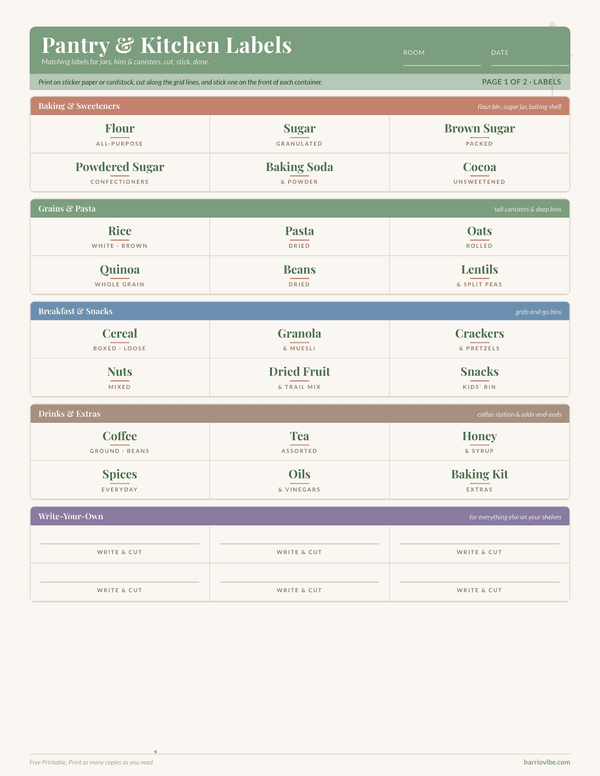
Pantry & Kitchen Labels, Free Printable
A free printable set of pantry and kitchen labels for jars, bins, and canisters, plus a cabinet zone map to plan where everything goes. Print on sticker paper or cardstock, cut, and stick.
What are the best organizers for kitchen cabinets?
The best organizers create vertical layers and pull-out access, because wasted vertical space is where cabinets quietly lose most of their capacity. A handful of workhorses solve nearly every cabinet problem, and you rarely need more than these:
- Shelf risers double your stacking height for plates, bowls, and short glasses.
- A turntable tames oils, vinegars, and spices in a deep or corner cabinet so nothing hides in back.
- A divided lid rack ends the container-lid avalanche once and for all.
- Drawer dividers keep utensils from sliding into one tangled jumble.
For a cohesive, stay-put look, a set of clear stackable bins lets you pull out a whole category at once instead of digging behind it, and the clear sides mean you can see at a glance when something is running low. Pair those bins with a simple label maker or the printable labels below so every container announces exactly what it holds. Before you buy anything, measure your shelf depth and height, because organizers that do not fit end up back in the box or wedged in sideways defeating the purpose. Do not feel you must buy for every cabinet at once, start with the two that frustrate you most and expand from there as your budget allows.
How do you organize a small kitchen with limited cabinets?
In a small kitchen, organize upward and outward, treat walls, cabinet doors, and narrow vertical gaps as extra shelves you have not used yet. When you cannot add cabinets, you add layers instead: adhesive hooks or a slim door-mounted rack on the inside of a cabinet door hold measuring cups, pot lids, or the foil and wrap boxes that never stack neatly. Stackable shelf risers turn one tall, half-empty shelf into two usable ones, and a spring tension rod set upright makes an instant divider for baking sheets and cutting boards stored on their edges. Then edit ruthlessly, because square footage you do not have cannot store things you do not use, pare down to one of each essential and move rarely used appliances out of prime cabinets entirely. For a full walkthrough of squeezing storage from a tight footprint, our small kitchen organization ideas cover doors, corners, and counters in detail. Small kitchens do not need fewer things stored; they need every single inch working twice.
How do you keep kitchen cabinets organized long-term?
Long-term order comes down to two small habits: a fast weekly reset and a firm one-in-one-out rule. Once your zones and labels are in place, spend about five minutes a week returning stray items to their home cabinet and squaring up the bins, catching drift early is what keeps it from snowballing into another full overhaul down the line. The one-in-one-out rule handles the slow creep: when a new mug, container, or gadget comes into the kitchen, an older one leaves, so your cabinets never quietly overflow again. Twice a year, do a deeper pass, toss expired pantry items, re-nest containers that lost their lids, and donate anything you did not touch since the last pass. If you want more quick wins between resets, these kitchen organizing hacks pair perfectly with a zone system for keeping counters and cabinets clear. It also helps to loop the family in once, showing everyone where a few key things now live, so you are not the only person who knows the system and the only person maintaining it. The system holds because the upkeep is small and constant, not because you found one perfect Saturday. Cabinets stay organized when staying organized is genuinely easy.
Should you label your cabinet shelves and bins?
Yes, labeling is what turns a one-time cleanup into a system the whole household actually maintains. A label removes the guesswork: everyone knows where the container lids go, which bin holds the baking supplies, and where the everyday glasses belong, so dishes get put away correctly the first time instead of shoved onto the nearest open shelf. Labels also quietly protect your zones from drift, because an empty labeled spot is an obvious visual cue to refill it with the right thing. Use them on shelf edges, on the front of clear bins, and directly on food-storage containers so contents stay visible at a glance. Keep the look clean and consistent, one font, one placement, one style, so the open cabinet reads as calm rather than cluttered. If you are nervous about committing, start with removable labels or a strip of washi tape you can relabel as your zones settle over the first few weeks. The printable kitchen and pantry labels below give you a coordinated set to cut out and stick, plus a cabinet zone map to plan the whole layout before you move a single dish.
Pantry & Kitchen Labels, Free Printable
A free printable set of pantry and kitchen labels for jars, bins, and canisters, plus a cabinet zone map to plan where everything goes. Print on sticker paper or cardstock, cut, and stick.
Frequently Asked Questions
How do I organize my kitchen cabinets so they stay that way?
Group like items together, then give each group a fixed zone based on where you use it, dishes near the dishwasher, pots near the stove, food storage by the prep counter. Work one cabinet at a time, keep only what belongs in that zone, and label the shelves so the system holds.
What is the best way to organize deep kitchen cabinets?
Deep cabinets hide things in back, so add pull-out access and vertical layers. A turntable brings oils and spices forward with a spin, shelf risers create a second usable level, and clear bins let you slide a whole category out at once instead of digging behind the front row.
How do I organize kitchen cabinets in a small kitchen?
Go upward and outward. Mount hooks or a slim rack inside cabinet doors, use shelf risers to split tall shelves, and stand baking sheets on end behind a tension rod. Then edit ruthlessly, keep one of each essential and move rarely used appliances out of prime cabinets entirely.
Should I use bins or organizers in kitchen cabinets?
Both help, but start with organizers that add layers and access: shelf risers, turntables, lid racks, and drawer dividers. Add clear labeled bins to group categories you can pull out in one motion. Measure your shelves first so everything fits, and buy for your two worst cabinets before expanding.
How do I keep my kitchen cabinets organized long-term?
Use two habits: a five-minute weekly reset to return strays to their zone, and a one-in-one-out rule so nothing quietly overflows. Twice a year, toss expired items and re-nest containers. Labeling shelves and looping in the family keeps everyone maintaining the system, not just you.