Some links in this guide are affiliate links, if you buy through them we may earn a small commission at no extra cost to you. Here’s our disclosure.
Quick Answer
The best home organization tips for a big household focus on systems that run without you: give every person a labeled bin and hook, set one home for each category, and keep a central command center for schedules and paperwork. Fix the highest-traffic zones first, then divide the daily reset among the whole family.
Big households run on volume. More people means more shoes piled by the door, more dishes in the sink by noon, more mail landing on the counter, and more laundry than any single hamper was built to hold. You put a system in place, a bin here, a hook there, and within a week it is buried under everyone else's stuff. The problem is rarely that you are disorganized. It is that a home with five or six people generates mess faster than one person can manage, and every solution that depends on you alone eventually collapses under the sheer traffic. When the family is large, tidying harder never wins; the clutter simply outnumbers you. You can spend a whole Saturday resetting the house and watch it unravel by Monday afternoon. What a busy, full house actually needs is different from what a couple in a small apartment needs, and knowing that difference changes everything about how you set things up.
What are the best home organization tips for a big household?
The best home organization tips for a big household all share one principle: build systems that run without you standing over them. In a full house, anything that depends on one person remembering, reminding, or re-doing will fail, there is simply too much volume. Instead, make the right action the easy action. Put a hook at kid height so backpacks land there automatically. Give every person a labeled bin so nobody has to ask where things go. Create one central spot, a command center or binder, that holds the schedules, contacts, and paperwork the whole family reaches for. The goal is to remove decisions: when the system tells everyone where things belong, you stop being the household's memory. Lean on labels, open bins, and set homes for each category so nobody has to guess. Start with the highest-traffic problem, not the prettiest project, because in a big home the entryway and kitchen counter cause more daily friction than any closet ever will. Fix the spots the whole family touches every day first, and the calmer routine spreads outward from there.
How do you set up organizing systems the whole family will actually use?
A system only works in a big household if it is obvious enough that a tired eight-year-old can follow it. That means labels over memory, open bins over lidded boxes, and one home for every category of stuff. Group belongings by owner and by activity: a bin per child for library books and gear, a shared drop zone for chargers and keys, a single tray for incoming mail. The fewer steps between "I'm holding this" and "it's put away," the more likely it happens. Keep a household command center where the family calendar, permission slips, and emergency contacts live in one place, so information stops floating around on scattered notes and nobody misses a practice or a form again. Assign a home for the categories that generate the most "where is it?" questions, shoes, chargers, mail, school papers, and put that home exactly where the item first lands. When you want a repeatable framework for all of this, our guide on how to make a home organization binder walks through the exact sections a busy family needs. Systems survive when they are visible, simple, and shared, not when they are perfect.
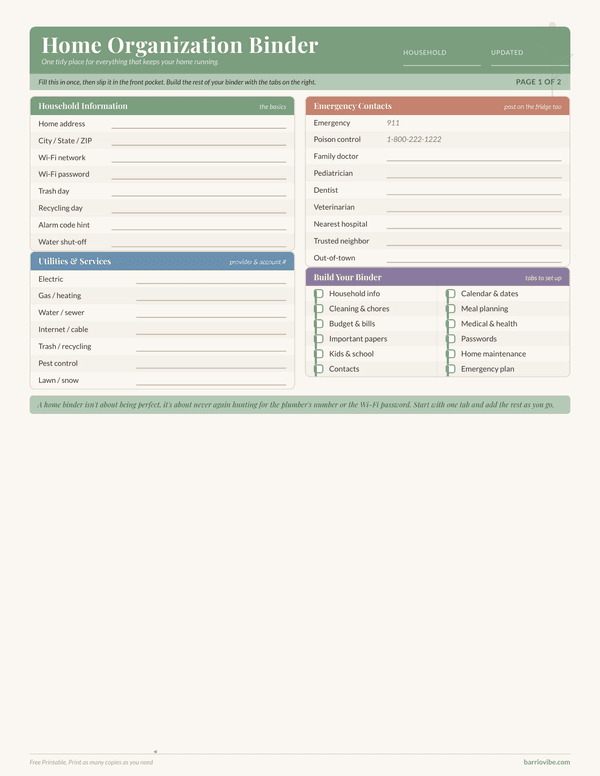
Home Organization Binder Set, Free Printable
A free printable home organization binder set with a household information sheet, emergency contacts, important dates, and a monthly zone and chore planner to keep everything your home needs in one tidy place.
Which zones cause the most chaos in a big household, and how do you organize them?
In a big household, a handful of high-traffic zones create most of the daily mess, so organizing those first delivers the biggest relief. The entryway, kitchen counter, and laundry area are where volume piles up fastest, because every person passes through them every day. Tackle them zone by zone rather than room by room, giving each a single clear job so the mess has nowhere to accumulate. A zone with one purpose is far easier for a distracted family to keep than a whole room with a dozen. Here is where to focus and what each zone needs:
| Zone | Biggest problem | Fix that scales |
|---|---|---|
| Entryway | Shoes, bags, coats for everyone | A hook and bin per person, at their height |
| Kitchen counter | Mail, homework, chargers | One mail tray, one "launch pad" per kid |
| Laundry room | Endless loads, lost socks | Sorted hampers by type, a sock-orphan basket |
| Pantry | Duplicate buys, stale food | Labeled bins by category, oldest in front |
| Bathroom | Shared products, clutter | A caddy or shelf per person |
| Family docs | Lost forms and schedules | A central binder or command center |
Fix the top three first, the rest can wait until the daily chaos settles.
How do you divide organizing responsibilities so it isn't all on one person?
You divide the work by making ownership explicit, because in a big household a single person cannot maintain what six people undo. Assign every family member a role tied to their own space and a shared area they help reset. The point is not perfection; it is distributing the load so the system does not rest on one set of shoulders. A simple split that works:
- Each child owns their bin, backpack hook, and bedroom reset (age-appropriate).
- Older kids and teens take a shared zone, unloading the dishwasher or a nightly counter wipe.
- Adults manage the command center, the calendar, and restocking supplies.
- Everyone does a 10-minute family tidy at the same time each evening.
Anchor the tidy to an existing habit, like right after dinner or before screen time, so it happens on its own without nagging or reminders. When responsibilities are named and repeated, "clean up" stops being a fight and becomes a routine. Our room-by-room home organization hacks give each person quick, specific wins for their assigned zone.
What organizing supplies are actually worth buying for a big family?
Buy the supplies that make putting things away faster, and skip the decorative ones that just add steps. In a large household, function beats aesthetics every time. A set of clear stackable bins earns its place because everyone can see what is inside without opening a lid, which matters when kids are doing the sorting. A simple label maker is the single best investment for a full house, labeled shelves and bins remove the constant "where does this go?" question that otherwise routes back to you. Add extra hampers so laundry sorts itself at the source, a few over-the-door organizers to reclaim vertical space, and one sturdy tray to corral daily mail. Resist the urge to buy matching containers before you know what you are storing; measure and declutter first, then buy to fit. Buying to impress the room wastes money in a big family, because the containers that photograph well are often the ones with lids and steps that kids quietly ignore. The right tools are the ones that let the least-motivated person in the house still get it right on the first try, without your help.
How do you keep a big household's systems from falling apart?
You keep the systems alive by scheduling small resets instead of waiting for a crisis. Big households drift out of order in days, not weeks, so build in a rhythm: a nightly 10-minute family tidy, a weekly restock and calendar check, and a monthly 20-minute declutter of one zone. Expect the systems to slip, that is normal with a full house, and treat maintenance as a chore, not a failure. When a bin overflows or a hook gets ignored, the fix is usually to simplify, not to add rules. Keep your command center current so the family always has one reliable source for schedules and paperwork, and refresh labels as needs change. A big household will never be spotless, and it does not need to be. It needs systems that recover quickly, spread the work, and keep running even on the loud, busy, overflowing days. The families who stay organized are not tidier by nature; they have simply agreed on a rhythm and let it repeat until it feels automatic. Print the planner, put it somewhere central, and let the structure carry the load instead of you.
Home Organization Binder Set, Free Printable
A free printable home organization binder set with a household information sheet, emergency contacts, important dates, and a monthly zone and chore planner to keep everything your home needs in one tidy place.
Frequently Asked Questions
How do you organize a house with a lot of people?
Build systems that don't depend on you: give each person a labeled bin and hook, set one clear home for every category of stuff, and keep a central command center for schedules and paperwork. Then divide a short daily reset among the whole family so no single person carries the load.
How do I keep my big family organized?
Schedule small, repeating resets instead of waiting for a crisis: a nightly 10-minute family tidy, a weekly restock and calendar check, and a monthly 20-minute declutter of one zone. Expect systems to slip, and when they do, simplify the setup rather than adding more rules.
What are the best organizing zones to fix first in a busy home?
Start with the entryway, kitchen counter, and laundry area, because that is where volume piles up fastest in a big household. Give each zone one job, a hook and bin per person at the door, a mail tray on the counter, sorted hampers in the laundry, before moving on to closets and the pantry.
What organizing supplies are worth buying for a big family?
Prioritize clear stackable bins so kids can see what's inside, a label maker to end the constant 'where does this go?' question, extra hampers so laundry sorts at the source, and a mail tray. Declutter and measure before buying containers, and skip decorative pieces with lids that get ignored.
How do you get kids to help keep the house organized?
Make ownership explicit and age-appropriate: each child manages their own bin, backpack hook, and bedroom, while older kids take a shared chore. Anchor a 10-minute family tidy to an existing habit like after dinner so it becomes routine, and use labels so the right action is always the obvious one.