Some links in this guide are affiliate links, if you buy through them we may earn a small commission at no extra cost to you. Here’s our disclosure.
Quick Answer
A home organization binder is one three-ring binder that keeps your household's key information in labeled sections: household info and emergency contacts, important dates, a chore or zone planner, accounts and warranties, and a running notes page. Build the skeleton in an afternoon, keep it somewhere central, and update it during your weekly reset.
You know the papers exist somewhere. The insurance card, the vet's phone number, the Wi-Fi password the babysitter always asks for, the school lunch calendar, the warranty for the dishwasher that just started leaking. But when you actually need one of them, it is buried in a junk drawer, stuck to the fridge under three other things, or lost in an email you cannot find. So you spend ten minutes hunting, ask your partner who also does not know, and eventually give up and call the company to ask all over again. Every household runs on a hundred little pieces of information, and when they live in scattered piles, the mental load of remembering where each one is falls on one person, usually you. The worst part is that it repeats: you re-find the same phone number, re-look-up the same account, and re-explain the same routine to a sitter every few months. It is not that you are disorganized. It is that your household's information has never had a single, agreed-upon home. That is the exact gap this system is built to close.
What is a home organization binder, and what should go in it?
A home organization binder is a single three-ring binder that holds all your household's important information and routines in one grab-and-go place. Instead of scattering account numbers, schedules, contacts, and to-dos across drawers, apps, and sticky notes, you file them into labeled sections behind tabbed dividers. At minimum, a home organization binder should include a household information sheet (address, Wi-Fi, emergency contacts), important dates and a family calendar, a chore or zone planner, key account and warranty details, and a running notes or to-do page. From there, families add meal plans, budgets, medical records, and a home maintenance log as needed. The point is not to file every paper you own, it is to keep the handful of things you reach for weekly, plus the things you would panic to lose in an emergency, in one predictable spot. When it all lives in one binder, anyone in the house can find what they need without asking you first.
How do you set up a home organization binder, step by step?
Start by gathering every loose piece of household information into one pile, then sort it into five or six broad categories before you buy a single supply. The setup goes faster when you decide the structure first and fill it in second. Step one: brain-dump every category your home runs on, contacts, dates, accounts, chores, meals, maintenance. Step two: choose your sections and label a tabbed divider for each. Step three: fill the front pages with your fill-in reference sheets (household info, emergency contacts, important dates) so the most-needed pages sit up front. Step four: slide reference pages into sheet protectors so they survive spills and wipe clean. Step five: add a few blank notes pages at the back for the running list every house generates. Do not aim for perfect on day one. Build the skeleton in an afternoon, then let the binder fill in naturally over the first few weeks as papers surface. A binder that exists and is half-filled is worth far more than the perfect one you never quite start.
What sections should a home organization binder include?
The most useful home organization binders are built around five core sections, with optional add-ons for your family's specific needs. Keep the core small enough that you actually maintain it. Here is a simple structure that works for most households:
| Section | What goes in it |
|---|---|
| Household info | Address, Wi-Fi password, emergency contacts, key account numbers |
| Important dates | Birthdays, renewals, appointments, school and work calendars |
| Chores & zones | Weekly chore assignments and a room-by-room zone planner |
| Home & accounts | Warranties, maintenance log, utility and service providers |
| Notes & to-do | Running list, meal ideas, and a weekly reset page |
Start with these five and only add a section once you have papers that genuinely need a home there, an empty "Medical" tab you never fill just adds bulk. The free printable set below gives you a ready-made page for each of these core sections, so you can build the whole binder in a single sitting instead of designing pages from scratch.
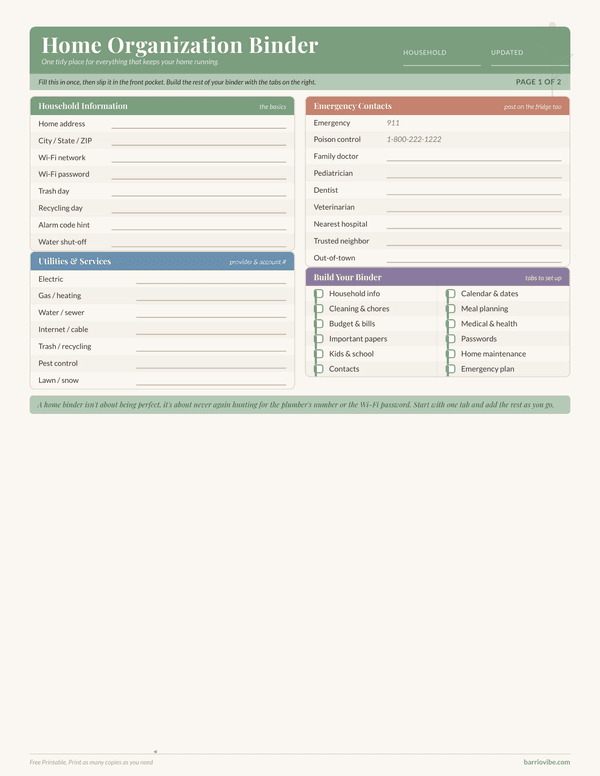
Home Organization Binder Set, Free Printable
A free printable home organization binder set with a household information sheet, emergency contacts, important dates, and a monthly zone and chore planner to keep everything your home needs in one tidy place.
Where should you keep your binder, and how do you keep it updated?
Keep your binder somewhere central and visible, a kitchen shelf, a command-center nook, or the counter where the mail lands, because a binder in a closet is a binder no one updates. The entire value comes from it being the default place everyone reaches first. To keep it current, tie updates to routines you already do. During your weekly reset, spend two minutes filing any new papers and updating the notes page. When a bill or appointment arrives, log the date immediately instead of setting the paper down "for now." Once a season, flip through and purge what is outdated, expired warranties, old schedules, finished projects. The goal is to keep the binder thin enough that flipping to the right page takes seconds, not minutes. If you also organize by room, our room-by-room home organization hacks pair naturally with the binder's zone planner, so the plan on paper matches the plan in each space. A binder only works when updating it is genuinely easier than not, so keep the friction as low as you can.
What supplies do you need to make a home organization binder?
You need surprisingly little to build a starter binder:
- A 1-inch three-ring binder with a clear front pocket
- A set of 5-8 tabbed dividers, one per section
- A pack of clear sheet protectors for the fill-in pages
- The printable reference pages
- A pen or a basic label maker for the tabs
The sheet protectors matter most, they let you slide fill-in pages in and out, wipe them clean, or check items off with a dry-erase marker instead of reprinting every week. A basic label maker makes the tabs look tidy and legible, but a fine-tip pen works just as well if you would rather not buy one. If you want the reference pages to feel cohesive, print them all at once on the same paper stock, and use one divider color per section so the tabs are easy to scan. And for families expanding beyond a binder into full-home systems, the right storage bins and baskets turn the binder's zone plan into an actually sorted space. Keep the supply list minimal so the project stays a one-afternoon job, not a weekend shopping expedition, you can always add a pocket folder or a hole punch later if a specific section demands it.
Is a home organization binder better than keeping everything digital?
A paper binder and a digital system each win at different things, and the best setup for most families is a hybrid of both. A binder beats an app for information you need at a glance or in an emergency, when the Wi-Fi is down, the babysitter is standing in your kitchen, or a caregiver needs your emergency contacts, paper never asks for a password or a charge. It is also faster for the whole family to use, since no one has to be added to an account or taught an app. Digital tools win for anything that changes constantly or that you share across locations, like a live shared calendar or cloud-stored documents. A practical rule: keep stable, reach-for-it-fast reference in the binder, and keep frequently changing, collaborative information digital. Many families even note "see binder" in a phone reminder, or snap a photo of the household info page as a backup, so the two systems point to each other instead of competing. You do not have to choose one forever. Start the binder this week, and let it hold the handful of things you are always hunting for.
A home organization binder will not organize itself, but it does something quieter and more valuable: it gives your household's information a single, predictable home, so the mental load of remembering where everything lives finally stops sitting in your head. It also shares that load, once the binder exists, your partner, an older kid, or a caregiver can find the Wi-Fi password or the pediatrician's number without a text to you. Print the set below, fill in the front pages tonight, and let the rest fill in naturally as papers surface over the next few weeks. Start small, keep it central, and update it in the two quiet minutes you already spend resetting for the week.
Home Organization Binder Set, Free Printable
A free printable home organization binder set with a household information sheet, emergency contacts, important dates, and a monthly zone and chore planner to keep everything your home needs in one tidy place.
Frequently Asked Questions
What should be included in a home organization binder?
At minimum, include a household information sheet (address, Wi-Fi, emergency contacts), important dates and a family calendar, a chore or zone planner, key accounts and warranties, and a running notes or to-do page. Add meal plans, budgets, medical records, or a maintenance log only as your family actually needs them.
How do I start a home organization binder?
Gather every loose piece of household information into one pile, sort it into five or six broad categories, then label a tabbed divider for each. Fill the front pages with your most-needed reference sheets, slide them into sheet protectors, and add blank notes pages at the back. Build the skeleton first, then fill it in over a few weeks.
What supplies do I need for a home organization binder?
You need very little: a 1-inch three-ring binder, 5 to 8 tabbed dividers, a pack of clear sheet protectors, the printable reference pages, and a pen or basic label maker for the tabs. Sheet protectors matter most because they let you wipe pages clean or check items off with a dry-erase marker instead of reprinting.
Is a home organization binder better than a digital app?
They win at different things, so a hybrid works best. A binder beats an app for information you need at a glance or in an emergency, since paper never needs a password or charge and the whole family can use it. Keep constantly changing, shared information like a live calendar digital, and keep stable reference in the binder.
Where should I keep my home organization binder?
Keep it somewhere central and visible, like a kitchen shelf, a command-center nook, or where the mail lands, because a binder in a closet is one no one updates. Tie updates to routines you already do: file new papers during your weekly reset and purge outdated pages once a season.