
Some links in this guide are affiliate links, if you buy through them we may earn a small commission at no extra cost to you. Here’s our disclosure.
Quick Answer
To declutter your closet in one afternoon, set a 3-hour timer and sort everything into four piles: keep, donate, sell, and toss. Work one section at a time, decide in seconds using the one-year rule, and move the go pile out of the house the same day so clutter cannot creep back.
You open the closet door, push a few hangers aside, and close it again. There is technically room in there, but you still cannot find the one shirt you actually want to wear, and half the shelf is a pile of things you have not touched since two seasons ago. Every morning starts with the same small stall, digging, sighing, giving up. You have thought about tackling it a dozen times, but the job feels enormous: pull everything out, and now your bed is buried and your afternoon is gone. So the door stays shut and the pile keeps growing. The problem is not that you own too much willpower-worth of clothes. It is that closet clutter builds in slow, invisible layers, and there has never been a clear, stop-when-you-are-done plan to clear it. Most closet cleanouts stall for one of two reasons: they have no time limit, so the job balloons, or they have no decision rule, so you agonize over every hanger. The plan below fixes both. That is what changes today.
How do you declutter your closet in one afternoon?
To declutter closet clutter in a single afternoon, work in one focused three-hour block using four labeled sorting piles: keep, donate, sell, and toss. Start by pulling everything off one section, hanging clothes first, and making a fast keep-or-go decision on each item before moving to shelves, then drawers, then shoes. The key is speed over perfection: hold each piece for no more than a few seconds and trust your first reaction. Set a timer for the whole session so the project has a finish line and cannot sprawl into the evening. Clear a staging spot on the bed for the piles before you begin, so items never drift back onto hangers. By working section by section instead of emptying the entire closet at once, you keep the mess contained and always have a visible sense of progress, which is exactly what keeps you going when your energy dips halfway through.
What is the fastest way to sort your clothes?
The fastest way to sort clothes is the four-pile method: keep, donate, sell, and toss, with no fifth "maybe" pile allowed. A maybe pile is where decluttering goes to die, it just recreates the clutter in a new spot and forces you to decide twice. Give every item exactly one home. Keep is for pieces you have worn in the last year and genuinely reach for. Donate is for anything clean and wearable that you simply do not use. Sell is reserved for higher-value or barely-worn items worth the listing effort. Toss covers the stained, torn, and pilled things no one should inherit. To move quickly, handle like with like: do all your tops, then all your bottoms, then dresses, then shoes. Grouping by category makes duplicates obvious, you will spot the seven nearly identical black tees fast, and turns a vague, emotional job into a series of quick, concrete comparisons.
Which clothes should you actually keep?
Keep the clothes that fit your body and your real life right now, not the size you hope to be or the occasions you rarely have. The clearest test is the one-year rule: if you have not worn it in twelve months and it is not truly seasonal or sentimental, it goes. Beyond that, use a few honest questions to speed up the borderline calls. This simple decision grid is exactly the logic the free printable walks you through, row by row:
| Ask yourself | Keep it if... | Let it go if... |
|---|---|---|
| Have I worn it in the last year? | Yes, regularly | No, and I keep skipping it |
| Does it fit me today? | Yes, comfortably | Only if I lose or gain weight |
| Would I buy it again now? | Absolutely | I forgot I even owned it |
| Is it stained, torn, or pilled? | No, it is in good shape | Yes, and I will not repair it |
| Do I have near-duplicates? | It is my favorite of them | I have three better versions |
| Does it match how I dress now? | Yes, it fits my real life | Only the life I imagined |
| Is it uncomfortable to wear? | No, I reach for it happily | Yes, it itches, pinches, or slips |
When a piece earns "keep" on these, it deserves prime closet real estate. When it does not, thank it and move it to the right pile. Run every questionable item through the same grid so the decision stays consistent and fast instead of emotional. The free closet decluttering checklist below turns this exact grid into a page you can hold and tick off as you go.
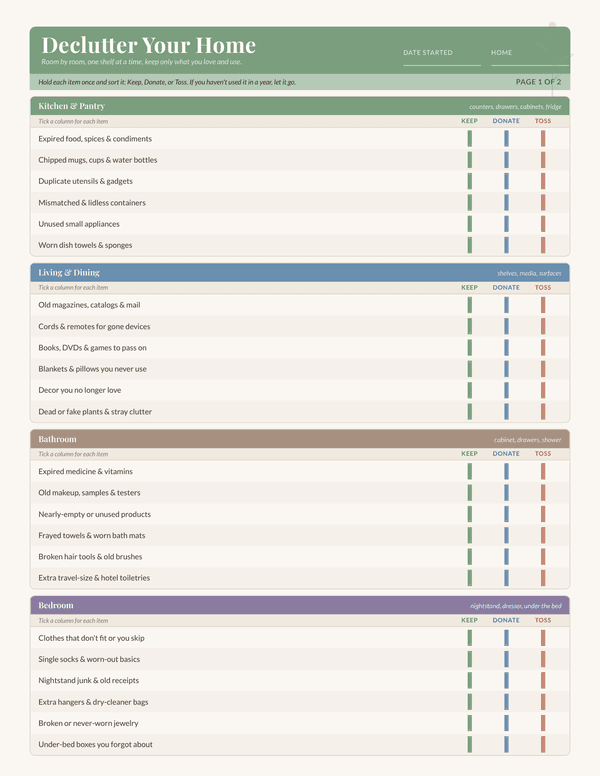
Declutter Your Home Checklist, Free Printable
A room-by-room decluttering checklist with Keep, Donate, and Toss columns plus twelve 20-minute declutter zones, so you can clear the clutter from your whole home one shelf at a time.
How do you keep your closet decluttered after you finish?
Keeping a closet decluttered comes down to two habits and a little structure. First, adopt the one-in, one-out rule: every time a new item comes in, one leaves. This single practice is what stops clutter from silently rebuilding over the next six months. Second, do a five-minute reset at the end of each season, re-hang, re-fold, and pull anything you did not wear that season into a donate bag. Structure makes both habits effortless: give every category a defined zone so items have an obvious place to return to. Matching hangers instantly make a closet look calmer and let clothes hang evenly, while a set of clear stackable bins keeps sweaters, bags, and off-season pieces visible and contained instead of avalanching off the top shelf. Labeling shelves and bins removes the last bit of guesswork about where things live. When everything has a home, tidying stops being a project and becomes a thirty-second habit.
What should you do with the clothes you remove?
Move the removed clothes out of your house the same day, before second-guessing pulls them back onto a hanger. Bag the donate pile immediately and put it in your car so the next errand carries it to a drop-off or charity shop. For the sell pile, be realistic: list only genuinely valuable or barely-worn items on resale apps or local marketplaces, and give yourself a deadline, if it has not sold in a few weeks, it becomes a donation. Truly worn-out textiles do not belong in the trash; many retailers and municipal programs now accept fabric for textile recycling, which keeps stained or torn pieces out of the landfill. Whatever you do, resist "storing" the go pile in the garage or under the bed, because a decluttered closet only stays that way once the excess actually leaves the building. The goal is not to relocate clutter, it is to be rid of it.
How often should you declutter your closet?
Do a full closet declutter twice a year, ideally at the spring and fall wardrobe changeovers, with a quick five-minute touch-up at the end of every season. The twice-yearly deep pass lines up naturally with swapping heavy and light clothing, so you are already handling everything anyway, it is the perfect moment to reassess what earned its space. Between those, the seasonal touch-up catches the few items that slipped through and stops small clutter from compounding into another overwhelming pile. If your mornings still feel chaotic, that is your real signal to declutter closet contents again, regardless of the calendar. Pair this rhythm with room-by-room decluttering across the rest of your home for lasting calm, our room-by-room decluttering checklist covers every space beyond the closet, and once the purge is done, these closet organization ideas help you set up zones that actually hold. Print the checklist, keep it on the shelf, and let the plan carry you.
Declutter Your Home Checklist, Free Printable
A room-by-room decluttering checklist with Keep, Donate, and Toss columns plus twelve 20-minute declutter zones, so you can clear the clutter from your whole home one shelf at a time.
You do not need a free weekend or a perfect system to declutter closet chaos, you need three hours, four piles, and a page that decides for you. Print the checklist, clear one section at a time, and get the go pile out of the house before the day ends. When the timer stops, so do you, and tomorrow morning you open a closet that finally shows you what you own. That is the whole payoff: not a magazine closet, just a calm one you can actually get dressed in.
Frequently Asked Questions
How long does it take to declutter a closet?
Most closets can be decluttered in about three hours when you work in one focused block. Set a timer, sort into four piles, and go section by section instead of emptying everything at once. The time limit is what keeps a one-afternoon job from stretching into a lost weekend.
What is the four-pile method for decluttering clothes?
The four-pile method sorts every item into keep, donate, sell, or toss, with no maybe pile. Keep is what you wear; donate is clean and wearable but unused; sell is higher-value pieces; toss is stained or torn. Giving each item one home stops you from deciding twice.
How do I decide which clothes to get rid of?
Use the one-year rule: if you have not worn it in twelve months and it is not seasonal or sentimental, let it go. Then check fit, condition, and duplicates. If it does not fit today, is damaged, or you have three better versions, move it to the donate or toss pile.
How do I keep my closet decluttered after cleaning it out?
Adopt the one-in, one-out rule so every new item replaces an old one, and do a five-minute reset each season. Give every category a defined zone and label shelves so items have an obvious place to return to. When everything has a home, tidying takes seconds, not hours.
What should I do with clothes I declutter?
Move them out the same day before you second-guess. Bag donations and put them in your car, list only genuinely valuable pieces for resale with a deadline, and send worn-out textiles to fabric recycling. Never store the go pile in the garage, the closet only stays clear once the excess leaves.