Some links in this guide are affiliate links, if you buy through them we may earn a small commission at no extra cost to you. Here’s our disclosure.
Quick Answer
The best at-home preschool activities are simple, hands-on, and play-based: sensory bins, playdough, sorting, block towers, and story time. Rotate them across five skill areas, aim for two short 15-to-30-minute activities a day, and use a free preschool activities printable to plan the week so you never scramble for ideas.
Some mornings start the same way: it's barely 9 a.m., your preschooler has already cycled through every toy in the bin, the tablet is starting to feel like the only answer, and you're standing in the kitchen mentally scrolling for one more idea that will buy you twenty minutes. You want the day to feel intentional, a little learning, a little play, a little calm, but "intentional" is hard to pull off when you're inventing it fresh every hour on no sleep. The Pinterest projects look beautiful and take forty minutes to set up for four minutes of interest. The worksheets feel too much like school for a three-year-old. And by mid-afternoon the guilt creeps in that the day was just snacks and screens on repeat. If planning enriching days for your little one has started to feel like one more invisible job you're failing at, you are not doing it wrong, you're doing it without a system.
What are the best preschool activities to do at home?
The best at-home preschool activities are simple, hands-on, and built around play instead of drills, think sensory bins, playdough, sorting games, water pouring, block towers, and picture-book story time. A preschool activities printable keeps these ideas in front of you so you rotate through them instead of defaulting to the same three toys or the tablet. Preschoolers, roughly ages 3 to 5, learn through their hands and their senses, so the activities that stick are the ones that let them scoop, stack, pour, cut, and pretend. You don't need a Pinterest-perfect setup or a cabinet full of craft supplies. A muffin tin, a cup of dried beans, and a few measuring spoons can hold a three-year-old longer than most toys. If you want a ready-made starting list, our roundup of 20 preschool activities to do at home gives you low-prep options you can pull from on any given morning.
What skills should preschool activities focus on?
Good preschool activities should cover five core developmental areas, and the easiest way to plan a balanced week is to touch a different one each day. When you spread activities across skill areas instead of repeating favorites, your child gets a fuller mix of growth without you ever running a formal "lesson." Here's how the areas break down:
| Skill area | What it builds | Easy at-home activities |
|---|---|---|
| Fine motor | Hand strength, pencil grip | Playdough, threading beads, tearing paper, tongs and pom-poms |
| Gross motor | Balance, coordination | Obstacle courses, dancing, animal walks, ball toss |
| Language & literacy | Vocabulary, letter awareness | Story time, rhyming games, letter hunts, "I spy" |
| Math & thinking | Counting, patterns, sorting | Sorting by color, counting snacks, simple puzzles |
| Social & creative | Sharing, imagination | Pretend play, art, dress-up, simple board games |
Covering all five over a week keeps development balanced and keeps you from over-relying on any single type of play.
How do you plan a week of preschool activities without burning out?
The trick to planning a week of preschool activities without burning out is to assign one focus per day and keep the prep under five minutes. When each day has a theme, a fine-motor day, a sensory day, an outdoor day, you stop deciding from scratch every morning and start choosing from a short, pre-set list. That single shift removes the mental load that makes at-home activities feel exhausting. Aim for one intentional activity in the morning and one in the afternoon, and let free play and normal life fill the rest; you are not running a classroom. A preschool activities printable does the remembering for you: jot two or three ideas per day on Sunday, note the supplies you'll need, and the week runs itself. Print it, stick it on the fridge, and let the plan decide so your tired 9 a.m. brain doesn't have to.
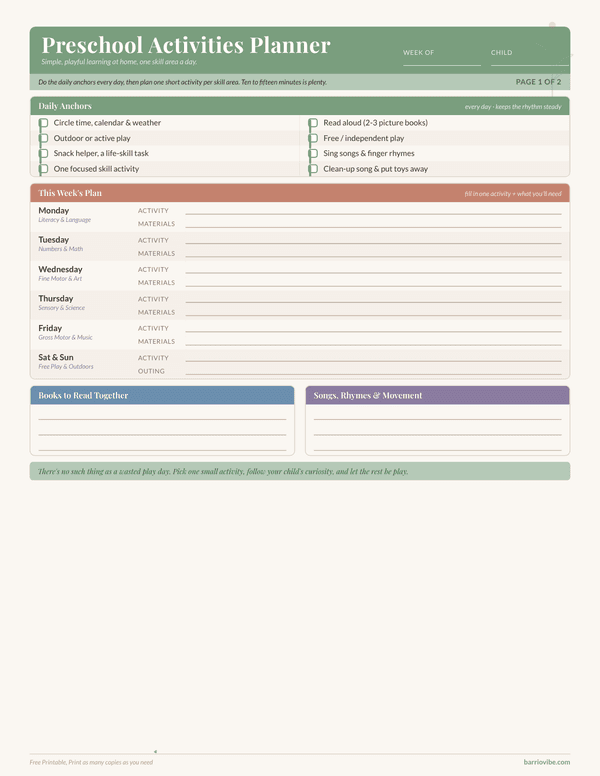
Preschool Activities Planner, Free Printable
A free printable preschool activities planner for learning at home, with a weekly plan organized by skill area plus a no-prep activity idea bank you can check off as you go.
How much structured activity time does a preschooler actually need?
A preschooler needs surprisingly little structured activity time, roughly two short blocks of 15 to 30 minutes a day is plenty, with the rest of the day left open for free play. At ages 3 to 5, attention spans are short by design, usually about two to five minutes per year of age, so a 20-minute guided activity is already a full effort for a four-year-old. Trying to fill hours with back-to-back structured lessons backfires: kids melt down, and you burn out. Unstructured free play is not filler between the "real" activities, it is where preschoolers do some of their most important learning, practicing imagination, problem-solving, and independence. So aim for one focused activity in the morning, one in the afternoon, and protect big stretches of open, child-led play in between. That balance keeps your child engaged and keeps your day sustainable, which matters just as much.
What supplies do you need for at-home preschool activities?
You need far less than the craft aisle suggests, most great preschool activities run on things you already own: paper, tape, crayons, kitchen scoops, dried pasta, cotton balls, and cardboard. The one upgrade genuinely worth making is storage. A few clear labeled bins let you build grab-and-go activity kits, a "playdough kit," a "sorting kit," a "cutting kit", so setup takes seconds instead of a hunt through three drawers. When everything for an activity lives in one bin, you're far more likely to actually pull it out on a hard morning. Keep a rotation of five or six kits and swap them every couple of weeks so the toys feel new again. If you're focused on building hand strength and pencil readiness, pair your bins with our list of fine motor activities for little hands, which turns everyday items like clothespins and stickers into simple skill-building play.
How do you keep preschool activities from feeling like school?
Keep at-home preschool activities feeling like play, not school, by following your child's lead and letting go of the finished product. Preschoolers learn through exploration, so it's fine if the sorting game becomes a dumping game or the "letter craft" turns into gluing everything into a pile, the process is the point, not a Pinterest-worthy result. Skip the worksheets and quizzing; instead, narrate what you see ("you stacked five blocks!") and ask open questions ("what do you think happens next?"). Follow their interest, too: if your child is obsessed with trucks, count trucks, sort trucks, paint trucks. Motivation soars when the activity connects to what they already love. And give yourself the same grace you'd give them, a day that only had one activity and a lot of free play was still a good day. Use the planner as a gentle guide, not a checklist you can fail.
Preschool Activities Planner, Free Printable
A free printable preschool activities planner for learning at home, with a weekly plan organized by skill area plus a no-prep activity idea bank you can check off as you go.
Keep the preschool activities printable somewhere you'll see it, fill in a couple of ideas each week, and let the rhythm take the pressure off. Meaningful, playful days with your preschooler are built one simple activity at a time.
Frequently Asked Questions
What are good preschool activities to do at home?
Good at-home preschool activities are hands-on and play-based: sensory bins, playdough, threading beads, sorting by color, block towers, obstacle courses, pretend play, and story time. Rotate a few each day across skill areas so learning stays balanced and you always have a low-prep option ready.
How many hours a day should a preschooler do activities?
A preschooler needs only about two short 15-to-30-minute structured activities a day, one morning, one afternoon. The rest of the day should be open, child-led free play, which is where much of their most important learning and problem-solving actually happens.
What skills should preschool activities build?
Preschool activities should cover five areas: fine motor (playdough, threading), gross motor (obstacle courses, dancing), language and literacy (story time, rhyming), math and thinking (sorting, counting, puzzles), and social-creative skills (pretend play, art). Touching a different area each day keeps development balanced.
How do I plan preschool activities for the week?
Give each day one focus, like a fine-motor day or a sensory day, and jot two or three ideas per day on Sunday with the supplies you'll need. A weekly planner removes the daily guesswork so you choose from a short list instead of inventing activities every morning.
Do preschool activities need to look like school?
No. Preschoolers learn best through play, not worksheets. Follow your child's lead, focus on the process rather than a finished product, narrate what they do, and connect activities to their interests. A day with one activity and lots of free play is still a great day.