
Some links in this guide are affiliate links, if you buy through them we may earn a small commission at no extra cost to you. Here’s our disclosure.
Quick Answer
A weekly family chore chart assigns household tasks to every family member across all seven days, sorted daily and weekly and matched to each person's age. Posted on the fridge, it becomes the authority so kids check it instead of waiting to be told, moving the mental load off one parent and onto a shared system.
There is a particular kind of tired that comes from being the only person in the house who sees the mess. You are the one who notices the overflowing hamper, the dishes crusting in the sink, the shoes abandoned three feet from the closet. So you either nag until everyone is annoyed, or you give up and do it all yourself, and then quietly resent it. Meanwhile the kids genuinely do not know what they are responsible for, your partner swears they would help "if you just asked," and every task somehow routes back to you. It is not that your family is lazy. It is that the work lives entirely in your head, invisible to everyone else, with no shared picture of who does what or when. That mental load is exhausting in a way the actual chores never are. What is missing is not more effort from you, it is a plan everyone can see.
What is a weekly family chore chart, and how does it work?
A chore chart weekly family plan divides household tasks among everyone in the home, mapped across all seven days of the week so the work is shared instead of shouldered by one person. It lives somewhere visible, usually the fridge, and answers the two questions that cause most household friction: who does what, and by when. Instead of you tracking every job mentally and dispatching reminders all day, the chart becomes the boss. A child checks the chart, sees "feed the dog" and "put away laundry" next to their name, and does it without being asked. The magic is not the tasks themselves; it is moving the responsibility off your shoulders and onto a system everyone can read. A good weekly family chore chart also right-sizes the work: little kids get one or two simple jobs, older kids take on more, and adults carry the heavier rotating tasks. Everyone contributes something, so no single person is stuck being the household's memory.
How do you set up a weekly family chore chart from scratch?
Start by listing every recurring task, then assign, do not volunteer yourself for all of it. Walk through a normal week and write down everything that keeps the house running: dishes, trash, laundry, pet care, tidying, floors, bathrooms, meal cleanup. Next, sort those jobs into daily (dishes, tidy, feed pets) and weekly (bathrooms, sheets, vacuuming) so the chart reflects real rhythm instead of dumping everything on one day. Then divide by ability, not by whoever complains least. A four-year-old can carry laundry to a basket; a ten-year-old can load a dishwasher; a teen can cook one dinner a week. Assign each person a fair, visible share and rotate the jobs nobody loves so resentment does not settle on one kid. Finally, pick a home for the chart where the family already gathers, the kitchen wins almost every time, and hold a five-minute family meeting to walk through it together, so the chart feels like a shared agreement rather than a list of orders handed down from you. Keep the first version deliberately small. It is tempting to assign twelve jobs per person on day one, but a chart with two or three tasks each that everyone actually completes builds far more momentum than an ambitious plan that overwhelms the family by Wednesday. You can always add more once the habit sticks.
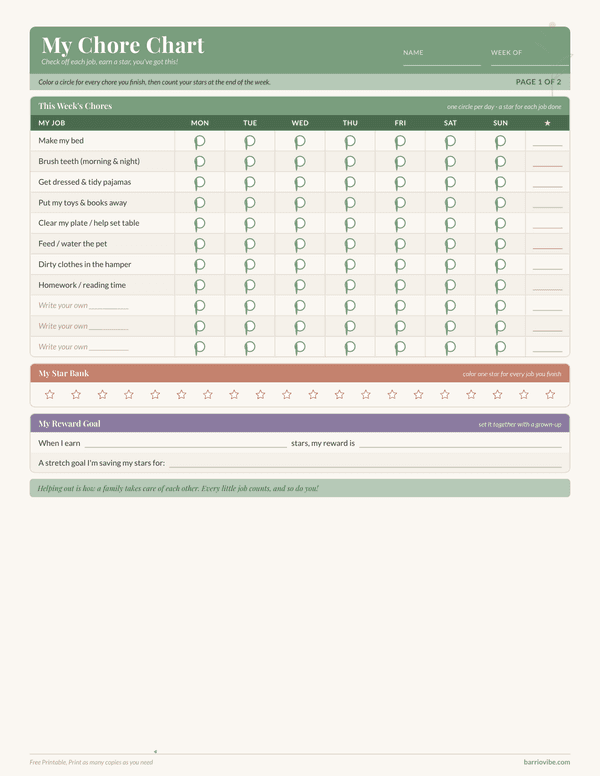
Kids Chore Chart, Free Printable
A free printable kids chore chart with a weekly grid, reward stars column, and age-appropriate chore suggestions for toddlers through tweens. Print it, pick a few jobs, and let kids track chores and earn stars toward a reward.
Which chores should each family member actually be responsible for?
Match chores to age and ability, then let kids grow into bigger jobs over time. The most common reason a chart fails is a mismatch, a job too hard frustrates a child, and one too easy gets ignored. Use this as a starting point and adjust for your own kids:
| Age group | Reasonable chores |
|---|---|
| Toddlers (2-3) | Put toys in a bin, throw diapers away, wipe up spills, carry laundry |
| Preschoolers (4-5) | Feed pets, make the bed, match socks, set napkins, dust low shelves |
| Early elementary (6-8) | Load/unload dishwasher, sweep, water plants, pack their own bag |
| Tweens (9-12) | Take out trash, vacuum, fold laundry, wipe bathroom sink, prep simple snacks |
| Teens (13+) | Cook a meal, do their own laundry, mow, clean a bathroom, watch siblings |
Adults hold the rotating heavy jobs, deep cleaning, bills, grocery runs, but should still appear on the chart, because kids buy in faster when they see everyone has a name and tasks. For a deeper breakdown of what to expect at each stage, our age-appropriate chores for kids guide maps skills to specific jobs so you assign with confidence.
How do you get kids to actually do their chores without nagging?
Make the chart the authority, so you stop being the one giving orders. When a child asks what to do, point to the chart instead of answering, over time they check it themselves, and the endless reminders fade. Attach chores to routines that already happen so they become automatic: beds and pets before school, a ten-minute family tidy before screen time, dishes right after dinner. Keep the bar at "done," not "perfect"; a wobbly bed made by a six-year-old still counts, and criticizing it teaches them to stop trying. Praise the specific action ("you cleared the whole table without being asked") rather than the child, which reinforces the habit. And build in a natural finish line, when the chart is checked off, the day's obligation is genuinely over. If mornings are your battleground, pairing the chore chart with a kids daily routine chart gives younger children a picture-based sequence to follow, which cuts the nagging even further because the routine, not you, sets the pace.
Should you tie chores to allowance, rewards, or nothing at all?
Separate baseline chores from paid work, and use rewards for motivation rather than payment. Most family experts suggest that some tasks are simply part of belonging to a household, making your bed, clearing your plate, tidying your room, and should not come with cash, because caring for shared space is an expectation, not a job. Then, if you want to teach money skills, offer a short list of extra, above-and-beyond tasks kids can choose for allowance: washing the car, cleaning baseboards, weeding. For younger children who do not yet care about money, a reward chart works better: a sticker or star for each completed day, building toward a small privilege like choosing movie night or a trip to the park. The key is consistency, whatever you promise, deliver, or the system loses all credibility fast. Many families find a simple star-tracking column on the chart itself, rather than a separate app or jar, is enough to keep young kids motivated without turning every chore into a negotiation. Whichever route you choose, decide it before you launch the chart and explain it once, clearly, so kids know exactly what earns a reward and what is simply expected. Changing the rules midweek, suddenly paying for a job that used to be free, teaches kids to hold out and bargain, which is the opposite of what you want.
How do you keep the chore chart working long-term?
Expect to reset it, and treat drift as normal rather than failure. Almost every chore chart weekly family plan works beautifully for two weeks and then fades, kids test whether you will actually enforce it, and life throws off the routine. Plan a standing weekly reset, ideally Sunday: review what got done, rotate the jobs nobody wants, and print or wipe clean a fresh chart for the week ahead. To make reuse effortless, slip a single printed copy into a dry-erase pocket sleeve and let kids check off tasks with a washable marker, so one printout lasts for months and the fresh-start feeling arrives every week. Revisit assignments each season, because a child who could barely carry laundry in spring can load the dishwasher by fall. When enthusiasm dips, shrink the chart rather than abandoning it, even two reliable chores per kid beat an ambitious plan that collapses. The families who succeed are not stricter; they simply expect the wobble and rebuild without guilt.
Kids Chore Chart, Free Printable
A free printable kids chore chart with a weekly grid, reward stars column, and age-appropriate chore suggestions for toddlers through tweens. Print it, pick a few jobs, and let kids track chores and earn stars toward a reward.
Print it, put it where everyone gathers, and let the chart do the reminding so you do not have to. A calmer, more even household is built one checked-off box at a time.
Frequently Asked Questions
What age should kids start doing chores?
Kids can start simple chores as young as two, like putting toys in a bin or carrying laundry. The tasks should match their ability and grow over time, preschoolers feed pets and make beds, while elementary kids load dishwashers and sweep. Early, age-appropriate chores build lasting habits.
How do I make a weekly chore chart for my family?
List every recurring task, sort them into daily and weekly jobs, then assign by age and ability so the work is shared fairly. Post the chart where the family gathers, usually the fridge, and walk through it together in a short family meeting so everyone agrees to their part.
How many chores should a child have per day?
Start with just two or three age-appropriate chores per day. A small, achievable list that gets completed builds far more momentum than an ambitious plan that overwhelms kids. Once the habit sticks and the routine feels automatic, you can gradually add more responsibility over the following weeks.
Should kids get paid for chores?
Most experts suggest separating baseline chores from paid work. Everyday tasks like making beds and clearing plates are part of belonging to a household and should not be paid. Offer allowance only for extra, above-and-beyond jobs, or use a sticker reward chart to motivate younger children.
How do I get my kids to do chores without nagging?
Make the chart the authority instead of you. When kids ask what to do, point to the chart until they check it themselves. Attach chores to existing routines, praise the specific action rather than the child, and keep the bar at done, not perfect, so they keep trying.