
Some links in this guide are affiliate links, if you buy through them we may earn a small commission at no extra cost to you. Here’s our disclosure.
Quick Answer
A daily routine schedule for kids is a simple visual chart that lists the day's steps, wake up, get dressed, breakfast, brush teeth, in order, so a child can see what comes next without being told. Post it at their eye level, pair each step with a picture, and let the chart replace your reminders.
The morning starts fine, and then somehow it doesn't. You've asked twice about shoes, the backpack has vanished again, and someone is still in pajamas eating cereal one slow bite at a time while the clock keeps moving. By the time everyone is finally in the car you feel like you've already worked a full shift, and it isn't even eight in the morning. Evenings run the same script in reverse, the long negotiation over teeth, pajamas, and one more show. If your days have become a string of reminders you repeat until you're hoarse, you are not disorganized and your kids are not difficult. Young children simply don't hold a sequence of steps in their heads the way adults do, so every transition turns into a fresh standoff you have to referee. There is a calmer way to run the day, and it does not depend on you remembering every single thing. It asks a piece of paper to do the reminding, and it frees you to be the parent instead of the household timekeeper.
What is a daily routine schedule for kids, and why does it work?
A daily routine schedule for kids is a simple, visual list of the day's steps, wake up, get dressed, breakfast, brush teeth, arranged in the order they happen, so a child can see what comes next without being told. It works because it moves the job of remembering off of you and onto the chart. Young children thrive on predictability; when the sequence is the same every single day, transitions stop feeling like surprises they have to resist. Instead of you issuing a steady stream of reminders, the child glances at the chart and moves themselves along. That shift matters more than it sounds. Nagging quietly puts you and your child on opposite sides; a routine chart puts you on the same side, both looking at the same plan. It also builds real independence, kids as young as three can follow pictures, which is the long game every tired parent is actually after.
What should be on a kids' daily routine chart?
A kids' daily routine chart should cover the three transition points where mornings and evenings tend to fall apart: the morning get-ready block, the after-school landing, and the bedtime wind-down. Keep each block to five or six steps, more than that and a young child tunes out. List only what genuinely needs to happen in order, and use the exact same wording every day so it becomes automatic.
| Time of day | Routine steps |
|---|---|
| Morning | Wake up · Bathroom · Get dressed · Breakfast · Brush teeth · Shoes & backpack |
| After school | Shoes & bag away · Wash hands · Snack · Homework or quiet play · Free time |
| Evening | Dinner · Bath · Pajamas · Brush teeth · Story · Lights out |
Notice what is not here: nothing is optional, and nothing is a chore in disguise. A routine chart is about the flow of the day, not about earning rewards. Keep it short, keep it visual, and let the chart carry the sequence so you no longer have to hold it all in your head.
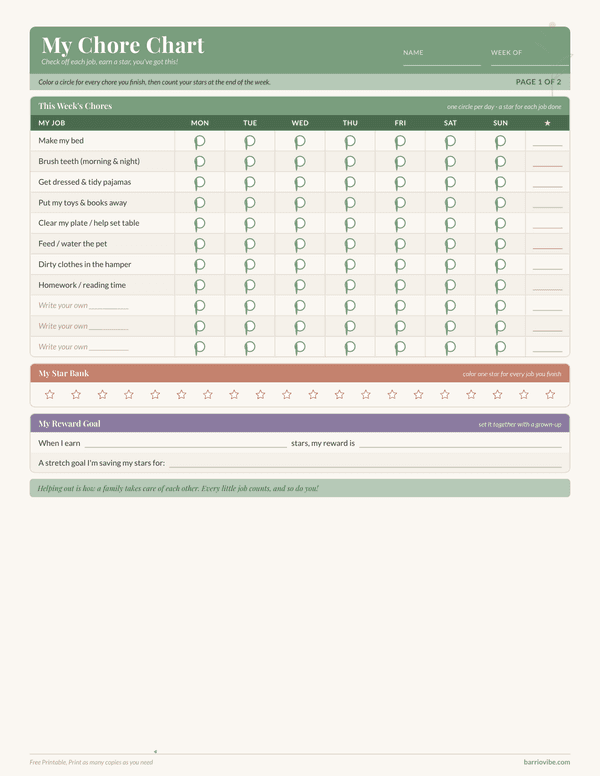
Kids Chore Chart, Free Printable
A free printable kids chore chart with a weekly grid, reward stars column, and age-appropriate chore suggestions for toddlers through tweens. Print it, pick a few jobs, and let kids track chores and earn stars toward a reward.
How do you make a visual routine chart a young child can actually follow?
Make it visual first and text second. A child who cannot yet read still recognizes a picture of a toothbrush or a cereal bowl, so pair every step with a simple icon or photo, even a quick phone snapshot of your own child doing the task works beautifully. Post the chart at the child's eye level, not yours, in the room where the routine actually happens: the get-ready list by the bedroom or bathroom, the bedtime list by the bed. Use one chart per time-of-day rather than a single giant all-day list, which just overwhelms. Add a way to mark progress, a movable arrow, a clip that slides down the list, or a dry-erase check, because the physical act of marking a step done is deeply satisfying to a young child and pulls them toward the next one. The goal is a chart they operate, not one you read aloud to them.
One practical tip: slip the printed chart into a sheet protector or laminate it, then let your child check off steps with a dry-erase marker and wipe it clean each night. A reusable chart survives the daily wear that plain paper doesn't, and the fresh, empty checklist each morning gives kids the same satisfying blank-slate feeling that keeps grown-up planners popular. Tape a small marker nearby so the tool is always right where the routine happens.
How do I get my child to stick to the routine without nagging?
Let the chart do the talking. Instead of naming the next task, ask "what does your chart say is next?", it redirects the child back to the plan and keeps you out of the enforcer role. Consistency beats intensity: run the same sequence at the same times for a full two weeks before you judge whether it is working, because routines only stick with repetition. A few small habits smooth the rough edges:
- Anchor each block to something that already happens, the morning list starts when feet hit the floor, the bedtime list starts after dinner.
- Add a simple visual timer, the kind with a colored disk that shrinks as the minutes run down turns abstract time into something a child can see, which quietly defuses the "five more minutes" standoff at every transition.
- Praise the effort, not just the finish, "you checked three things off all by yourself" reinforces the habit far better than a reward at the end.
And when a day falls apart, you don't restart the child, you just point back to the chart tomorrow.
Routine chart vs. chore chart, what's the difference?
A routine chart maps the sequence of the day; a chore chart tracks the responsibilities a child completes, often for a reward. They solve different problems and work best side by side. The routine chart answers "what happens next", it smooths transitions like getting dressed and heading to bed. A chore chart answers "what am I responsible for", feeding the dog, clearing the table, and usually ties to stars or an allowance. Younger kids need the routine chart most; the chore piece grows in as they do. If nagging over jobs is your bigger daily battle, our free printable kids chore chart sets up responsibilities without the constant reminders. And because a three-year-old and a nine-year-old can't handle the same tasks, this guide to age-appropriate chores for kids helps you match jobs to what your child can genuinely do. Run the routine chart daily and layer the chores on top as they're ready.
How do you keep the routine working as your child grows?
Revisit the chart every few months, because a routine that fits a three-year-old will bore a seven-year-old. As your child masters a sequence, you can fold several picture steps into one word, "get ready" can replace the six-icon morning strip once it runs on autopilot. Hand over ownership gradually: let an older child help choose the order, redraw the icons, or move to a written checklist they tick off themselves. Add new steps as life changes, homework, a musical instrument, packing their own lunch, and quietly retire the ones that have become second nature. Keep the bedtime wind-down the most stable of all, since a consistent evening routine protects everyone's sleep. The point was never a perfect chart; it is a household that runs on a shared, visible plan instead of your voice repeating itself. Print a fresh copy when the season or the schedule shifts, and let the routine keep pace with your kid.
It also helps to review the chart together on a calm afternoon rather than mid-meltdown. Ask which steps feel easy now and which still cause friction, then adjust one thing at a time. Kids follow a plan they helped build far more willingly than one handed down, and that small sense of ownership is what carries a routine into the tween years.
Kids Chore Chart, Free Printable
A free printable kids chore chart with a weekly grid, reward stars column, and age-appropriate chore suggestions for toddlers through tweens. Print it, pick a few jobs, and let kids track chores and earn stars toward a reward.
Post the chart where your child will see it, keep the sequence the same, and let it carry the reminders you have been carrying alone. Calmer mornings aren't about a stricter parent, they're about a plan the whole family can see.
Frequently Asked Questions
At what age can kids start using a daily routine chart?
Most children can start following a picture-based routine chart around age two to three, once they recognize simple images. Toddlers follow one or two steps with help; preschoolers can handle a five-step block; and by age six most kids can run a written checklist almost entirely on their own.
How do I get my toddler to follow a routine chart?
Use pictures instead of words, keep it to three or four steps, and post it at their eye level. Walk through it together at first, pointing to each step, and let them move a clip or arrow as they finish. The physical marking makes it a game rather than a demand.
What's the difference between a routine chart and a chore chart?
A routine chart maps the sequence of the day, wake up, dress, breakfast, bedtime, to smooth transitions. A chore chart tracks responsibilities like feeding the dog or clearing the table, usually tied to a reward. Younger kids need the routine chart most; chores layer on as they grow.
Should a kids' routine chart use pictures or words?
Use pictures for any child who cannot yet read fluently, since an icon of a toothbrush or backpack communicates instantly. Add words alongside the images so early readers connect the two. As your child grows, you can drop the pictures and move to a simple written checklist they tick themselves.
How long does it take for a kids' routine to stick?
Give it a full two weeks of running the same sequence at the same times before you judge it. Routines depend on repetition, not willpower, so consistency matters more than intensity. Expect resistance early on; once the pattern feels predictable, most kids start moving through it with far less prompting.