
Some links in this guide are affiliate links, if you buy through them we may earn a small commission at no extra cost to you. Here’s our disclosure.
Quick Answer
A chore chart is a visual grid that lists each child's tasks and lets them check off what's done, moving responsibility out of your head and onto the wall. Assign two or three age-appropriate chores per child, set a done-by time, and let the chart do the reminding instead of you.
You've asked three times. The trash is still sitting by the back door, the shoes are still in a pile in the hallway, and now you're standing in the doorway using The Voice, the one you swore you'd never use. Somewhere between the first polite reminder and the tenth, getting your kids to help around the house turned into a second job you never applied for: the one where you have to remember every task, assign it to someone, and then follow up again and again until it feels easier to just do it yourself. If you feel less like a parent and more like an unpaid household manager that nobody listens to, you are not lazy and your kids are not uniquely difficult. The real problem is that the entire system lives inside your head. When the work is invisible, every single chore requires a conversation, and every conversation is one more chance for a standoff. The nagging isn't a character flaw, it's the only tool you have left when nothing is written down.
What exactly is a chore chart, and why does it stop the nagging?
A chore chart is a simple visual grid that lists each child's assigned tasks and lets them check off what's finished, and it ends the nagging by moving responsibility out of your head and onto the wall where everyone can see it. Once the chore chart exists, the chart does the reminding instead of you. Your kids can see precisely what's expected without asking, and "Did you feed the dog?" quietly becomes "Go check your chart." That small change rewires the whole dynamic. The task is now a matter between the child and the chart, not between the child and you, so there's far less to push back against, the expectation isn't your mood on a given day, it's a fixed line on a page. A good chore chart makes three things visible at the same time: who is responsible, when the job is due, and whether it actually got done. That visibility is the entire point. When expectations are written down and stay consistent day after day, kids stop treating each request as a fresh negotiation, and you stop being the family's walking to-do list.
What chores are age-appropriate for kids?
Match each chore to what a child can genuinely do without you hovering, and the whole system runs smoother. Toddlers manage single-step tasks, grade-schoolers can follow multi-step routines, and tweens and teens can take ownership of entire areas of the house. A job that's too hard breeds frustration and abandoned tasks; one that's too easy breeds boredom and eye-rolls. The sweet spot is a chore a child can finish start to finish on their own and feel a little proud of. Use this as a starting point, then adjust for your own kids:
| Age | Chores they can own |
|---|---|
| 2-3 | Put toys in a bin, carry laundry, wipe low surfaces |
| 4-5 | Make the bed, feed a pet, set the table, sort socks |
| 6-8 | Pack their backpack, take out trash, water plants |
| 9-11 | Load the dishwasher, fold laundry, sweep, tidy their room |
| 12+ | Cook a simple meal, mow, do their own laundry, babysit |
Start below what you think they can handle, early wins build the momentum that keeps a chart alive.
How do you set up a chore chart that actually gets used?
Start small and make the chart effortless to maintain, most charts fail because they're too ambitious on day one or too much work to keep current. Pick just two or three chores per child to begin, and add more only once the habit is sticking; an overloaded chart reads as a punishment and gets ignored. Assign each task to a specific name so there's no daily debate about whose turn it is, and attach a clear "done by" cue like before dinner or before any screens come on. Keep the chart somewhere everyone walks past without trying, the fridge, the kitchen, or a mudroom wall beats a bedroom nobody visits. To make checking off painless, slide the printable into a set of reusable dry-erase pocket sleeves so kids can mark tasks with a wipe-off marker and you can reset the entire chart in seconds each week instead of reprinting. The easier the chart is to use, the longer it survives; a chart that costs you ten minutes of setup every night simply won't make it to month two.
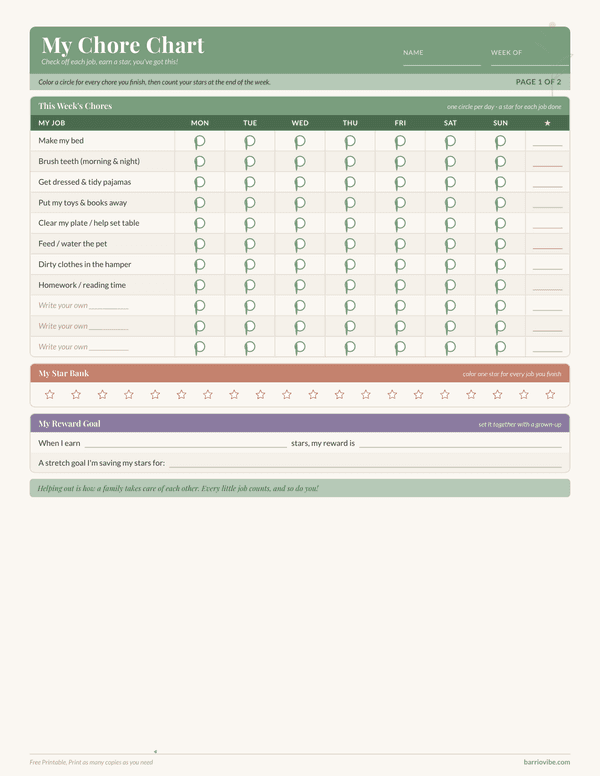
Kids Chore Chart, Free Printable
A free printable kids chore chart with a weekly grid, reward stars column, and age-appropriate chore suggestions for toddlers through tweens. Print it, pick a few jobs, and let kids track chores and earn stars toward a reward.
Should you pay kids for chores, or use a reward system?
Keep everyday household chores unpaid, and save money or rewards for extra jobs that go beyond the basics. The logic is straightforward: making a bed, clearing a plate, and picking up toys are part of belonging to a family, not a service you purchase. When every task comes with a payout, kids quickly learn to ask "what do I get?" before they'll lift a finger, the exact opposite of the helpful instinct you're trying to build. Instead, tie any reward system to consistency rather than to individual chores. For younger kids, a star or sticker for each completed day, with a small treat or privilege after a full week, makes the streak itself the motivator. Older kids can earn allowance for optional "above and beyond" work, washing the car, pulling weeds, deep-cleaning a closet, kept on a separate list from their expected chores. That split quietly teaches both lessons at once: some work you do because you live here, and some work you do to earn. The reward column on the chart tracks whichever approach you land on.
How do you get kids to stick with chores without daily reminders?
Consistency comes from routine, not willpower, anchor chores to something that already happens every day, and the chart stops needing your voice to run. Attach the after-school jobs to snack time, or the evening tidy to the moment right before screens, so the chore becomes the small toll for the thing they already want to do. Run the chart at the same time every day until it's automatic, because predictability is what turns a nagged task into an unprompted habit. Resist the urge to rescue: when a job doesn't get done, let the natural consequence land instead of swooping in or launching into another reminder. Praise the check-off itself, not only the finished result, kids repeat the behavior that gets noticed. And keep your own role deliberately small, because a system that depends on you enforcing it all day long isn't really a system; it's just nagging with a chart attached. If mornings are your household's flashpoint, pairing chores with a kids daily routine chart for calmer mornings lifts even more reminders off your plate.
How often should you update the chore chart as kids grow?
Revisit the chart every few months and raise the bar as your kids get older, the chart should grow with the child, not stay frozen at what they could handle a year ago. Kids quietly get bored of the same tasks and just as quietly become capable of harder ones, so a chart that never changes slowly stops working. Every season or so, retire a chore they've mastered, hand over one that used to be yours, and let older kids help choose their own tasks, because ownership climbs the moment they have a say. Watch for the tell that a job has gone fully automatic and no longer needs the chart's prompt, that's your cue to level it up. If you're not sure what's reasonable at each stage, our guide to age-appropriate chores for kids breaks it down year by year. Reprint a fresh chart whenever roles shift, and let the new version reset everyone's expectations at the same time.
Kids Chore Chart, Free Printable
A free printable kids chore chart with a weekly grid, reward stars column, and age-appropriate chore suggestions for toddlers through tweens. Print it, pick a few jobs, and let kids track chores and earn stars toward a reward.
Put the chart somewhere everyone passes, let it do the reminding, and give the new routine a couple of weeks to settle in before you judge it. The nagging fades, not because your kids suddenly love chores, but because the responsibility finally lives somewhere other than your head.
Frequently Asked Questions
At what age should kids start doing chores?
Kids can start as young as 2 or 3 with simple one-step tasks like putting toys in a bin or carrying laundry. The goal at that age isn't a clean house, it's building the habit of helping, so responsibility feels normal long before it feels optional.
How many chores should a child have on a chore chart?
Start with just two or three chores per child and add more only once the habit sticks. An overloaded chart reads like a punishment and gets ignored, while a short, doable list builds early wins and the momentum that keeps the whole system alive.
Should I pay my kids for doing chores?
Keep everyday chores like making beds and clearing plates unpaid, since they're part of belonging to a family. Reserve money or allowance for optional 'above and beyond' jobs on a separate list, so kids don't learn to ask 'what do I get?' before they'll help.
How do I get my kids to actually do their chores?
Anchor chores to something that already happens daily, like snack time or right before screens, and run the chart at the same time each day until it's automatic. Praise the check-off, let natural consequences land, and resist rescuing so the chart does the reminding, not you.
Do I need to print a new chore chart every week?
No. Slip one copy into a dry-erase pocket sleeve and check tasks off with a wipe-off marker, then reset it each week in seconds. Reprint a fresh chart only when roles change or your kids are ready to level up to new responsibilities.