
Some links in this guide are affiliate links, if you buy through them we may earn a small commission at no extra cost to you. Here’s our disclosure.
Quick Answer
A chore chart by age matches tasks to a child's stage: toddlers (2-3) do one-step jobs like putting toys away, preschoolers (4-5) set the table and feed pets, kids (6-9) make beds and clear dishes, and tweens and teens (10+) handle laundry, cooking, and trash. Match the chore to the age and cooperation follows.
You hand your eight-year-old a job that turns out to be too hard, and it ends in tears. You ask your four-year-old to "clean your room" and come back to find nothing moved. Meanwhile your twelve-year-old insists the dishwasher isn't "their thing." If assigning chores in your house feels like a daily negotiation that leaves everyone frustrated, you are not imagining it, and it is rarely about lazy kids. The real problem is usually a mismatch: the task is either too advanced for the child's stage or so vague they don't know where to begin. When the job doesn't fit the kid, resistance follows, and you end up doing it yourself just to end the standoff. What most families are missing isn't stricter discipline or a fancier reward system. It's a simple way to match the right job to the right age, every time, without guessing or arguing.
What chores are age-appropriate at each stage?
Age-appropriate chores match a task's difficulty to a child's coordination, attention span, and sense of responsibility, which is exactly what a chore chart by age is built to organize. As a general rule, toddlers (2-3) can do one-step tasks like putting toys in a bin; preschoolers (4-5) can handle simple two-step jobs like setting napkins and feeding a pet; early elementary kids (6-9) can manage multi-step routines like making a bed or clearing the table; and tweens and teens (10 and up) can take on real household work like laundry, simple cooking, and taking out the trash. The point of sorting chores this way isn't to hold anyone back, it's to set kids up to succeed. A job that fits a child's stage builds confidence and independence; a job that doesn't builds frustration and resistance. When you match the chore to the age, cooperation stops being a battle and starts being a habit, because success feels good and kids want to repeat it. A chore chart by age takes the guesswork out of that match, instead of wondering whether a job is too much or too little, you assign straight from a list already sorted by developmental stage.
What chores can toddlers and preschoolers (ages 2-5) do?
Toddlers and preschoolers can do more than most parents expect, as long as the task is a single, concrete action they can picture. At this stage the goal isn't a spotless result; it's building the habit of pitching in. Two- and three-year-olds thrive on one-step jobs: putting toys in a bin, tossing a diaper in the trash, handing you laundry from the basket, or wiping a spill with a cloth. Four- and five-year-olds can stretch to simple two-step tasks: setting the table with napkins and spoons, feeding a pet a measured scoop, matching clean socks, watering a plant, or putting away their own shoes. Keep instructions short and physical, "toys in the box" beats "clean up" every time, and work alongside them at first so the routine feels like togetherness, not punishment. Praise the effort, not the outcome, and expect to re-teach the same job many times. These early wins are what make chores feel normal, not negotiable, by the time school starts. A toddler who learns that toys go in the bin every night is already building the muscle a school-age chore routine depends on later.
Which chores fit kids ages 6 to 12?
By elementary age, kids can follow multi-step routines and remember them with a visual reminder, which is where a printed chart earns its keep. School-age children (6-9) can make their bed, clear and wipe the table, sort laundry by color, pack part of their lunch, and tidy their room with a checklist. Tweens (10-12) are ready for genuine responsibility: running the dishwasher, folding and putting away laundry, vacuuming, taking out the trash and recycling, and helping cook a simple meal. Here's a quick menu to assign from at a glance:
| Age group | Chores that fit |
|---|---|
| Toddlers (2-3) | Put toys in a bin, wipe spills, throw trash away, stack books |
| Preschoolers (4-5) | Set napkins, feed a pet, match socks, water plants, put away shoes |
| Kids (6-9) | Make the bed, clear the table, sort laundry, pack lunch, tidy room |
| Tweens & teens (10+) | Run the dishwasher, fold laundry, vacuum, take out trash, help cook |
Treat it as a starting point, not a rule, slide a chore up or down a row to fit the child in front of you. The strength of a chore chart by age is that it flexes: a mature seven-year-old can borrow a tween job, and a child who needs more support can stay a row lower without anyone feeling singled out. Growth, not a fixed grade, is the goal.
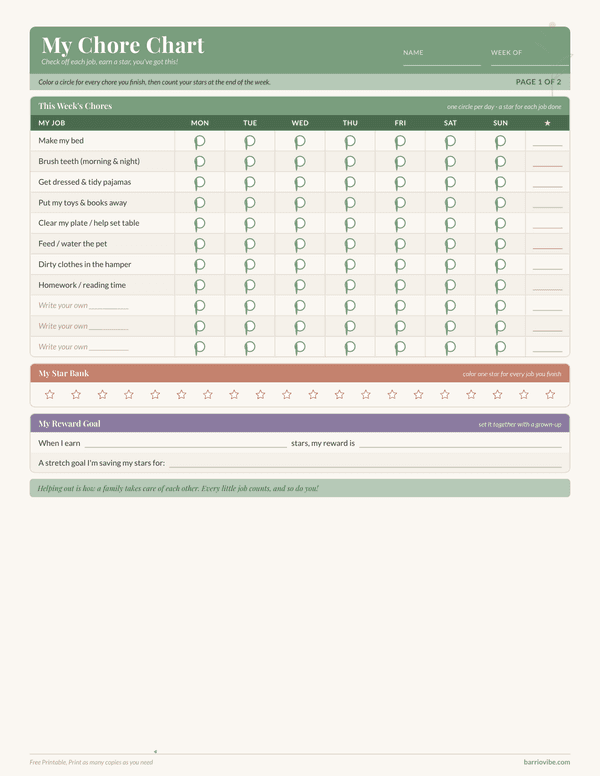
Kids Chore Chart, Free Printable
A free printable kids chore chart with a weekly grid, reward stars column, and age-appropriate chore suggestions for toddlers through tweens. Print it, pick a few jobs, and let kids track chores and earn stars toward a reward.
How do you use a chore chart without the daily nagging?
A chore chart ends the nagging when it becomes the thing that gives the instructions, so you don't have to. The shift is subtle but powerful: instead of you reminding, redirecting, and repeating, you point to the chart and let it hold the expectations. Post it somewhere everyone passes, the fridge or a kitchen wall, and review it together at the same time each day, like right after breakfast or before screen time. Let kids physically check off or move a marker when a job is done; that small act of completion is genuinely motivating and gives them ownership. Keep the list short (two to four chores per child) so it never feels crushing, and pair each chore with a natural stopping point so kids know when they're finished. If you want the version built specifically to stop the back-and-forth, our kids chore chart printable is designed around this exact routine. When the chart carries the reminders, you get to be the encourager instead of the enforcer.
Should kids be paid for doing chores?
The most common approach is to split chores into two buckets: unpaid "family contributions" everyone does simply because they live in the home, and optional "paid extras" a child can choose to earn money on. Basic jobs, making their bed, clearing their plate, tidying their room, belong to the first bucket, because tying every task to cash teaches kids to ask "what do I get?" before helping. Bigger or beyond-the-basics jobs, washing the car, cleaning out the garage, raking leaves, work well as paid opportunities that introduce the connection between effort and reward. Many families combine this with a small weekly allowance used to teach saving, spending, and giving, a low-stakes first lesson in managing money that pays off long before a kid ever holds a real paycheck. What matters most is consistency: decide which chores are expected and which are earnable, write it on the chart, and stick to it. For a shared-responsibility approach that works across ages, our weekly family chore chart printable lays out who does what so no single child, or parent, carries the whole load.
How do you keep the chore chart working long-term?
The charts that last get refreshed before kids get bored, usually every few weeks. Rotate chores so no one feels stuck with the "worst" job forever; rotation keeps things fair and quietly teaches new skills. Reset expectations as kids grow, moving them up a row on the chore chart by age every birthday or new school year so the work keeps pace with their ability. This is the quiet payoff of the whole system, a five-year-old who feeds the pet today is on a clear path to a twelve-year-old who cooks dinner, one age-appropriate step at a time. Make the tools easy to reach, too: a few clear labeled bins for toys, cleaning cloths, and laundry sorting remove the friction that makes kids give up before they start, when everything has an obvious home, "put it away" actually means something. Celebrate consistency over perfection; a bed that's made imperfectly every day beats a perfect one made once a month. And expect setbacks around busy seasons, just resume the chart instead of scrapping it. If mornings are your trouble spot, a kids daily routine chart pairs perfectly with your chore chart to keep the whole day running calmly. Keep it visible, keep it current, and let the chart do the deciding.
Kids Chore Chart, Free Printable
A free printable kids chore chart with a weekly grid, reward stars column, and age-appropriate chore suggestions for toddlers through tweens. Print it, pick a few jobs, and let kids track chores and earn stars toward a reward.
Frequently Asked Questions
What are age-appropriate chores for a 4-year-old?
A 4-year-old can handle simple two-step chores: setting the table with napkins and spoons, feeding a pet a measured scoop, matching clean socks, watering a plant, and putting away their own shoes. Keep instructions short and concrete, and praise the effort rather than the result.
At what age should kids start doing chores?
Kids can start around age 2 with one-step tasks like putting toys in a bin or throwing trash away. The early goal isn't a clean result but building the habit of pitching in, so chores feel normal and expected by the time school starts.
How many chores should a child have per day?
Keep it to two to four chores per child per day. A short list feels doable instead of crushing, which keeps kids from shutting down. As children grow more capable, add responsibility gradually rather than piling on many tasks at once.
Should kids be paid for chores?
Most families split chores into unpaid family contributions everyone does because they live in the home, plus optional paid extras like washing the car. Tying every basic task to money can teach kids to ask what they get before helping, so keep core chores expectation-based.
How do I get my kids to do chores without nagging?
Let a posted chore chart give the instructions instead of you. Review it at the same time each day, keep the list short, and let kids check off completed jobs. When the chart holds the expectations, you get to encourage rather than enforce.