Some links in this guide are affiliate links, if you buy through them we may earn a small commission at no extra cost to you. Here’s our disclosure.
Quick Answer
To meal plan for the week, set aside twenty minutes once a week to decide every dinner in advance. Check your calendar for busy nights, choose a few go-to meals plus one new recipe using theme nights, shop your kitchen first, then build one grocery list and post the plan where everyone sees it.
It's 5:47 on a Wednesday and the question lands like it does every night: "What's for dinner?" The fridge is half-full of things that don't quite go together, one kid won't eat what the other will, and the ground beef you meant to use is one day past hopeful. So you order takeout again, or throw together the same tired pasta, and quietly resent that feeding your family somehow requires a fresh act of willpower every single evening. If this is your week, the problem isn't that you're disorganized or that you don't cook well enough. It's that you're making seven separate high-stakes decisions on an empty tank, right when your patience is thinnest and everyone is hungriest. Every night starts from zero. The mental load of deciding, shopping, and cooking all at once, after work, after school, after everything, is what makes dinner feel so much heavier than it should, night after night after night.
How do you meal plan for the week?
To meal plan for the week, block twenty minutes once a week to decide every dinner in advance, then shop from that plan in a single trip. Start by checking your calendar for busy nights that need something fast, like a slow-cooker meal or leftovers. Next, pull two or three dinners you already know by heart, add one new recipe, and assign each to a day. Then "shop your kitchen" first, note what you already have, before writing a grocery list grouped by store section. Finally, post the plan somewhere everyone can see it. The order matters: you're batching all the thinking into one calm session instead of spreading it across seven stressful evenings. That single shift is the whole point. When the decisions are already made, dinner becomes assembly instead of problem-solving, and the 5 p.m. panic quietly disappears from your week. You cook the same food you always would, you just stop renegotiating it every night. Here's the twenty-minute session, step by step:
- Scan the week, mark the busy nights that need something fast or hands-off.
- List your regulars, write down two or three dinners you can make without a recipe.
- Add one new meal, pick a single new recipe so the rotation doesn't go stale.
- Shop your kitchen, note what's already in the pantry, fridge, and freezer.
- Fill in the planner, assign a meal to each night and build your grocery list from it.
What's the fastest way to plan a week of meals?
The fastest way to plan a week of meals is to use theme nights, so you're choosing a recipe within a category instead of from every food on earth. Deciding "Monday is pasta" narrows infinite options down to three or four, and your brain fills the blank in seconds. Assign a loose theme to each night, keep the list on your planner, and rotate favorites within each slot so the week never feels repetitive:
| Night | Theme | Quick example |
|---|---|---|
| Monday | Pasta night | Spaghetti, baked ziti, pesto |
| Tuesday | Taco / Tex-Mex | Tacos, burrito bowls, quesadillas |
| Wednesday | Sheet-pan | Chicken and veggies, sausage bake |
| Thursday | Breakfast for dinner | Eggs, pancakes, frittata |
| Friday | Pizza or takeout | Homemade or a planned treat |
| Saturday | Try something new | The one new recipe of the week |
| Sunday | Roast + leftovers | Batch cook for the week ahead |
Themes remove decision fatigue without locking you into the exact same meals. You still get plenty of variety, you simply skip the daily debate about where to even begin. They also make picky eaters easier: if the whole family agrees that Tuesday is tacos, you're only negotiating the toppings, not the entire meal. Once your themes are set, planning a full week can take less than ten minutes, because every night already has a starting point.
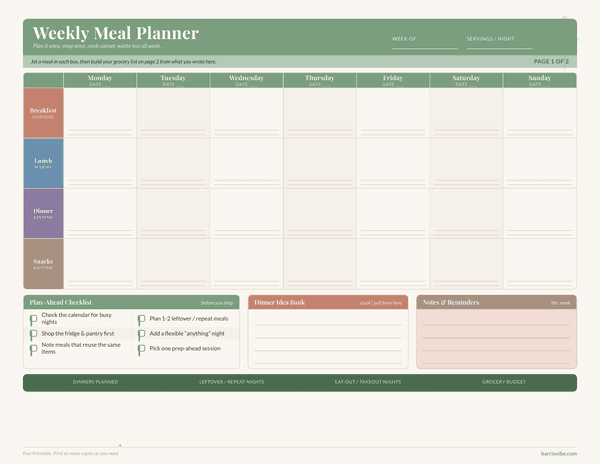
Weekly Meal Planner, Free Printable
A free printable weekly meal planner with a Monday, Sunday grid for breakfast, lunch, dinner, and snacks, plus a by-aisle grocery list and prep plan so you can plan your meals for the week and shop just once.
How do you build a grocery list from your meal plan?
Build your grocery list straight from the plan, one meal at a time, so you buy exactly what the week needs and nothing it doesn't. Go dinner by dinner and jot down every ingredient, then walk the same list through breakfasts, lunches, and snacks so nothing gets forgotten mid-week. Before you finalize it, shop your own kitchen: check the pantry, fridge, and freezer, and cross off anything you already own so you're not buying a third jar of cumin. Finally, reorganize the list by store section, produce, dairy, meat, pantry, frozen, so you move through the aisles once without backtracking. This last step alone can shave fifteen minutes off a trip and kill the impulse buys that happen when you wander. A plan-driven list is also your best defense against waste: you buy the half-bunch of cilantro a recipe actually needs, not a hopeful cartful that rots by Friday. For a ready-made version, our grocery list template that saves money comes already sorted by aisle so you can skip the reorganizing entirely.
What should you keep stocked to make weekly meal planning easier?
Keep a short list of "building block" staples on hand so you can always assemble a meal even when a plan falls apart. With these basics stocked, any missed dinner becomes a quick pivot instead of another takeout order:
- Pantry anchors: pasta, rice, canned beans and tomatoes, broth, and a few jarred sauces
- Freezer basics: ground meat, chicken, and a couple of bags of frozen vegetables
- Fridge workhorses: eggs, cheese, butter, and two or three sturdy vegetables
It also helps to actually see what you have. A set of clear stackable storage bins turns a jumbled pantry into a quick visual inventory, so you plan around what's already there instead of buying duplicates you forgot you owned. Restock these staples on the same weekly trip and they quietly become the safety net under your whole plan. When a night goes sideways, a well-stocked shelf means dinner is still fifteen minutes away instead of a delivery fee. The goal isn't a stuffed pantry, it's a reliable shortlist you can build ten easy dinners from on any given week.
How do you meal plan for the week on a budget?
Meal planning on a budget starts with planning around what's already cheap and what you already have, rather than around recipes you saw online. Build the week's dinners from a few inexpensive proteins, eggs, chicken thighs, dried beans, ground turkey, and let one ingredient do double duty across two nights, like a roast chicken that becomes tacos or soup the next day. Check store flyers before you plan and let the sales pick two of your meals for you. Plan one deliberate "clean-out" night each week to use up produce and leftovers before they turn, which quietly erases the money most households throw straight in the trash. Cooking once and eating twice is the single biggest lever: double a batch and freeze half, and you've bought yourself a free future dinner with almost no extra effort. If you want a full system for stretching every dollar, our guide to meal planning on a budget walks through it step by step. A plan really is the cheapest tool in your kitchen.
How do you stick with meal planning when the week gets busy?
Stick with meal planning by making the plan visible and forgiving instead of perfect. Post your filled-in planner where the whole family passes it, the fridge is ideal, so "what's for dinner" gets answered by the paper, not by you at your most tired. Pick the same twenty-minute planning slot every week and anchor it to something you already do, like Sunday coffee or the drive home from the grocery run, so it happens on autopilot. Build in flexibility: keep one flex night with no assigned meal for the inevitable curveball, and don't be afraid to swap two days when plans change, the plan bends instead of breaking. Above all, aim for four solid dinners a week, not seven flawless ones. A planner you actually use beats an ambitious one that collapses by Tuesday. Print a fresh copy each week, check off what you cook, and let the small wins compound into a routine you barely have to think about anymore.
Weekly Meal Planner, Free Printable
A free printable weekly meal planner with a Monday, Sunday grid for breakfast, lunch, dinner, and snacks, plus a by-aisle grocery list and prep plan so you can plan your meals for the week and shop just once.
Keep the planner somewhere you'll see it, plan around what you already have, and let the paper answer the dinner question so you don't have to. Start with just this week, five dinners, one grocery trip, one calm planning session, and notice how much lighter the evenings feel when the deciding is already done. A calmer week of meals, and a Wednesday evening that no longer starts with panic, is built one twenty-minute planning session at a time.
Frequently Asked Questions
How long does it take to meal plan for the week?
Most people can plan a full week of dinners in about twenty minutes once they use theme nights and a set planner. The first week takes a little longer while you build your list of go-to meals, but it gets faster every single time you do it.
What is the easiest meal planning method for beginners?
Theme nights are the easiest place to start. Assign a loose category to each day, pasta, tacos, sheet-pan, breakfast-for-dinner, so you choose within a small set instead of from everything. It removes decision fatigue and makes a full week of dinners come together in minutes.
How do I meal plan on a tight budget?
Plan around cheap proteins like eggs, beans, and chicken thighs, let store sales pick a couple of meals, and cook once to eat twice by doubling batches. Add one clean-out night each week to use up leftovers and produce before they spoil, which cuts the waste that quietly costs the most.
Should I meal plan for breakfast and lunch too, or just dinner?
Start with dinner, since that is the meal that causes the most nightly stress. Once the dinner routine feels automatic, add a simple rotation for breakfasts and lunches. Building the habit one meal at a time is far more sustainable than trying to plan every meal at once.
What should I do when I don't feel like cooking the planned meal?
Keep one flex night each week with no assigned meal, and don't be afraid to swap two days when your energy or schedule changes. The plan is a guide, not a rule. A well-stocked pantry also lets you pivot to a fast backup dinner without ordering takeout.