Some links in this guide are affiliate links, if you buy through them we may earn a small commission at no extra cost to you. Here’s our disclosure.
Quick Answer
Meal planning on a budget starts in your own kitchen: shop what you already have, set a weekly number, then plan five or six dinners that share ingredients before writing your list. Build meals around cheap staples like rice, beans, eggs, and pasta, and a plan typically cuts grocery and takeout spending 20 to 30 percent.
You had a number in your head when you walked into the store. By the time the last item beeps across the scanner, the total is thirty, forty, sometimes sixty dollars past it, again. You are not buying luxuries. It is the same chicken, the same milk, the same handful of dinners you always make, and somehow groceries keep climbing while half of what you bought last week is quietly wilting in the crisper drawer. Maybe you have tried to rein it in: a list scribbled on the back of an envelope, a vague plan to "cook more this week," a coupon app you opened twice and forgot about. But the bill still creeps, the takeout still happens on the nights nobody planned for, and the food you did buy still goes bad before you get around to it. If groceries feel like a leak you cannot find, you are not overspending on purpose, you are shopping without a system.
How do you start meal planning on a budget?
Meal planning on a budget starts in your own kitchen, not at the store. Before you write down a single dinner, check what you already own, the pantry cans, the freezer proteins, the half-bag of rice, the vegetables that need using, and build the week around those first. Then set a realistic weekly number and plan backward from it. Pick five or six dinners (leave a night or two flexible for leftovers), choose meals that share ingredients so nothing gets bought for a single use, and only then write your grocery list straight from that plan. The order is what does the work: shop your kitchen, set the budget, plan the meals, then make the list. Following that exact sequence is what keeps the total down, because now every item on your list has a job to do. It also protects the fun stuff: when the essentials are planned and priced, there is room left for the coffee or the small treat that makes a budget feel livable instead of punishing. Put it all on one sheet you can actually see, and the guesswork, the real source of overspending, quietly disappears.
How much can meal planning actually save you?
A weekly meal plan typically trims a household's combined grocery and takeout spending by 20 to 30 percent, and the savings come from three specific leaks it plugs. The first is waste: households throw out a striking share of the food they buy, and a plan means you only purchase what you will actually cook. The second is impulse buys, walking in with a list built from a plan keeps the "while I'm here" extras out of the cart. The third is last-minute takeout, which quietly becomes the most expensive ingredient in any week. For a family spending around $200 a week, cutting even a quarter of that is $50 back every single week, roughly $2,600 a year, for doing the same cooking with far less chaos. And unlike couponing, this saving compounds automatically, once the routine is set, you keep the money every week without any extra effort. The point of meal planning on a budget is not to eat worse or spend an hour clipping coupons. It is to stop paying twice: once for food you waste, and again for the takeout that replaces it.
What does a week of budget meal planning look like?
A budget-friendly week leans on inexpensive base ingredients, cooks once to eat twice, and keeps one flexible night for leftovers. Instead of shopping for seven brand-new recipes, you build a rhythm where a Sunday roast chicken becomes Monday's soup and a big pot of chili stretches across two dinners. That overlap is the whole trick, it is what lets a short grocery list cover a full week of meals. Here is a sample week that feeds a family without a big spend:
| Day | Dinner | Budget move |
|---|---|---|
| Monday | Roast chicken + roasted veg | Cook once, use the meat twice |
| Tuesday | Chicken and rice soup | Built from Monday's leftovers |
| Wednesday | Bean and veggie chili | Cheap pantry-and-protein night |
| Thursday | Chili-topped baked potatoes | Stretches Wednesday's pot |
| Friday | Pasta with garlic and greens | Under $5 for the whole pan |
| Saturday | Breakfast-for-dinner | Eggs are the cheapest protein |
| Sunday | Leftovers / flex night | Zero waste, zero new spend |
Notice how few unique ingredients that actually is. Mapping your own dinners onto a simple layout like this, one glance, seven nights, is what turns a vague intention into a plan you will genuinely follow.
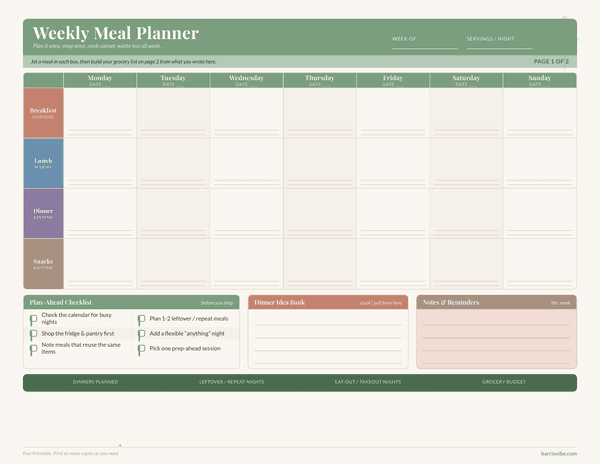
Weekly Meal Planner, Free Printable
A free printable weekly meal planner with a Monday, Sunday grid for breakfast, lunch, dinner, and snacks, plus a by-aisle grocery list and prep plan so you can plan your meals for the week and shop just once.
Which cheap staples should a budget meal plan be built around?
Build the plan around a core of cheap, versatile staples that stretch across many meals, these are the ingredients that do the heavy lifting when money is tight. Rice, dried or canned beans, lentils, eggs, oats, potatoes, pasta, frozen vegetables, and whatever produce is in season all cost little per serving and combine into dozens of different dinners. A few flavor anchors, onions, garlic, canned tomatoes, broth, and a small spice shelf, turn those basics into meals that never taste like sacrifice. The strategy is simple: let inexpensive staples form the base of most dinners, and use pricier items like meat or cheese as an accent rather than the centerpiece. A single pound of ground beef stretches much further in chili or a rice bowl than it does as burgers. When these staples stay stocked, you can plan and cook a whole week without a special trip. Keep a running note of what is running low so you restock on your normal shop, never at premium last-minute prices.
How do you cut your grocery bill without couponing all day?
You can shave real money off your grocery bill with a few habits that take minutes, not hours of coupon-clipping. Shop with your list and stick to it, that list, built from your plan, is your budget in physical form. Buy store brands, which often run 20 to 40 percent cheaper for an identical product, check the unit price instead of the sticker price, and buy versatile staples in bulk only when they are actually on sale. Cook once and eat twice by batch-cooking, and never let leftovers die in the back of the fridge, a set of clear, stackable glass food-storage containers makes it easy to see and actually finish what you made, which is exactly where most "wasted" grocery money quietly disappears. Shop your pantry before every trip so you are not double-buying, and hold yourself to one planned shop a week, since each extra run is another doorway for impulse spending. None of this needs an app or an hour of prep, just the same shopping with a little structure.
How do you stick to a meal plan without wasting food?
The meal plans that last are the ones that bend when your week does. Build in a flex night or two so the plan survives the evening soccer practice runs long or someone brings home a pizza, a rigid seven-day plan collapses the first time life interrupts, while a flexible one simply shifts. Keep the plan visible: a printable on the fridge means the whole family knows what is for dinner, which shuts down the 5 p.m. "what are we even eating" spiral that so often ends in takeout. Prep one or two things ahead on your lightest day, wash the greens, cook the rice, brown the meat, so weeknight cooking becomes assembly instead of a project. And loosely track what got eaten versus tossed; after a few weeks you will know your real portions and stop over-buying. If you want the full habit, our step-by-step guide to meal planning for the week walks through building the routine, and pairing it with a budget grocery list keeps the shopping trip itself in check.
Here is the whole method boiled down to four steps you can run every week:
- Shop your kitchen first, plan the week around what you already own before you buy anything new.
- Set your number, pick a realistic weekly total to aim for, so the plan has a target to hit.
- Plan five or six dinners that share ingredients and cook once to eat twice, leaving a flex night for leftovers.
- Write the list from the plan, and at the store, buy only what is on it.
Weekly Meal Planner, Free Printable
A free printable weekly meal planner with a Monday, Sunday grid for breakfast, lunch, dinner, and snacks, plus a by-aisle grocery list and prep plan so you can plan your meals for the week and shop just once.
Start with next week: shop your kitchen first, pick five or six dinners that share ingredients, and let one sheet on the fridge do the deciding for you. Track it for a month and you will have your own repeatable routine, one that bends with real life instead of falling apart the first hectic week, and one your grocery total will notice. Meal planning on a budget was never about eating less. It is about wasting less, and that is a change you can start this Sunday.
Frequently Asked Questions
How do I start meal planning on a budget?
Start in your kitchen, not the store. Check what you already own in the pantry and freezer, set a realistic weekly spending number, then plan five or six dinners that share ingredients. Write your grocery list straight from that plan so every item you buy has a purpose.
How much money can meal planning actually save?
A weekly meal plan usually cuts combined grocery and takeout spending by 20 to 30 percent. The savings come from three leaks it plugs: wasted food, impulse buys at the store, and expensive last-minute takeout. For a family spending $200 a week, that can be roughly $2,600 a year.
What are the cheapest foods to build a meal plan around?
Lean on versatile staples: rice, dried or canned beans, lentils, eggs, oats, potatoes, pasta, and frozen vegetables. Add flavor anchors like onions, garlic, canned tomatoes, and broth. Use pricier meat or cheese as an accent rather than the centerpiece so a little stretches across several meals.
How many meals should I plan for the week?
Plan five or six dinners rather than a full seven, and leave one or two nights flexible for leftovers or a takeout night that happens anyway. Choosing meals that share ingredients, and cooking once to eat twice, means a short grocery list can still cover the whole week.
How do I stop wasting food and groceries?
Shop your pantry before every trip so you never double-buy, plan meals that reuse the same ingredients, and store leftovers in clear containers so you actually eat them. Build in a flex night for leftovers, and keep the plan visible on the fridge so nothing gets forgotten in the back of the crisper.