
Some links in this guide are affiliate links, if you buy through them we may earn a small commission at no extra cost to you. Here’s our disclosure.
Quick Answer
A realistic weekly cleaning schedule pairs a 15-minute daily routine (dishes, counters, beds, a quick tidy) with one focus zone per day: floors Monday, bathrooms Tuesday, dusting Wednesday, kitchen Thursday, laundry Friday, bedrooms Saturday, and a reset Sunday. Download the free printable, put it on the fridge, and check off what you can.
Some weeks the house gets away from you. The dishes stack up on Tuesday, the bathroom gets skipped, and by Saturday every room seems to need you at the same time, so you lose a whole day to catching up instead of resting. If cleaning has become an all-or-nothing weekend marathon, the problem usually is not effort. It is that there is no rhythm. Without a plan, every mess feels equally urgent, so nothing gets done until it is overwhelming. The fix is not cleaning harder. It is spreading the work into small, repeatable pieces you can do in fifteen minutes a day, on autopilot, without deciding what to tackle each time. That is exactly what a weekly cleaning schedule gives you: a set order, a daily focus, and permission to stop once the day's part is done.
How often should you actually clean each part of your house?
Not everything needs weekly attention, and treating it that way is why cleaning feels endless. The trick is matching each task to how fast it actually gets dirty. Daily tasks are the ones that snowball overnight: dishes, wiping counters, making beds, a quick bathroom swipe, and a ten-minute tidy. Weekly tasks keep grime from building: vacuuming and mopping floors, scrubbing bathrooms, dusting surfaces, and changing sheets. Monthly or seasonal tasks, wiping baseboards, washing windows, cleaning inside the oven, vacuuming vents, can wait without anyone noticing. When you sort chores by frequency instead of doing everything at once, the daily load shrinks to a few minutes and the weekly load fits into one focus zone per day. That single shift is what turns a exhausting whole-house clean into a manageable routine.
What does a realistic weekly cleaning schedule look like, day by day?
The most sustainable weekly cleaning schedule assigns one focus zone to each day, on top of a short daily routine. This keeps any single day light and means the whole house gets covered by Sunday. Here is the day-by-day rhythm this free printable follows:
| Day | Focus zone |
|---|---|
| Monday | Floors, vacuum, sweep, mop |
| Tuesday | Bathrooms, scrub, wipe, fresh towels |
| Wednesday | Dusting and surfaces |
| Thursday | Kitchen deep-clean |
| Friday | Laundry and catch-up |
| Saturday | Bedrooms and living spaces |
| Sunday | Reset and plan the week ahead |
Because each day targets just one area, you are never scrubbing the whole house at once. Miss a day? You simply pick up where you left off, the schedule bends instead of breaking. Print it, put it on the fridge, and let the plan decide so you do not have to.
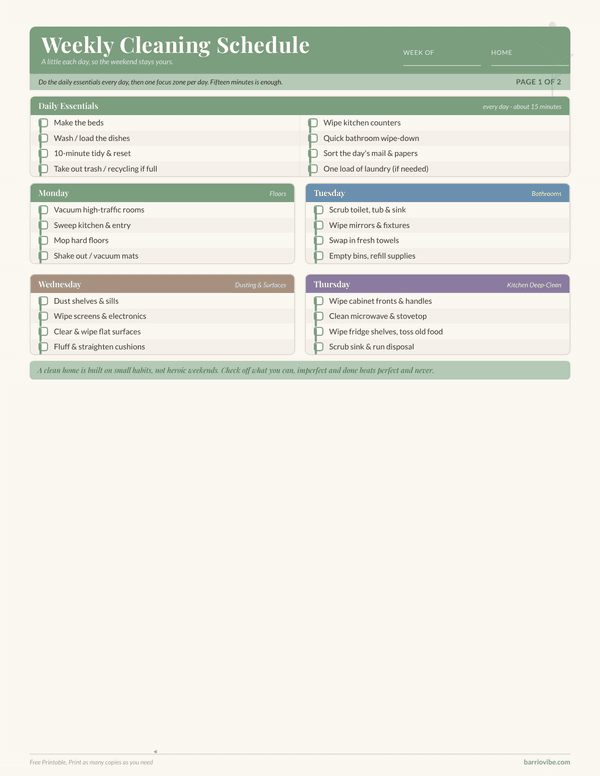
Weekly Cleaning Schedule, Free Printable
A realistic weekly cleaning schedule: a 15-minute daily-essentials checklist plus one focus zone per day, Monday through Sunday, with a weekly reset and progress summary. Print on standard letter paper.
How long should your daily cleaning routine take?
Aim for about fifteen minutes. The daily portion of a cleaning schedule is not meant to deep-clean anything, it exists to stop small messes from becoming big ones. Fifteen focused minutes covers the essentials that snowball fastest: loading the dishwasher, wiping the kitchen counters, making the beds, a quick wipe of the bathroom sink, and a ten-minute tidy to put stray items back where they belong. Set a timer, because the timer does two things: it keeps you moving, and it gives you permission to stop when it goes off. Most people overestimate how long these tasks take and dread them for far longer than they actually last. When the daily reset becomes automatic, same tasks, same time, every day, the weekly focus zones stay small and the weekend never turns into a recovery mission.
How do you stick to a cleaning schedule when life gets busy?
The schedules that last are the ones you attach to habits you already have. Anchor the daily reset to an existing routine, right after breakfast, or while the coffee brews, so it happens without a decision. Keep supplies where you use them: a small caddy of your favorite all-purpose spray and a stack of color-coded microfiber cloths under each sink removes the friction of gathering tools every time. Use a timer so cleaning has a clear finish line. Most importantly, when you miss a day, do not restart the whole week, just resume the next zone. A cleaning schedule is a guide, not a test you can fail. Checking off four of seven days still leaves your home dramatically cleaner than an all-or-nothing plan that collapses the first busy week. Progress compounds; guilt does not.
Cleaning schedule vs. deep-cleaning checklist, what's the difference?
A weekly cleaning schedule is your maintenance rhythm; a deep-cleaning checklist is the occasional reset. The schedule handles the recurring work that keeps a home livable week to week, floors, bathrooms, surfaces, laundry. A deep clean tackles the build-up that maintenance does not reach: behind appliances, inside cabinets, grout, light fixtures, and the tops of doorframes. You do not need both every week. Run the weekly schedule continuously, and reach for a deep clean seasonally or when a room has drifted. If you want the room-by-room version for those bigger resets, our free deep-cleaning checklist printable breaks the whole house into zones you can tackle one at a time. And when the kitchen is your trouble spot, these kitchen organization hacks make the Thursday deep-clean far faster. Together they cover both the rhythm and the reset.
What should be on your Sunday reset?
Sunday is the hinge of the whole schedule, a short reset that closes the past week and sets up the next. Keep it light: a ten-minute whole-home tidy, wiping down the entryway, watering plants, and restocking anything that ran low, like paper goods and hand soap. Then plan forward, glance at the week ahead, jot a meal plan and grocery list, and lay out what the next few days need. This is also the moment to reset the schedule itself: start the new week with clean sheets, empty bins, and a fresh printable on the fridge. A good Sunday reset is less about cleaning and more about lowering the mental load, so Monday starts calm instead of chaotic. Fill in the summary boxes at the bottom of the printable to track your loads of laundry and give the week a rating, a small, satisfying way to see progress.
Weekly Cleaning Schedule, Free Printable
A realistic weekly cleaning schedule: a 15-minute daily-essentials checklist plus one focus zone per day, Monday through Sunday, with a weekly reset and progress summary. Print on standard letter paper.
Keep the printable somewhere you'll see it, check off what you can, and let the rhythm do the deciding. A consistently tidy home is built one fifteen-minute day at a time.
Frequently Asked Questions
How many hours a week does it take to keep a house clean?
With a weekly cleaning schedule, most homes stay tidy on about 15 minutes of daily upkeep plus one 20-to-30-minute focus zone per day, roughly 3 to 4 hours spread across the whole week, instead of one exhausting weekend block.
What is the 15-minute cleaning rule?
The 15-minute rule means doing a short, timed daily reset, dishes, counters, beds, and a quick tidy, in about 15 minutes. The timer keeps you moving and gives you permission to stop, which stops small messes from piling into big ones.
In what order should you clean a room?
Work top to bottom and dry to wet: declutter surfaces first, then dust from high to low, then wipe surfaces, and finish with floors. Cleaning floors last means any dust or crumbs you knock down get picked up in the final step.
What is a good cleaning schedule for a working mom?
Anchor a 15-minute daily reset to an existing habit like after breakfast, assign one focus zone per day (floors, bathrooms, dusting, kitchen, laundry, bedrooms, Sunday reset), and never restart the week after a missed day, just resume the next zone.
Do I need to print a new cleaning schedule every week?
You can, and many people like the fresh-start feeling of a blank checklist each week, but it is not required. Print one copy and slip it into a sheet protector to check off with a dry-erase marker, or reprint weekly to track your summary stats.