Some links in this guide are affiliate links, if you buy through them we may earn a small commission at no extra cost to you. Here’s our disclosure.
Quick Answer
A grocery list printable saves money by moving buying decisions out of the store and back to your kitchen. Organize it by aisle, build it from your meal plan, check what you already own, and track a running total in the budget column so you shop once and skip impulse buys.
You get home from the store, unpack the bags, and there it is again, the thing you actually needed, still not bought, while three things you didn't need somehow made it into the cart. The receipt is longer than you expected, half the produce will wilt before you cook it, and you already know a mid-week run for the forgotten ingredient is coming. It is a strangely exhausting kind of failure: you shopped, you spent, and the fridge still feels wrong. Most of us blame willpower or the checkout-lane candy, but the real leak is upstream, in how the trip was planned, or wasn't. When you walk in with a vague list scrawled on a receipt back, or no list at all, the store gets to decide what you buy. Every unplanned lap past the end-caps is an invitation to overspend, and every forgotten item is a second trip waiting to happen. The list itself is the problem.
What makes a grocery list template save you money?
A grocery list printable saves money because it forces every purchase to be a decision you make at home, calmly, instead of one the store makes for you under fluorescent lights. When you plan the list in advance, you buy against a plan rather than an impulse, and studies of shopper behavior consistently find that unplanned trips and in-store browsing drive the bulk of impulse spending. A structured template does three things a scrap of paper cannot. First, it prompts you to check what you already own, so you stop buying a third jar of cumin. Second, it groups items so you shop once, efficiently, without backtracking or lingering. Third, it pairs each item with a running total or budget column, so the number stops being a surprise at the register. Put together, that means fewer trips, less waste, and a cart that matches your plan instead of your cravings.
How should you organize a grocery list, by aisle or by category?
Organize your grocery list by store section, not alphabetically or in the random order things pop into your head. A by-aisle list means you walk the store once in a logical loop, grab everything in a zone before moving on, and never double back for the mustard you passed three aisles ago. That single change cuts both your time in the store and your exposure to impulse displays. Here is the section-by-section structure this free printable follows:
| Store section | What goes here |
|---|---|
| Produce | Fruit, vegetables, fresh herbs |
| Meat & seafood | Proteins, deli items |
| Dairy & eggs | Milk, cheese, yogurt, butter |
| Pantry & dry goods | Canned goods, pasta, rice, baking |
| Frozen | Vegetables, fruit, prepared meals |
| Bakery & bread | Loaves, wraps, tortillas |
| Household & other | Paper goods, cleaning, toiletries |
Fill each column as you plan, and the list mirrors your actual path through the store. You shop the perimeter first for fresh items, dip into the center aisles only for what's written down, and check out before the end-caps can talk you into anything. A by-section grocery list printable also makes it obvious when a zone is empty, if nothing's written under "frozen," you skip that aisle entirely instead of wandering it and finding something to buy.
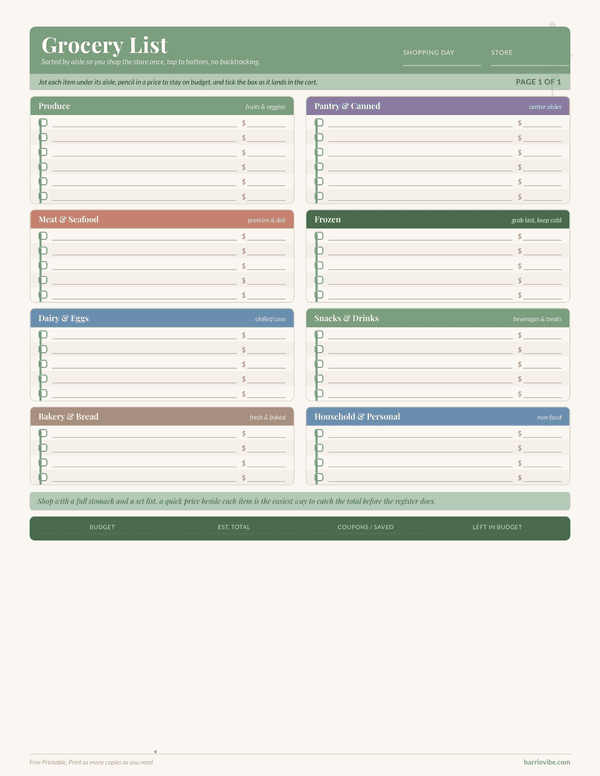
Grocery List Template (By Aisle), Free Printable
A free printable grocery list template organized by store aisle, produce, meat, dairy, pantry, frozen, and more, with a price column and budget tracker so you shop faster and spend less.
How do you use a grocery list with your meal plan?
Build the grocery list straight from your meal plan, and the two become one system instead of two chores. Start by deciding the week's meals first, even just five dinners and a couple of breakfasts, then read each recipe and write its ingredients onto the matching section of the list. This way every item you buy has a job, and nothing lands in the cart "just in case." It also surfaces overlap: if three meals use onions, you write onions once, at the right quantity, instead of guessing. The habit works best when the planning happens together in one sitting. Our guide on how to meal plan for the week walks through choosing meals fast, and once they're set you can drop the ingredients onto a by-aisle grocery list organizer in minutes. Planned meals give the list its content; the list turns that plan into a single, efficient trip. Keep the meal plan and the grocery list printable side by side while you write, and you'll catch the ingredients that do double duty before they turn into duplicates in your cart.
What should always be on your grocery list?
Keep a short master list of staples you restock on repeat, so you never run out of the basics between planned meals. These are the items that quietly enable everything else, the ones whose absence sends you back to the store mid-recipe. A reliable staples core looks like this:
- Produce anchors: onions, garlic, lemons, a hardy green, and whatever fruit gets eaten raw
- Proteins: eggs plus one or two freezer-friendly meats
- Pantry backbone: olive oil, canned tomatoes, beans, broth, pasta or rice
- Dairy: milk, butter, a block of cheese, plain yogurt
- Flavor makers: salt, a few core spices, soy sauce, and a vinegar
Pre-printing these on your template means you only decide the variable items each week, the meal-specific ingredients, while the backbone restocks automatically. That's less thinking, fewer gaps, and a kitchen that can always produce a simple meal without an emergency run. Circle the staples you're low on rather than rewriting them every time, and the weekly list stays fast to fill even on the busiest Sunday. Over a few weeks you'll learn your household's real rhythm, how fast you actually go through eggs, milk, and bread, and the template stops needing much thought at all.
How do you stop overspending at the grocery store?
Set the budget before you shop and track it on the list as you go, so the total is visible while you still have the power to change it. The single most effective move is to shop from a plan you made at home, on a full stomach, using a list you don't deviate from. Before you write a single item, take two minutes to "shop your kitchen", a quick look at the fridge, freezer, and pantry tells you what you already have so you don't rebuy it. This is where a set of clear stackable pantry bins earns its keep: when staples are grouped and visible instead of buried, you can see at a glance that you're low on rice but flush with pasta, and the list reflects reality. Use the budget column on the printable to tally items as you add them, round up as you shop, and give yourself a firm stop number. Seeing the running total is what keeps the cart honest.
How do you keep a reusable grocery list that actually gets used?
Keep the list where the cooking happens and make adding to it effortless, because a list only saves money if it's in your hand at the store. Print a stack and clip one to the fridge at the start of each week, or slide a single copy into a sheet protector and check items off with a dry-erase marker to reuse it indefinitely. The key habit is capturing items the moment you notice them, when you use the last of the ketchup, it goes on the list right then, not later from memory. A phone photo of the finished sheet is your backup if you leave the paper on the counter. Treat the template as a living document that fills up all week rather than something you scramble to write minutes before leaving. When adding to the list is frictionless and the list travels with you, forgotten items and second trips simply stop happening.
Grocery List Template (By Aisle), Free Printable
A free printable grocery list template organized by store aisle, produce, meat, dairy, pantry, frozen, and more, with a price column and budget tracker so you shop faster and spend less.
Print it, keep it on the fridge, and let the plan fill the cart instead of the store. None of this asks for more willpower or a stricter budget, it just moves the decisions out of the store and back to your kitchen table, where they're easy to make well. A shorter receipt, fewer mid-week runs, and a fridge full of food you'll actually cook is built one organized list at a time.
Frequently Asked Questions
Does a grocery list actually help you save money?
Yes. Shopping from a pre-made list keeps you buying against a plan instead of an impulse, and unplanned in-store browsing is where most overspending happens. A list also stops you rebuying things you own and cuts second trips, so you spend less on both groceries and gas over the month.
How should I organize my grocery list?
Organize it by store section, produce, meat, dairy, pantry, frozen, bakery, household, rather than alphabetically. A by-aisle list lets you walk the store in one logical loop, grab everything in a zone before moving on, and avoid backtracking, which cuts both your shopping time and your exposure to impulse displays.
Should I make my grocery list from a meal plan?
Ideally, yes. Decide your meals first, then copy each recipe's ingredients onto the matching section of the list. Every item then has a job, nothing lands in the cart just in case, and overlapping ingredients like onions get written once at the right quantity instead of bought twice.
Can I reuse the printable grocery list instead of printing a new one weekly?
Absolutely. Slide one copy into a sheet protector and check items off with a dry-erase marker to reuse it indefinitely, or print a fresh stack and clip one to the fridge each week. Snap a phone photo of the finished sheet as a backup in case you leave the paper at home.
What should always be on a grocery staples list?
Keep a restock core of onions, garlic, eggs, milk, butter, a block of cheese, olive oil, canned tomatoes, beans, broth, and pasta or rice. Pre-printing these means you only decide the meal-specific items each week while the backbone restocks automatically, so your kitchen can always produce a simple meal.