
Some links in this guide are affiliate links, if you buy through them we may earn a small commission at no extra cost to you. Here’s our disclosure.
Quick Answer
The best small closet organization ideas all use vertical space: add a second hanging rod to double capacity, store off-season items in labeled bins on the top shelf, keep shoes and a laundry basket on the floor, and give every category one zone. Download the free printable plan to map your closet in minutes.
You open the door and something slides off the top shelf. Half your clothes are crammed onto the rod so tightly you can't see what you own, the floor has turned into a pile, and the shelf overhead is a graveyard of things you meant to deal with someday. You've tried refolding all of it on a Sunday afternoon, but by Wednesday it looks exactly the same. When a closet is small, every extra sweater, every spare pair of shoes, every stray blanket competes for the same few square feet, and losing that competition means getting dressed feels stressful before your day has even started. The frustrating part is that you're not messy. You simply own more than the closet was built to hold, and you have no clear rule for where any of it belongs. That's a design problem, not a discipline problem, and design problems have solutions you can set up once and stop thinking about.
What are the best closet organization ideas for small spaces?
The best closet organization ideas small spaces can actually handle all share one principle: build upward and use vertical space instead of fighting over the floor. A small reach-in closet usually has a single rod at chest height, which wastes the two or three feet of air above it and the floor below. Reclaim that height and you can often nearly double what fits without moving a single wall. Start by clearing the floor completely, then add a second hanging rod beneath the first for shirts and folded pants, and turn the shelf above the rod into labeled bin storage for anything out of season. The goal is to give every category, shirts, pants, shoes, accessories, folded knits, one defined home, stacked vertically so nothing has to sit in a pile. Before you buy a single organizer, though, empty the closet completely: you cannot organize a small space that is still holding clothes you never wear. If that step feels overwhelming, our guide to decluttering your closet in one afternoon walks you through it in a couple of hours.
How do you plan zones for a small closet?
Zoning turns a chaotic small closet into a predictable one by assigning every type of item a fixed home, so putting things away stops requiring a decision. Instead of stuffing garments wherever they happen to fit, you decide in advance where shoes, hanging clothes, folded items, and accessories live, then you keep them there. In a tight space, the most efficient layout stacks zones vertically by how often you reach for each one: the highest, hardest-to-reach shelf holds what you rarely touch, eye level holds your daily clothes, and the floor holds shoes and a single laundry basket. Here is a simple zone plan that fits almost any reach-in closet:
| Zone | Location | What goes here |
|---|---|---|
| Top shelf | Above the rod | Out-of-season clothes, spare bedding, in labeled bins |
| Upper rod | Chest height | Dresses, coats, long-hanging items |
| Lower rod | Below upper rod | Shirts, blouses, folded pants, skirts |
| Floor | Below the rods | Shoes on a rack, one laundry basket |
| Back of door | Door-mounted | Accessories, belts, bags, or a shoe pocket |
Assign these zones once, label them, and the closet stays organized because every item has an obvious place to return to, no daily willpower required.
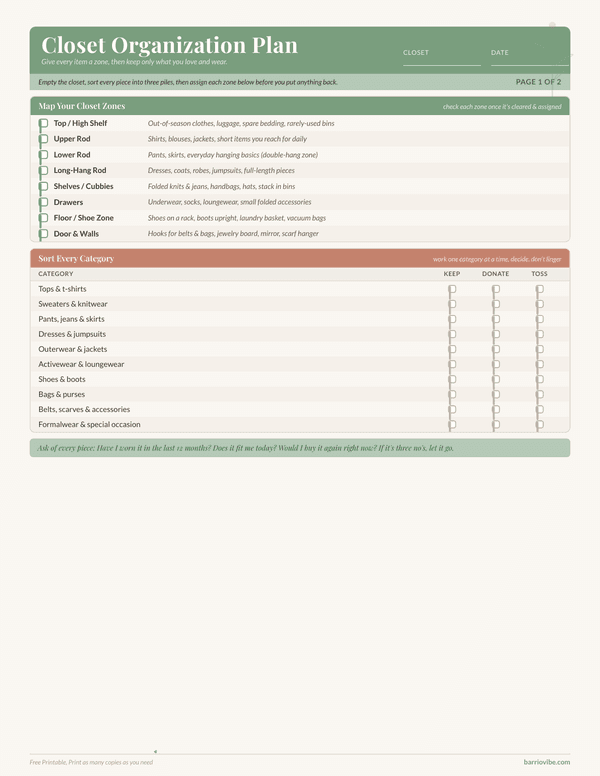
Closet Organization Plan + Labels, Free Printable
A free printable closet organization plan that maps every zone of your closet, walks you through a keep/donate/toss capsule declutter, and includes cut-out shelf and bin labels plus a weekly reset routine.
How can you double the hanging space in a small closet?
You can nearly double a small closet's hanging capacity by adding a second rod beneath the first one. Most reach-in closets set their single rod high, leaving three or more feet of dead air underneath that does nothing but collect a floor pile. A hang-down double rod fixes this instantly: it simply hooks over your existing rod and drops a second bar below, creating two tiers where you had one. Long items like dresses, robes, and coats stay up top, while shirts, blouses, and folded trousers move to the bottom bar. Because most shirts and pants need only about 40 inches of vertical space, doubling them up wastes almost nothing. Then swap your bulky plastic and wooden hangers for slim velvet ones, they're a fraction of the thickness, so noticeably more garments fit per foot of rod, and clothes stop sliding off onto the floor. Matching hangers also make the closet look calmer, which sounds cosmetic but genuinely helps you keep it that way. Together, a second rod and slim hangers often free up enough room that the floor pile disappears entirely, with no renovation and no contractor.
How do you use the floor and the shelf above the rod?
Treat the floor and the top shelf as prime storage, not overflow zones, and match what lives there to how often you actually need it. In a small closet these two areas usually collapse into clutter, but with the right containers they hold a surprising amount. On the floor, a slim shoe rack or a row of clear stackable bins keeps footwear visible and off the ground, while one designated laundry basket catches the daily pile before it spreads across the whole space. On the shelf above the rod, the hardest zone to reach, store what you need least: off-season sweaters, spare bedding, and sentimental keepsakes, packed into labeled bins so you never have to pull everything down to find one thing. Keep the items you wear constantly between hip and eye level, where they're effortless to grab, and push the rarely used things up high or down low. This single habit, matching a zone's reachability to how often you use what's inside it, is what keeps a small closet genuinely functional instead of just looking tidy for a week.
How do you organize a small closet on a budget?
You don't need a custom closet system to organize a small closet, a handful of inexpensive tools does most of the real work. The highest-impact upgrades are also the cheapest. A set of matching clear storage bins corrals folded knits, bags, and off-season clothes so the shelf stops sliding into chaos and you can see what's inside at a glance. Slim velvet hangers reclaim rod space for a few dollars. An over-the-door organizer turns the back of the door, usually wasted, into a home for shoes or accessories. And if you want zones that actually stick, a small label maker (or even neatly printed labels) turns vague bins into obvious homes, so everyone in the house puts things back in the right spot instead of guessing. Before you buy anything, shop your own house first: shoeboxes, baskets, and drawer dividers you already own can stand in perfectly well. For a full walkthrough of the whole space, labels, bins, rods, and layout for closets of every size, our complete closet organization guide covers it step by step. Spend money on containers only after you've decluttered and mapped your zones, never before.
How do you keep a small closet organized long-term?
Keeping a small closet organized comes down to two low-effort habits: a one-in, one-out rule and a quick seasonal reset. Because the space is fixed, the only way clutter stays gone is to stop it from creeping back, so every time a new piece comes in, an old one leaves. Twice a year, when you swap your seasonal clothes, spend fifteen minutes pulling anything you didn't wear last season and moving it straight to a donate bag. Keep that donate bag on the closet floor year-round; the moment something no longer fits or feels like you, it goes in immediately instead of returning to the rod. Put things back in their assigned zone the same day rather than letting a chair pile grow into next weekend's project. None of this takes willpower once the zones are set and labeled, you're simply maintaining a system, not rebuilding one from scratch each season. Print the closet organization plan below, map your zones a single time, add the labels, and let the printable do the remembering so you don't have to.
Closet Organization Plan + Labels, Free Printable
A free printable closet organization plan that maps every zone of your closet, walks you through a keep/donate/toss capsule declutter, and includes cut-out shelf and bin labels plus a weekly reset routine.
A small closet will never magically become big. But with clear zones, a second rod, slim hangers, and a one-in, one-out rule, it can comfortably hold everything you actually wear, and let you find any of it in seconds, on the busiest morning of the week.
Frequently Asked Questions
How do you organize a small closet with a lot of clothes?
Declutter first so you're only storing what you wear, then go vertical. Add a second rod beneath the first to double hanging space, switch to slim velvet hangers to fit more per foot, store off-season pieces in labeled bins up top, and keep shoes on a floor rack. A one-in, one-out rule keeps it from refilling.
How can I add more storage to a small closet without renovating?
Use no-drill upgrades: a hang-down double rod hooks over your existing bar to create a second tier, an over-the-door organizer reclaims the door for shoes or accessories, and stackable clear bins turn the top shelf and floor into real storage. None require tools, a contractor, or permission if you rent.
What should go on the top shelf of a small closet?
Store what you reach for least, since the top shelf is the hardest zone to access. Off-season clothing, spare bedding, and sentimental keepsakes belong there, packed in labeled bins so you never have to pull everything down to find one item. Keep daily-use clothes between hip and eye level instead.
Do slim velvet hangers really save space?
Yes. Slim velvet hangers are a fraction of the thickness of plastic or wooden ones, so you fit noticeably more garments per foot of rod. The velvet also grips fabric, so clothes stop sliding off onto the floor. Switching your whole closet to matching slim hangers is one of the cheapest, highest-impact upgrades.
How do I keep a small closet organized long-term?
Set your zones once, label them, and maintain them with two habits. Follow a one-in, one-out rule so nothing new comes in without something old leaving, and keep a donate bag on the closet floor year-round. Twice a year, when you swap seasonal clothes, remove anything you didn't wear last season.