Some links in this guide are affiliate links, if you buy through them we may earn a small commission at no extra cost to you. Here’s our disclosure.
Quick Answer
To organize a walk-in closet, empty it completely, sort into keep, donate, and relocate piles, then return items by zone: double-hang rods for tops, a long-hang section for dresses, upper shelves for off-season bins, and a floor rack for shoes. Match your hangers and download the free printable plan to map it.
You open the closet door and the space that was supposed to make getting dressed easier just makes you tired. Clothes are packed so tightly you can't see half of what you own. Shoes are in a heap on the floor. There's a shelf up top holding things you forgot you had, a chair or a stationary bike quietly wearing last week's laundry, and three empty hangers tangled somewhere in the middle of it all. A walk-in closet promised order, but yours has slowly become the room where clutter goes to hide. The frustrating part is that it's genuinely big enough to work, you're not short on square footage, you're short on a system. Every attempt to tidy it holds for a few days before the piles creep back, because you keep rearranging the same mess instead of giving everything an actual home. You've probably even bought bins that are now part of the clutter. Before you spend another dollar or another Saturday, it helps to understand why this particular space keeps defeating you.
How do you organize a walk-in closet from start to finish?
The best walk-in closet organization starts by emptying the space completely, then sorting every item before anything goes back in. Search closet organization ideas walk in and the polished before-and-after photos all quietly skip this step, but it's the one that makes the difference. Pull every item out, wipe down the shelves and rods, and sort what you own into three piles: keep, donate, and relocate. Once the closet is bare you can finally see the bones of the space, the rods, shelves, and floor you actually have to work with, instead of the mess layered on top of them. Group your keep pile by category (tops, bottoms, dresses, shoes, bags, accessories) so you know how much room each type actually needs. Then return items by zone rather than cramming them wherever there's a gap. This top-down sequence, empty, sort, plan, place, prevents the single most common mistake, which is organizing around clutter you should have let go of. A walk-in closet only works when everything inside it earns its spot, and you can't judge that fairly while the space is still packed full.
How should you divide a walk-in closet into zones?
Divide the closet into zones by category, so every type of item has one dedicated home you return it to automatically. Zoning is what separates a walk-in that stays neat from one that slowly slides back into chaos: when each category has a fixed address, tidying becomes putting things back instead of rethinking the entire room every week. Here's a simple zone map that works for most walk-in closets:
| Zone | What it holds |
|---|---|
| Double-hang rods | Shirts, blouses, folded trousers |
| Long-hang section | Dresses, coats, jumpsuits |
| Upper shelves | Off-season and rarely used items in labeled bins |
| Eye-level shelves | Folded knits, jeans, handbags |
| Floor / lower zone | Shoes on a rack, a laundry hamper |
| Drawers or dresser | Underwear, socks, small accessories |
Assign the prime real estate, eye level and within easy reach, to the things you wear most, and push off-season coats and sentimental keepsakes to the high shelves and low corners. Map your zones once, mark them on the plan, and the closet will practically maintain itself.
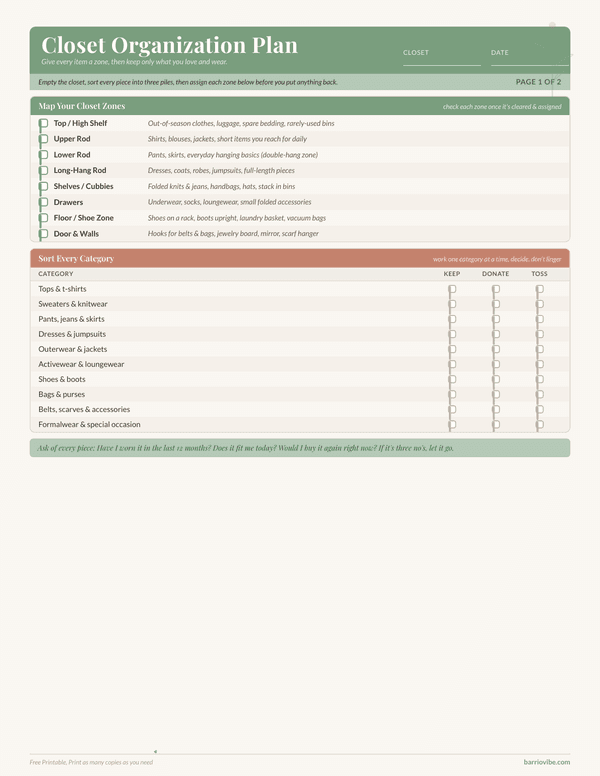
Closet Organization Plan + Labels, Free Printable
A free printable closet organization plan that maps every zone of your closet, walks you through a keep/donate/toss capsule declutter, and includes cut-out shelf and bin labels plus a weekly reset routine.
What's the best way to organize clothes in a walk-in closet?
Organize clothes by category first, then by color within each category, so getting dressed becomes a five-second scan instead of a frustrating search. Start by grouping like with like, all short-sleeve tops together, all jeans together, all dresses together, so you can see exactly what you own in each group. Within each group, arrange from light to dark; a color-blocked rod is far easier to shop from and instantly reveals the duplicates you can donate. Hang anything that wrinkles or loses its shape, blouses, dresses, blazers, dress pants, and fold heavy knits and jeans that would stretch out on a hanger. Match your hangers, too: a single consistent hanger style makes the whole rod look calmer and lets clothes hang at a uniform height, which frees up surprising amounts of vertical space. Face all the hangers the same direction, and turn one backward each time you wear that piece, after a season, the still-backward hangers show you exactly what you never reach for. The goal is a closet you can read at a glance, where every category lives in a predictable, consistent place.
How do you make the most of a small walk-in closet?
Go vertical: the most overlooked space in any walk-in closet is the wall above the top rod and the empty air between shelves. In a small walk-in, floor space is precious, so the trick is moving storage upward with a second hanging rod, stacked shelf dividers, and slim hanging organizers that use height instead of width. A double-hang rod instantly doubles your hanging capacity for shorter items like shirts and folded trousers. Shelf dividers keep folded stacks from toppling into each other, and the back of the door is prime real estate for a hanging rack of shoes, scarves, or accessories. Swap bulky plastic hangers for slim velvet ones, they take up a fraction of the rod space and let you fit noticeably more per foot. And keep the floor as clear as you can: a clear floor makes even a tight walk-in feel roomy and lets you actually stand and turn around inside it. When you use the full height of the space rather than just the middle, a small walk-in closet holds far more than its footprint would suggest.
What products actually help organize a walk-in closet?
A few targeted organizers do most of the heavy lifting: matching hangers, clear bins, shelf dividers, and a simple labeling system. You don't need to buy out the container store, start with the pieces that remove the most friction. Slim matching hangers unify the rods and reclaim space you didn't know you had. A set of clear stackable bins for the upper shelves keeps off-season clothes visible and dust-free, and because you can see straight into them, you actually use what's stored there instead of forgetting it exists by October. Shelf dividers keep folded stacks standing upright, and a small handheld label maker turns those bins and shelves into obvious, return-to-me spots the whole household can follow without asking you. Add a slim over-the-door rack for shoes or accessories if your floor is tight on space. Most importantly, buy in stages: organize and zone the closet first, then purchase only the bins and dividers that fit the zones you actually mapped, that way you're never storing empty containers you bought on impulse.
How do you keep a walk-in closet organized for good?
Keep it organized with a five-minute weekly reset and a one-in-one-out rule, so the closet never drifts far enough to need another full overhaul. Each week, rehang the strays, return shoes to the rack, and clear whatever has migrated onto the floor or the chair, five minutes of upkeep stops a month of slow creep. Adopt a one-in-one-out habit: when a new top comes in, an older one leaves, which keeps your carefully mapped zones from quietly overflowing again. Do a bigger edit each season, using the backward-hanger trick to spot what you haven't worn in months, and donate it without guilt. If the rest of your home needs the same treatment, our closet organization ideas and free printable labels walk you through the labeling system step by step, and for the pile that always ends up on the floor, these shoe organization ideas for any closet keep footwear off the ground for good. Consistency, not intensity, is what keeps a walk-in closet working long after the initial cleanup is done.
Closet Organization Plan + Labels, Free Printable
A free printable closet organization plan that maps every zone of your closet, walks you through a keep/donate/toss capsule declutter, and includes cut-out shelf and bin labels plus a weekly reset routine.
Print the plan, map your zones one time, and let the system carry the closet from there. An organized walk-in isn't built in a single marathon Saturday, it's built one five-minute reset at a time, and kept by a plan you can actually see.
Frequently Asked Questions
How do you organize a walk-in closet on a budget?
Start with what you already own: empty the closet, declutter, and re-zone by category before buying anything. Then add only a few low-cost basics, slim matching hangers, a second tension rod, and a handful of clear bins for the upper shelves. Organize first, purchase second, so you never buy containers you don't use.
How should you arrange clothes in a walk-in closet?
Group clothes by category first, tops, bottoms, dresses, jackets, then arrange each group from light to dark. Hang anything that wrinkles or loses shape, and fold heavy knits and jeans. Keep what you wear most at eye level, and store off-season pieces on the high shelves in labeled bins.
What is the best way to organize a small walk-in closet?
Use the full height of the space. Add a double-hang rod to double your hanging room, install shelf dividers, and use the back of the door for shoes or accessories. Switch to slim velvet hangers to fit more per foot, and keep the floor clear so the closet still feels roomy.
How do I stop my walk-in closet from getting messy again?
Do a five-minute weekly reset, rehang strays, return shoes to the rack, and clear the floor, and adopt a one-in-one-out rule so nothing overflows. Each season, use the backward-hanger trick to spot what you never wear and donate it. Consistency, not intensity, keeps the closet neat.
Should you hang or fold clothes in a walk-in closet?
Hang anything that wrinkles or stretches out of shape: blouses, dresses, blazers, dress pants, and skirts. Fold heavy items that a hanger would distort, sweaters, chunky knits, and jeans, and store them on eye-level shelves or in drawers. Matching your hangers keeps the hung sections looking calm and uniform.