Some links in this guide are affiliate links, if you buy through them we may earn a small commission at no extra cost to you. Here’s our disclosure.
Quick Answer
The best bathroom organization hacks go vertical and group like with like: use the back of the door and wall above the toilet, add pull-out bins and a tension rod under the sink, divide drawers, and label every zone. A one-in-one-out rule keeps the counter clear for good.
You reach for the hairdryer and knock over three bottles of half-used product. The drawer won't close because a tangle of hair ties, sample tubes, and an old thermometer is jammed at the back. Extra toilet paper is balanced on the tank, the counter has become a landing strip for everything that doesn't have a home, and you can never find the nail clippers when you actually need them. Bathrooms are the smallest, most-used rooms in the house, and they collect a very specific kind of chaos: tiny items, damp surfaces, and almost no square footage to work with. Whether you're sharing one bath with a whole family or squeezing a lifetime of toiletries into a rental with a single skinny cabinet, the mess feels stubborn, because the usual advice, "just buy more storage," rarely fits the space you actually have. The good news is that the fix has far less to do with buying bins than with a handful of small moves that make every item easier to put away than to leave out.
What are the best bathroom organization hacks for a cluttered bathroom?
The best bathroom organization hacks start by going vertical and grouping like with like, because open floor and counter space is the one thing a bathroom never has enough of. Pull everything out, wipe down the surfaces, and sort what you own into small piles, daily essentials, backups, first aid, hair tools, before a single item goes back in. That edit alone usually reveals two or three duplicates and a fistful of expired products you can toss on the spot. Then move up the walls: an over-the-door rack, a tension rod inside the cabinet to hang spray bottles by their triggers, and a slim shelf above the door frame all reclaim storage you didn't know you had. Give each pile its own container so related items travel together and empty out at a glance. The single most effective habit, though, is a one-in-one-out rule for products, a bathroom only stays organized when the sheer volume of stuff stops growing. It also helps to store items where you use them: shower products in the shower, everyday makeup near the mirror, and towels within arm's reach of the tub. Start with these bathroom organization hacks and the counter tends to clear itself within an afternoon.
How do you organize a bathroom with no storage or counter space?
When a bathroom has almost no built-in storage, the answer is to claim the vertical and hidden spaces most people overlook. The back of the door is prime real estate: an over-the-door organizer holds everything from hair tools to cleaning spray without touching your limited shelf space. The wall above the toilet fits a slim shelf or a narrow cabinet for backups and folded towels, turning dead air into a whole storage zone. Inside the vanity, a stacking shelf riser doubles your usable height, and a small lazy Susan tames the awkward corner behind the pipes so nothing gets lost in the back. Even the inside of the cabinet door earns its keep with adhesive caddies for brushes and toothpaste. If your space is truly tiny, our small bathroom organization system walks through a six-zone plan built for rentals and half-baths. The rule for small bathrooms is simple: every product should live off the counter, so the one surface you actually use stays clear, dry, and easy to wipe down.
How do you organize under the bathroom sink?
Start by pulling everything out and planning around the pipes rather than fighting them. The plumbing under a bathroom sink makes it the hardest zone in the room to use well, so the trick is choosing storage shaped for the obstacle instead of forcing square bins into a curved space. A two-tier pull-out drawer slides neatly past the trap and brings the back of the cabinet to your fingertips, which is where things usually go to disappear. Stack shallow bins by category, cleaning supplies in one, backup toiletries in another, hair tools in a third, and face the labels forward so anyone can put things back correctly. Use the tall vertical gap beside the pipes for spray bottles and cleaners, and mount a small tension rod across the cabinet to hang those bottles by their triggers, freeing up the floor of the cabinet entirely. A caddy with a handle is another quiet win: it lifts a whole group of cleaning supplies out in one motion so you can reach the pipes to wipe them down, then drops back in. Keep only what you reach for weekly down here; true overflow belongs in a linen closet. Grouping by task means you pull out one labeled bin, not a dozen loose bottles, every single time.
How do labels keep a bathroom organized long-term?
Labels turn a one-time cleanup into a system that survives the whole family. Once every category has a clearly labeled home, cotton swabs, first aid, backup toiletries, hair tools, putting things away stops being a decision and becomes obvious, even for kids, partners, and houseguests who have no idea where anything "goes." Remove the guesswork and the bins stop drifting back into chaos within a week. Labels also quietly expose overbuying: when the sunscreen bin is already overflowing, you can see it before you toss a fourth bottle into the cart. For a damp room, choose water-resistant labels and stick them to the front of each bin at eye level, or along the shelf edge so the category still shows even when the bin is pulled out. You don't need a fancy label maker to do this well. This free printable bathroom label set includes ready-made tags for every common bathroom zone, toiletries, first aid, cleaning, hair, and more, plus a small-bathroom zone map to help you plan where each group should live before you start.
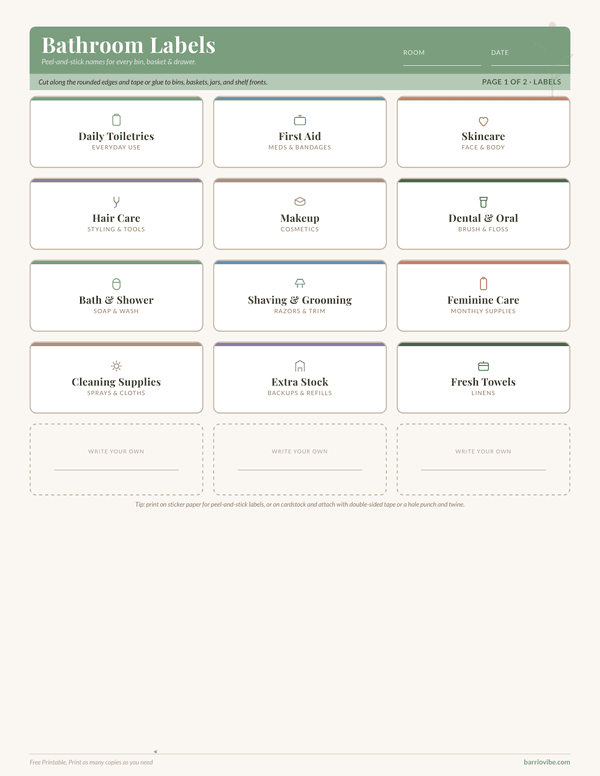
Bathroom Organization Labels + Zone Plan, Free Printable
Free printable bathroom organization labels for toiletries, first aid, skincare, and more, plus a small-bathroom zone plan to give every item a home.
What's the best way to organize bathroom cabinets and drawers?
The fastest way to organize bathroom cabinets and drawers is to divide them into zones and give every zone a container with a flat bottom and a clear front. Drawer dividers keep small items, tweezers, clippers, hair ties, sample tubes, from migrating into one hopeless pile at the back. In the cabinet, a set of clear stackable bins lets you see what's inside and pull one full group at a time without unpacking the whole shelf; because they're see-through, you restock from a glance instead of a dig. Then assign each shelf a specific job so the system actually holds:
| Zone | What lives here |
|---|---|
| Top shelf | Backups and rarely-used items |
| Eye-level shelf | Daily essentials and hair tools |
| Lower shelf / bins | First aid, cleaning, bulk supplies |
| Drawers | Small tools, divided by category |
| Cabinet door | Brushes and spray bottles on a tension rod |
Matching height to how often you reach for something means the daily items are always the easiest to grab. For a deeper, shelf-by-shelf reset, our bathroom cabinet organization guide breaks the whole cabinet down step by step.
How do you keep a bathroom organized for good?
Keeping a bathroom organized comes down to shrinking the daily friction so tidying happens almost without thinking. Do a 60-second reset each night: cap and return the products you used, wipe the counter, and drop any stray items into their labeled bins. Because everything already has a home, the reset takes less time than reading this paragraph. Once a season, pull everything out, toss expired products and empty bottles, and check that each zone still matches how you actually use the room, needs shift, and so should the layout. Follow a one-in-one-out rule so new purchases replace old ones instead of stacking on top of them. Keep a small caddy of cleaning supplies under the sink so wiping down never means hunting for the spray first. The goal isn't a magazine-perfect bathroom; it's a room where everything has an obvious place and returning it takes seconds. A shared basket by the door for each family member's own products stops the counter from filling up again, and a single hook for damp towels does more for a tidy look than any bin. When the system is this easy, it survives busy weeks, overnight guests, and kids. Print the label set, put each group in its place, and let the labels do the remembering for you.
Bathroom Organization Labels + Zone Plan, Free Printable
Free printable bathroom organization labels for toiletries, first aid, skincare, and more, plus a small-bathroom zone plan to give every item a home.
Frequently Asked Questions
How do you organize a bathroom with no storage?
Claim vertical and hidden space: hang an over-the-door organizer, add a shelf or cabinet above the toilet, use a stacking riser inside the vanity, and mount adhesive caddies on the cabinet door. Keep every product off the counter so your one usable surface stays clear.
What is the best way to organize under a bathroom sink?
Plan around the pipes. Use a two-tier pull-out drawer to reach the back, stack shallow labeled bins by category, and mount a tension rod to hang spray bottles by their triggers. Keep only weekly-use items there and send overflow to a linen closet.
How do you keep a bathroom organized long-term?
Do a 60-second nightly reset, cap products, wipe the counter, and return stray items to labeled bins. Follow a one-in-one-out rule so new purchases replace old ones, and re-edit each zone once a season to match how you actually use the room.
Do labels really help keep a bathroom organized?
Yes. Labeled bins remove the guesswork of where things go, so kids, partners, and guests put items back correctly and the system holds. Labels also expose overbuying at a glance. Use water-resistant labels on the front of each bin at eye level.
What should you declutter first in a bathroom?
Start with expired and empty products: old medications, dried-out makeup, near-empty bottles, and duplicate items. Clearing these first frees the most space fastest and reveals what you truly use, so you can size storage to what's left instead of the clutter.