Some links in this guide are affiliate links, if you buy through them we may earn a small commission at no extra cost to you. Here’s our disclosure.
Quick Answer
The best free printable worksheets for kids are simple, single-skill pages that practice one thing at a time, tracing a letter, writing a number, or forming a shape, with dotted guide lines and open practice space. For ages three to five, letter and number tracing builds the fine-motor control reading and math depend on. Download the free printable and start with five minutes.
You print a stack of pages, sit your child down at the kitchen table, and within four minutes the pencil is on the floor, the sheet has one wobbly letter on it, and someone is asking for a snack. Or maybe the opposite happens, your four-year-old actually loves practicing letters, races through everything you own by Tuesday, and you are left scrambling for more before boredom turns into a meltdown. Either way you land in the same spot. You want to give your child a gentle head start with letters and numbers at home, but the worksheets you find are too babyish, too hard, cluttered with cartoon characters that distract more than they teach, or locked behind an email sign-up and a paywall. You are not trying to run a curriculum from your dining room. You just want a few clean pages your child can actually use today, without the fuss or the upsell.
What are the best free printable worksheets for kids?
The best free printable worksheets for kids are simple, single-skill pages that practice one thing at a time, tracing a letter, writing a number, or forming a shape, without busy illustrations competing for attention. For preschool and kindergarten ages, that means dotted guide lines your child traces over, followed by a blank line or two to try on their own. Letters and numbers are the highest-value place to start because they build the fine-motor control and symbol recognition that reading and math sit on top of. Skip the packets crammed with fifty activities; a child does far better with one clear page than a maze of tasks. Look for generous line spacing, a clean font, and plenty of white space so little hands are not overwhelmed. Our free printable worksheets for kids keep to exactly that, dotted letters A, Z, numbers 0-9, and open practice lines, with nothing to color in and nothing to distract.
| Skill focus | Best for | What it builds |
|---|---|---|
| Letter tracing (A, Z) | Ages 3-5 | Letter formation and recognition |
| Number tracing (0-9) | Ages 3-5 | Number writing and counting sense |
| Pre-writing lines & shapes | Ages 2-4 | Pencil grip and fine-motor control |
| Independent practice lines | Ages 4-6 | Confidence and memory recall |
At what age should kids start letter and number worksheets?
Most children are ready for letter and number worksheets between ages three and five, but readiness matters far more than the number on the birthday cake. The real signal is fine-motor control: can your child hold a crayon in a tripod grip, draw a rough circle, and stay focused for a few minutes? If so, tracing is a good fit. Around age three, keep sessions to about five minutes and focus on big, simple strokes, vertical lines, circles, the first letter of their name. By four and five, most kids can trace full letters and numbers and attempt a few independently. Younger toddlers benefit more from pre-writing play, scribbling, playdough, threading beads, than from formal pages, and our free preschool worksheets start right there with shapes and pre-writing lines. There is no prize for starting early, and pushing before little hands are ready usually backfires into frustration. Follow interest, keep it short, and let mastery set the pace.
How do you use tracing worksheets so they actually help?
Use tracing worksheets in short, focused bursts, and always model the stroke first. Before your child touches the pencil, show them how the letter is formed, top to bottom, left to right, because a letter traced in the wrong order looks correct on the page but builds an awkward habit that is hard to undo later. Sit alongside them, say the letter's sound as you trace, and let them do just two or three repetitions well rather than filling every line sloppily. Praise the effort and the shape, not perfection. Keep sessions to five or ten minutes and stop while your child is still enjoying it, so they come back willingly next time. Rotate letters instead of drilling the same one twenty times, a little variety keeps attention fresh. Most importantly, connect the practice to real life: point out the same letters on cereal boxes, mailboxes, and street signs so learning does not stay trapped on the worksheet.
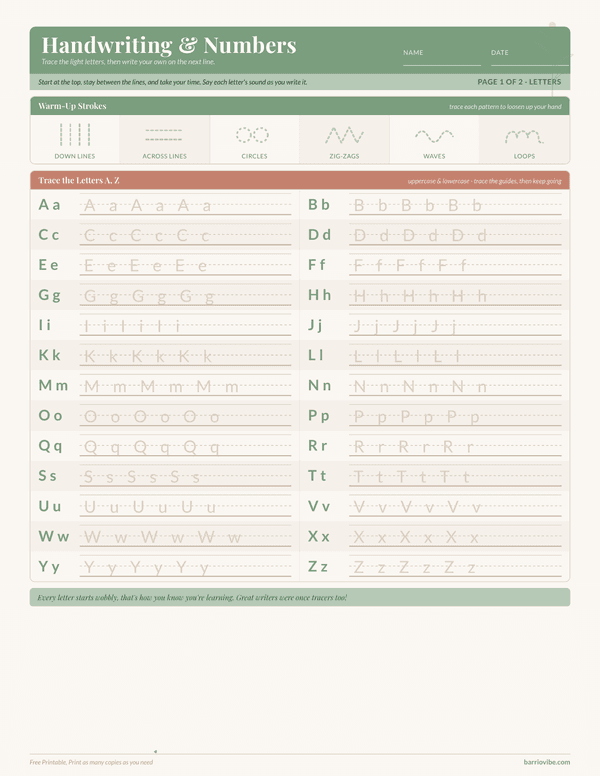
Preschool Handwriting & Numbers Worksheet, Free Printable
A free printable preschool handwriting worksheet with dotted guide lines for tracing uppercase and lowercase letters, numbers 1-10, and first words, plus warm-up strokes and count-and-write practice.
How can you make printable worksheets reusable and less wasteful?
Slide each worksheet into a dry-erase pocket and your child can trace the same page dozens of times with a wipeable marker instead of burning through paper and printer ink. This one small change turns a single free printout into a reusable practice tool, which matters a lot when a four-year-old decides to write the number three forty times in a row. A pack of clear dry-erase sleeves costs only a few dollars, wipes clean in a second, and doubles as a spill-proof surface for the kitchen table. If you would rather keep the finished work, print two copies, one to save in a folder as a keepsake and progress record, one to reuse. Store a small kit within arm's reach: the printed pages, a couple of chunky pencils or washable markers, and the sleeves, so practice can start in the ten minutes before dinner without a scavenger hunt for supplies. Lowering the friction is what keeps a good habit alive.
How do you keep worksheets feeling like play instead of a chore?
Keep worksheets feeling like play by pairing them with movement, choice, and a clear finish line. Let your child pick which letter or number to practice, a small choice gives them ownership and cuts resistance in half. Turn tracing into a game: trace the letter in the air first, then on the page, then hunt for that same letter around the room. Set a five-minute timer so there is a visible end, and celebrate finishing rather than pushing for one more page. Mix printable pages with hands-on practice, forming letters out of playdough, writing in a tray of salt or sugar, drawing giant letters with sidewalk chalk, so writing feels like one activity among many instead of a daily drill. If your child resists on a given day, simply stop. One cheerful five-minute session beats a twenty-minute battle that teaches them worksheets mean tears. The goal is a willing learner, not a perfectly completed page.
How do you track whether the worksheets are working?
Watch for small, steady changes rather than perfect penmanship. Progress with letters and numbers shows up as a firmer pencil grip, strokes formed in the right order, more consistent sizing, and, the big one, recognizing and naming letters out in the world, not just on the page. Keep one dated worksheet a month in a folder so you can compare a wobbly October A to a confident December one; the contrast is genuinely motivating for both of you. Do not measure your child against other kids or a grade-level chart. Some children write their name at three and others at five, and both end up in the same place. If your child consistently reverses letters past age six or seven, mention it to their teacher, but before that, occasional b/d flips are completely normal. When letters start to click and your child is ready for short words and early math, our free printable kindergarten worksheets pick up right where these leave off.
Start with one letter, one number, and five willing minutes. Keep the pages within reach, celebrate the effort over the outcome, and let your child set the pace, the whole point of at-home worksheets is comfort, confidence, and control, built one short session at a time. Grab the free printable worksheets for kids below, slip a page into a dry-erase sleeve, and let today's five minutes count.
Preschool Handwriting & Numbers Worksheet, Free Printable
A free printable preschool handwriting worksheet with dotted guide lines for tracing uppercase and lowercase letters, numbers 1-10, and first words, plus warm-up strokes and count-and-write practice.
Frequently Asked Questions
At what age should kids start doing worksheets?
Most children are ready between ages three and five, but readiness matters more than age. If your child can hold a crayon in a tripod grip, draw a rough circle, and focus for a few minutes, tracing worksheets are a good fit. Younger toddlers do better with pre-writing play first.
How long should a worksheet session last for a preschooler?
Keep it to about five to ten minutes. Short, focused sessions protect attention and keep worksheets feeling like play instead of a chore. Set a timer for a clear finish line, and stop while your child is still enjoying it so they come back willingly next time.
How do I make printable worksheets reusable?
Slide each page into a clear dry-erase pocket and let your child trace over it with a wipeable marker. One printout then lasts for dozens of practice rounds, which saves paper and ink. To keep finished work, print two copies, one to reuse and one to file as a keepsake.
Is it normal for kids to reverse letters and numbers?
Yes. Occasional b/d flips and backward numbers are completely normal through age six or seven as children learn letter formation. Focus on modeling the correct stroke order rather than correcting every reversal. If reversals persist past age seven, mention it to your child's teacher.
Do these free printable worksheets require an email sign-up?
No. The letters-and-numbers worksheet downloads as a free PDF with no email, account, or payment required. Print as many copies as you need, use them at home or in a classroom, and reprint whenever you want a fresh set of practice pages.