Some links in this guide are affiliate links, if you buy through them we may earn a small commission at no extra cost to you. Here’s our disclosure.
Quick Answer
The best free preschool worksheets are simple, single-skill pages a child finishes in a few minutes: dotted-line letter and number tracing, shapes, matching, and pre-writing lines with big elements and lots of white space. Use them 5-10 minutes a few times a week, and download the free printable to start.
You wanted to give your preschooler a little head start, so you searched for something to print, and an hour later you had twenty tabs open and nothing on paper. Half the pages were cluttered with cartoons and buried under ads. Some were secretly a free trial that wanted your email before they would hand over the download. A few looked right until your three-year-old sat down, gripped the crayon, and either scribbled over the whole thing in ten seconds or pushed it away because the letters were too small and the instructions assumed she could already read. Now you are second-guessing yourself: Is this even the right skill for her age? Am I pushing too hard, or not enough? Should a preschooler be doing worksheets at all? If you have felt that mix of good intentions and quiet confusion standing at the printer, you are not doing anything wrong, you just need pages built for how little kids actually learn, and a simple sense of what to do with them.
What are the best free preschool worksheets to print at home?
The best free preschool worksheets are simple, single-skill pages a child can finish in a few minutes without help, one clear task, big elements, and plenty of white space. For a three- to five-year-old, that means dotted-line letter and number tracing, basic shapes, matching, simple counting, and pre-writing lines (straight, curved, and zigzag). Skip anything crowded with cartoons or timed drills; visual clutter overwhelms new learners and hides the actual skill you want them to practice. Look for pages printed in black and white to save color ink, with fonts large enough that little hands can trace inside the lines. Free preschool worksheets should feel like play, not school, a child should glance at the page and immediately know what to do without a grown-up explaining it. Watch out for downloads that demand an email or unlock only part of the file; the genuinely free ones let you print the whole thing on the spot. Our free preschool handwriting and numbers worksheet is built exactly this way: dotted guide lines, generous spacing, and one skill per section, so your child can succeed on the very first try.
What skills should preschool worksheets actually build?
Preschool worksheets should build the specific foundational skills that get a child ready for kindergarten, not academics for their own sake. At this age, the goal is exposure and confidence, not mastery, so a page that ends in a smile matters more than a page filled in perfectly. The areas that matter most are pre-writing control, letter and number recognition, early math sense, and visual discrimination, spotting how things are the same or different. A good printable rotates through these instead of drilling one skill to exhaustion, because variety keeps a preschooler curious and stops any single task from feeling like a chore. Here is how the core skill areas break down and what a worksheet for each one looks like:
| Skill area | What it builds | Sample worksheet page |
|---|---|---|
| Pre-writing | Pencil control, line direction | Trace straight, curved, and zigzag lines |
| Letter recognition | Alphabet familiarity | Trace and match uppercase letters |
| Number sense | Counting, quantity | Count objects, trace numbers 1-10 |
| Shapes & colors | Visual vocabulary | Trace and name basic shapes |
| Visual discrimination | Matching, sorting | Circle the one that is different |
Cover these five areas and your child touches every readiness skill a formal preschool program would introduce, no curriculum, tuition, or teaching degree required. Rotate one area at a time and the learning feels effortless.
How do you help a preschooler start tracing letters and numbers?
Start with big, dotted guide lines and let your child trace over them with a chunky crayon or washable marker before you ever expect free-hand writing. Tracing does the heavy lifting: it teaches the shape and the direction of each letter while the guide keeps the result recognizable, which builds confidence fast and protects little ones from the frustration of a wobbly, unreadable attempt. Model it first, say the letter's sound out loud as you trace, then let your child copy you. Keep sessions to a few letters, not the whole alphabet, and always begin with the letters in their own name, because personal meaning makes them stick far better than starting at A. Use short, cheerful bursts and stop while your child still wants more. If holding the crayon still looks awkward or the grip keeps slipping, spend a week on control first; these fine motor activities for little hands strengthen the exact muscles that writing depends on, so the pencil work comes far more easily afterward. When your child is ready to put marker to paper, this free printable gives them clean, evenly spaced tracing lines for every letter and number.
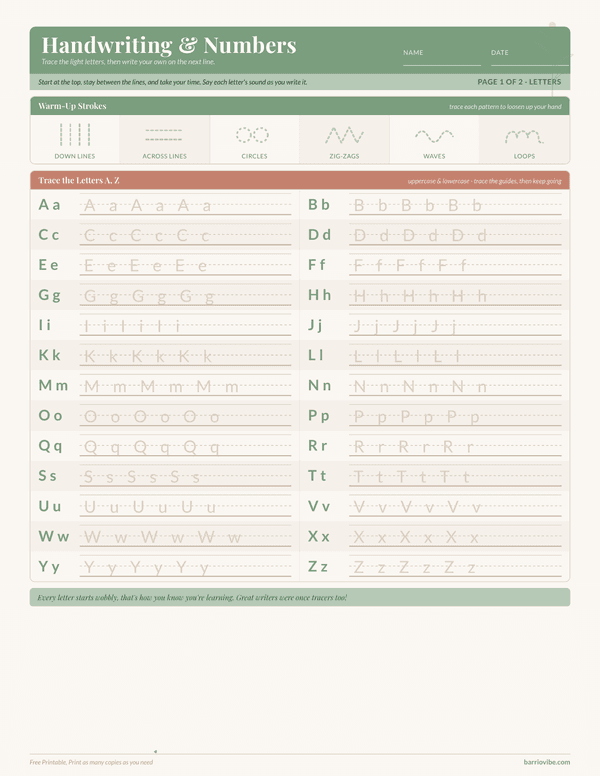
Preschool Handwriting & Numbers Worksheet, Free Printable
A free printable preschool handwriting worksheet with dotted guide lines for tracing uppercase and lowercase letters, numbers 1-10, and first words, plus warm-up strokes and count-and-write practice.
Are worksheets good for preschoolers, and how much is too much?
Worksheets are good for preschoolers in small, playful doses, think five to ten minutes, a few times a week, never a forced daily sit-down. At three and four, children learn most through movement, play, and hands-on exploration, so a worksheet should be one small ingredient in the day, not the whole meal. The right amount looks like a short, cheerful page while you make lunch, or one tracing sheet after a bedtime story, stopped the moment interest fades, not pushed to completion because the page "isn't finished." Watch your child, not the clock: focused engagement means it is working; squirming, scribbling, or a quick "I'm done" means put it away with zero pressure and try again another day. Forcing worksheets is the fastest way to make a preschooler dislike them, and a child who dreads the page learns nothing from it except that learning feels bad. Pair short worksheet moments with plenty of unstructured, sensory, and gross-motor play, building, digging, pouring, climbing, and the printables become a fun little bonus rather than a chore. Done this way, a few minutes of pencil time genuinely helps; done as a daily requirement, it backfires.
How do you make printable worksheets reusable so you save ink and paper?
Slip each printed worksheet into a dry-erase pocket sleeve and hand your child a washable dry-erase marker instead of printing a fresh copy every single time. This one swap turns a single printout into an endlessly reusable page, your child traces, you wipe it clean, and the same sheet is ready to go again tomorrow. Reusable dry-erase pockets are inexpensive, save a surprising amount of ink and paper over a few months, and carry a hidden bonus: a child who knows the page erases feels free to try, mess up, and try again without the stakes of "ruining" it, which is exactly the low-pressure mindset early learners need. Store your printed pages in a simple binder or folder, sorted by skill, so the next session is grab-and-go instead of grab-and-reprint at the moment your toddler is finally in the mood. For pages you want to keep as a record of progress, print a fresh paper copy occasionally and write the date on it, a small stack from month one to month six becomes a lovely, low-effort keepsake of just how far your child has come, and a quiet reassurance on the days it feels like nothing is sinking in.
How do you turn free preschool worksheets into a simple weekly routine?
Anchor worksheets to a calm moment you already have, right after breakfast, or during a younger sibling's nap, and rotate one skill per day so no single area gets over-drilled. A gentle week might look like tracing lines on Monday, letters on Tuesday, counting on Wednesday, shapes on Thursday, and a free-choice page on Friday, each lasting just a few minutes. Keep it loose: if the day gets away from you, skip it entirely without guilt, because quiet consistency over weeks matters far more than a perfect daily record that stresses everyone out. Lay out the sleeve and marker the night before so the activity is ready the second your child is willing, and follow their energy rather than a rigid schedule. Balance the quiet worksheet time with active, hands-on learning so your preschooler gets real variety, these at-home preschool activities pair beautifully with the printable pages and keep the whole week from feeling like desk work. Print the tracing worksheet, tuck it into a dry-erase sleeve, and let a light, predictable rhythm do the work, a few cheerful minutes a day quietly adds up to a confident, curious, kindergarten-ready little learner.
Preschool Handwriting & Numbers Worksheet, Free Printable
A free printable preschool handwriting worksheet with dotted guide lines for tracing uppercase and lowercase letters, numbers 1-10, and first words, plus warm-up strokes and count-and-write practice.
Frequently Asked Questions
At what age should a child start doing worksheets?
Most children are ready for simple worksheets around age 3 to 4, once they can hold a crayon and follow a one-step instruction. Keep it playful and short, tracing and matching pages, five to ten minutes at a time, rather than any structured, seated academic work.
Are worksheets bad for preschoolers?
No, in small, playful doses worksheets are fine and even helpful. They become a problem only when they replace hands-on play or are forced. A few minutes a few times a week, stopped the moment interest fades, gives the benefit without the burnout or pressure.
What should preschoolers learn before kindergarten?
Before kindergarten, preschoolers benefit from recognizing letters and numbers, counting small groups, naming basic shapes and colors, holding a pencil, and tracing simple lines. The goal is friendly exposure and confidence, not mastery, readiness skills matter far more than early academic performance.
How do I make printable worksheets reusable?
Slip each printed page into a dry-erase pocket sleeve and use a washable dry-erase marker. Your child traces, you wipe it clean, and one printout lasts for months. It saves ink and paper and removes the pressure, so kids feel free to try again.
How long should a preschooler work on a worksheet?
Aim for about five to ten minutes, and follow your child's cues rather than the clock. Engagement means it is working; squirming or scribbling means put it away with zero pressure. Short, cheerful sessions build a positive relationship with learning better than long ones.