Some links in this guide are affiliate links, if you buy through them we may earn a small commission at no extra cost to you. Here’s our disclosure.
Quick Answer
Free printable kindergarten worksheets are ready-to-print pages that help five- and six-year-olds practice forming letters and numbers, early phonics, and fine-motor skills. The best ones use dotted tracing guide lines, keep each page short, and can be reprinted or slipped into a dry-erase sleeve so kids can practice the same sheet again and again.
You printed a stack of worksheets last month, and most of them are still sitting in a folder, untouched. Or maybe your kindergartner sat down eager, wrote three wobbly letters, then slid off the chair and announced she was done. Or the pages you found online were either too babyish or clearly built for second graders, and nothing matched where your five-year-old actually is right now. Finding worksheets is easy, there are thousands of them. Finding ones your child will actually finish, that build real skills in the right order, and that you can reprint next week without digging through fifteen open browser tabs? That is the part that quietly wears you down. You want the fifteen quiet minutes at the kitchen table to feel like they counted, not to end in crumpled paper, a frustrated kid, and a fresh reason to dread tomorrow's practice.
What are the best free printable kindergarten worksheets to start with?
The best free printable kindergarten worksheets to start with are letter and number tracing pages, because they build the two foundations everything else rests on: handwriting control and number recognition. At five, a child's hand is still developing the fine-motor strength to form letters, so dotted guide lines they trace over, rather than blank pages they must fill from scratch, set them up to succeed instead of struggle. Start with the letters in their own name; that personal connection makes practice feel meaningful and hands them an early, motivating win. Then add number formation from 0 to 10 and a little counting. Keep every session to one or two pages so the worksheet feels finishable, never endless. So when you search kindergarten worksheets free printable and feel buried in flashy character-themed packs, reach for a clean tracing sheet first. The printable below gives you exactly that: dotted letter and number lines, no cartoon clutter, sized right for small hands.
What skills should free kindergarten worksheets cover?
Free kindergarten worksheets should cover five core skill areas, not just letters. A balanced week touches literacy, math, and fine-motor practice so no single skill races ahead while the others quietly fall behind. You do not need a separate download for each area, the point is variety across the week, not more paper. Here is a simple breakdown of what to look for and why each one earns its place:
| Skill area | What the worksheet does | Why it matters |
|---|---|---|
| Letter formation | Trace upper- and lowercase letters | Builds handwriting and letter recognition |
| Number writing | Trace and count 0 to 10 | Links each symbol to a quantity |
| Fine-motor | Trace lines, curves, and shapes | Strengthens the pencil grip |
| Early phonics | Match letters to beginning sounds | Bridges letters to reading |
| Patterns & sorting | Extend or complete simple patterns | Builds early logic and math sense |
Rotate through the areas across the week, letters Monday, numbers Tuesday, patterns Wednesday, using the same reusable tracing sheet as your handwriting anchor. That keeps prep low and gives your child steady, well-rounded practice instead of one skill drilled to death.
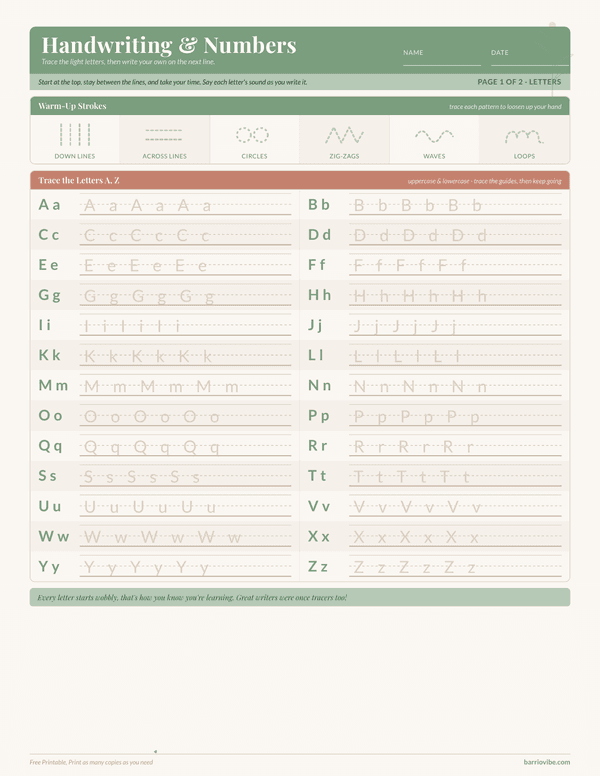
Preschool Handwriting & Numbers Worksheet, Free Printable
A free printable preschool handwriting worksheet with dotted guide lines for tracing uppercase and lowercase letters, numbers 1-10, and first words, plus warm-up strokes and count-and-write practice.
How much time should a kindergartner spend on worksheets each day?
About ten to fifteen minutes a day is plenty for a kindergartner. At five and six, sustained focus is still short, a good rule of thumb is roughly the child's age in minutes plus a few, so one or two pages is the right dose, not a full workbook sitting. Longer stretches usually backfire: the writing gets sloppier, frustration climbs, and your child starts associating worksheets with feeling bad at them. Pick a consistent time when they are rested and fed; mid-morning or right after an afternoon snack works far better than the tired end of the day. Do a page or two, then stop while they still feel successful, and praise the effort rather than the neatness of the letters. Short and positive beats long and forced every single time. If your child asks to keep going, wonderful, but let that be their choice, not your requirement. At this age you are building a habit and a good feeling around learning.
How do you make free kindergarten worksheets fun enough to finish?
Turn the worksheet into an activity instead of a test, and finishing stops being a fight. The single easiest trick: slip the printed page into a reusable dry-erase sleeve so your child can write with a bright marker and wipe it clean to try again. Kids will happily trace the same letters five times over when they get to erase and reset, and you only print the sheet once. A set of inexpensive dry-erase pockets and a few fine-tip markers turns a plain stack of paper into a wipe-clean workbook that lasts all year. Beyond that, let them pick the marker color, add a sticker when a page is done, or race a two-minute timer on the tracing rows. Sit down and do a page yourself, modeling makes it feel shared, not assigned. Keep corrections light; at this age, enthusiasm matters far more than perfect penmanship. A worksheet your child looks forward to is the one that actually gets finished.
Kindergarten worksheets vs. preschool worksheets, what's the difference?
Kindergarten worksheets ask a child to produce, while preschool worksheets mostly ask them to explore. Preschool pages lean on pre-writing strokes, matching, coloring, and recognizing shapes and letters, pure readiness. Kindergarten pages step up to actually forming letters and numbers, sounding out the beginnings of words, and simple addition within ten. If your child is still mastering a proper pencil grip or gets frustrated the moment they trace, it is worth starting a rung lower: our free preschool worksheets ease into the same skills with far less writing demand. Once letters and numbers feel comfortable, you can layer in early math, our free printable math worksheets carry the counting foundation into simple sums and number lines. There is no strict cutoff by age; match the worksheet to what your child can manage with a little effort but not total struggle. Meeting them at exactly the right level is what keeps practice feeling like a win.
How do you print and reuse kindergarten worksheets at home?
Print one master copy and make it reusable rather than printing fresh pages every day. A home printer and standard letter paper are all you need, no laminator, no special supplies. A few small habits make that one sheet last for months:
- Set your printer to "actual size" or 100% so the tracing lines stay scaled for small hands.
- Slide the page into a dry-erase sleeve or clear sheet protector so your child can write, wipe, and repeat.
- Keep the current week's sheets on a clipboard or in a folder so practice starts without a hunt for supplies.
- Save a few finished paper copies in a binder, it becomes a keepsake of how their handwriting grows.
Download the tracing worksheet below, print a copy, and slip it into a sleeve. That single sheet can carry your kindergartner through months of letter and number practice without another trip back to the printer.
Preschool Handwriting & Numbers Worksheet, Free Printable
A free printable preschool handwriting worksheet with dotted guide lines for tracing uppercase and lowercase letters, numbers 1-10, and first words, plus warm-up strokes and count-and-write practice.
Free printable worksheets will not teach your child on their own, you will, in those unhurried minutes side by side at the table. But the right sheet removes every excuse not to start: nothing to buy, nothing to search for, nothing to lose. Keep the sessions short, keep them positive, and let your kindergartner set the pace. Fifteen calm minutes a day adds up to real, visible progress by the end of the year, one carefully traced letter at a time.
Frequently Asked Questions
What worksheets should a kindergartner be doing?
A kindergartner should practice letter formation, number writing from 0 to 10, early phonics like matching letters to beginning sounds, fine-motor tracing, and simple patterns. Rotate these skills across the week instead of drilling one. Dotted tracing sheets are the best starting point because they build handwriting control before blank-page writing.
Are printable worksheets good for kindergarten?
Yes. Free printable worksheets are ideal for kindergarten when kept short and used consistently, because a five-year-old only needs a page or two a day. Printables cost nothing, let you reprint the pages your child needs most, and can be slipped into a dry-erase sleeve so one sheet is reused many times.
How many worksheets should a kindergartener do a day?
One or two pages a day, about ten to fifteen minutes total, is plenty for a kindergartener. Focus fades quickly at this age, so stopping while your child still feels successful matters more than page count. Short, positive sessions build a lasting habit better than long, forced ones that create resistance.
What should a child know by the end of kindergarten?
By the end of kindergarten, most children can write their own name, form upper- and lowercase letters, count and write numbers to at least 20, recognize letter sounds, and add simple numbers within ten. Steady daily practice with letters, numbers, and phonics worksheets builds each of these foundations gradually.
How do I make kindergarten worksheets reusable?
Slide a printed worksheet into a dry-erase sleeve or clear sheet protector, then let your child write with a dry-erase marker and wipe it clean to try again. This lets you print one master copy and reuse it for months, saving ink and paper while keeping practice feeling fresh.