Some links in this guide are affiliate links, if you buy through them we may earn a small commission at no extra cost to you. Here’s our disclosure.
Quick Answer
The best preschool activities for 3 year olds are simple and hands-on: play dough, sorting by color, stacking blocks, water play, sticker pages, and pretend cooking. Keep each activity short, about six to nine minutes of focus, and rotate several through the day. Download the free printable planner to keep them ready.
Some afternoons stretch out forever. Your three-year-old is bored, a little cranky, and orbiting your ankles while you try to get one thing done, and every idea you reach for either ends in tears after ninety seconds or turns into a mess you have to clean up alone. You know screen time is the easy button, and you reach for it more than you'd like to admit. It isn't that you don't want to play with your child; it's that at 3:00 on a Tuesday you are out of ideas, low on energy, and unsure what a three-year-old can even do without constant help. Pinterest makes it look effortless, but half those activities need supplies you don't own and a patience you've already spent. What you actually want is a short list of simple, low-prep things that hold a small attention span, without a craft-store run or a full-blown meltdown.
What are the best preschool activities for 3-year-olds?
The best preschool activities for 3 year olds are simple, hands-on, and open-ended, think play dough, sorting objects by color, stacking and knocking down blocks, water play, sticker pages, and pretend cooking. At this age children learn through doing, not through instructions, so the activity should invite exploration rather than a "right answer." A good rule is that the setup takes you under two minutes and uses things you already own: measuring cups, a muffin tin, pom-poms, painter's tape, a laundry basket. Rotate a handful of these so novelty does the heavy lifting. Three-year-olds crave repetition, so an activity that flopped last week may be a hit today, offer it again. Aim for a mix each day: something for the hands, something for the body, and something imaginative. When play feels easy to start and hard to "fail," your child stays with it longer and you get a rare few minutes back.
How long can a 3-year-old actually focus on one activity?
Expect about six to nine minutes of focused attention on a single activity, roughly two to three minutes per year of age, and far less if the task is too hard or too easy. That short window is normal, not a sign something is wrong, and it's exactly why back-to-back "stations" work better than one long project. Instead of fighting for a thirty-minute stretch, plan three or four short activities you can rotate through as interest fades. When your child drifts, that's your cue to swap, not to push. You can gently stretch focus over time by sitting nearby, narrating what they're doing ("you stacked four blocks!"), and resisting the urge to take over. Independent, uninterrupted play is a skill that grows with practice. Keep sessions short and end on a high note, stopping while it's still fun makes them far more likely to come back to it tomorrow.
Which activities build the skills a 3-year-old needs most?
The activities that matter most build three things: fine motor control, language, and early independence. Fine motor skills, the small-hand strength behind holding a crayon and, later, a pencil, grow through pinching, threading, pouring, and squeezing. Play dough, stringing pasta onto a shoelace, and using kid-safe tongs to move pom-poms all count, and you can find dozens more in our guide to fine motor activities for preschoolers. Language grows through narration, picture books, and pretend play, so talk through everything and let them lead the story. Independence grows through self-serve tasks: pouring their own water, choosing between two activities, cleaning up one bin before the next comes out. You don't need a curriculum to hit all three, most simple activities quietly develop more than one skill at once. The goal at three isn't academics; it's confident little hands, growing words, and the belief that they can do things themselves.
What does a simple daily activity routine look like for a 3-year-old?
A workable daily rhythm gives a three-year-old predictability without a rigid schedule, a loose sequence of active, quiet, and creative blocks they can count on. Predictability lowers meltdowns because your child always knows roughly what's next. Here's a sample structure this free printable follows:
| Time block | Activity type | Examples |
|---|---|---|
| Morning | Active / gross motor | Dance, obstacle course, ball play |
| Late morning | Fine motor / table time | Play dough, sorting, sticker pages |
| After lunch | Quiet / calm-down | Books, puzzles, sensory bin |
| Afternoon | Creative / pretend | Kitchen play, dress-up, drawing |
| Late afternoon | Outdoor / free play | Backyard, water table, chalk |
You don't have to hit every block every day. Use it as a menu, not a mandate, pick one from each type and let your child's mood steer the rest. Print it, keep it on the fridge, and let the plan carry the mental load so you're not inventing the day from scratch.
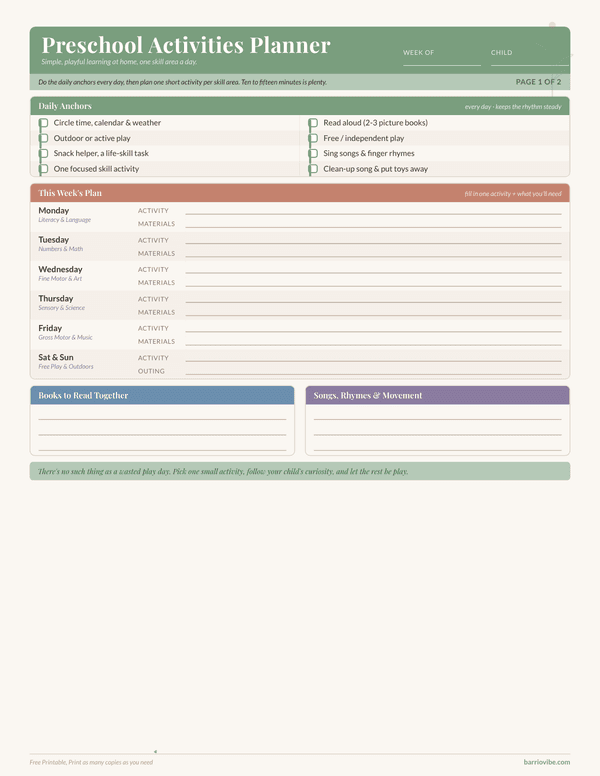
Preschool Activities Planner, Free Printable
A free printable preschool activities planner for learning at home, with a weekly plan organized by skill area plus a no-prep activity idea bank you can check off as you go.
How do you set up preschool activities at home without spending a fortune?
You almost never need to buy anything, the best preschool setup uses kitchen and recycling-bin objects, plus a simple system for keeping them ready to grab. The trick isn't more stuff; it's low friction. Build four or five "invitation to play" kits in advance so an activity is one reach away when the whining starts. A set of clear stackable storage bins makes this effortless: one bin for play dough and tools, one for sorting and threading, one for art supplies, one for sensory fillers like rice or pom-poms. Because they're clear, your child can see the options and choose, which builds independence, and cleanup becomes "everything back in its bin." Rotate two or three bins out each week and hide the rest so old toys feel new again. For a full list of no-cost ideas built from things you already own, see our 20 preschool activities to do at home. Cheap, contained, and ready, that's the whole system.
What do you do when your 3-year-old refuses the activity?
Refusal is normal, a three-year-old is testing independence, not rejecting you, so the fix is usually offering control, not more convincing. Start by giving a small choice: "Do you want the blue bin or the red bin?" A choice between two options you're happy with sidesteps the power struggle while letting them feel in charge. If they still say no, try sitting down and starting the activity yourself without inviting them; curiosity often pulls them in within a minute. Lower the bar, too, a task that's slightly too hard reads as "no fun," so simplify it on the spot. And accept that some days the answer is genuinely no, and free play or a walk outside is a perfectly good plan B. Never force it into a battle; forcing teaches them that activities mean conflict. Keep it light, keep it optional, and keep offering, consistency, not pressure, is what builds the habit of play.
Preschool Activities Planner, Free Printable
A free printable preschool activities planner for learning at home, with a weekly plan organized by skill area plus a no-prep activity idea bank you can check off as you go.
Keep the planner somewhere you'll see it, rotate a few activities at a time, and let the routine decide so you don't have to. A calmer afternoon isn't about doing more, it's about having a short, ready list of small things that little hands love.
Frequently Asked Questions
What activities should a 3-year-old be doing?
A 3-year-old benefits from hands-on play that builds fine motor, language, and independence: play dough, sorting and stacking, simple puzzles, picture books, pretend cooking, drawing, and active play like dancing or obstacle courses. Aim for a mix of active, quiet, and creative activities each day rather than academics.
How long should preschool activities last for a 3-year-old?
Plan for about six to nine minutes of focused attention per activity, roughly two to three minutes per year of age. Instead of one long project, rotate three or four short activities and swap when interest fades. Ending while it's still fun makes your child more likely to return to it.
What is the best daily routine for a 3-year-old at home?
A loose sequence works best: active or gross-motor play in the morning, fine-motor table time late morning, a quiet or calm-down block after lunch, creative pretend play in the afternoon, and outdoor free play late day. Use it as a menu, not a strict schedule, and let your child's mood steer.
How do I do preschool at home for a 3-year-old for free?
You rarely need to buy anything. Build a few grab-and-go activity kits from kitchen and recycling items, measuring cups, muffin tins, pom-poms, painter's tape, stored in clear bins. Rotate a couple of bins each week so old materials feel new, and let your child choose between two options to build independence.
What do I do when my 3-year-old won't do the activity?
Offer a small choice between two options you're happy with, which sidesteps the power struggle. If they still refuse, start the activity yourself without inviting them, curiosity often pulls them in. Simplify anything too hard, and accept that some days free play or a walk outside is a perfectly good plan B.