Some links in this guide are affiliate links, if you buy through them we may earn a small commission at no extra cost to you. Here’s our disclosure.
Quick Answer
Preschool activity printables are single-page, at-home learning pages like tracing, counting, matching, and coloring. To make an activity book, sort them into four skill areas (fine motor, literacy, math, and creativity), protect each page in a sheet protector, bind them in a slim binder, and add a weekly planner so every day has one balanced, low-prep activity.
You printed the alphabet tracing pages, the counting mats, and the scissor-skills sheets, and now they live in a lopsided stack on the kitchen counter, half of them already crayoned on the back. Every morning your three- or four-year-old asks what you're doing today, and you're the one flipping through loose pages trying to decide on the spot. Some days you land on something that holds their attention for a solid twenty minutes; other days everything you pull out gets pushed away in two. The pages themselves are fine. The problem is that a pile of paper is not a plan, and choosing fresh every single morning is quietly exhausting. Without a system, good activities get buried, the same three favorites get overused, and whole skill areas go weeks without a single page. And the low-grade guilt that tags along, the nagging sense you should be doing more, and doing it more consistently, often weighs heavier than the actual mess on the counter. What preschoolers actually thrive on is gentle structure, the steady, predictable rhythm that makes learning feel like play instead of a scramble.
What are preschool activity printables, and how do they become an activity book?
Preschool activity printables are single-page, at-home learning pages, tracing lines, counting mats, matching games, cutting strips, coloring sheets, that a child can finish in just a few minutes each. On their own they are a loose stack; an activity book is what you get when you organize them into a bound, reusable collection with a plan behind it. Turning the pile into a book does three things at once: it groups pages by skill so nothing gets skipped, it protects them so they survive repeated use, and it pairs them with a simple weekly planner so you are not deciding on the spot every morning. Think of the printables as the ingredients and the book as the recipe that arranges them into something you can actually cook from. You do not need fancy or expensive pages, either, a handful of good, varied printables organized well beats a hundred loose sheets you can never find when you need them.
How do you organize a preschool activity book by skill area?
Organize a preschool activity book by developmental skill area, not by theme or by the random order you happened to print things. Preschoolers grow across several domains at the same time, and sorting pages this way makes it instantly obvious when one area is getting all your attention and another is being ignored for weeks. The four core skill areas to build sections around are: fine motor (tracing, cutting, lacing, dot markers), early literacy (letters, sounds, name practice), early math (counting, sorting, shapes, patterns), and creativity plus problem-solving (open-ended drawing, mazes, memory matching). Give each section its own tab or colored divider so both you and your child can find it in seconds. When every skill area has a clear home in the book, planning a balanced week becomes as simple as pulling one page from each section. It also turns an overwhelming stack into something a four-year-old can help manage, which quietly builds independence and models everyday organization right alongside the skills themselves.
Which activities belong in a preschool activity book?
The best preschool activity book is built from a small, rotating set of preschool activity printables that cover all four skill areas, not dozens of one-time pages. You do not need endless variety; you need a handful per area that stay interesting through repetition. Here is a simple starting lineup, organized the way the planner in this set is:
| Skill area | Sample activities |
|---|---|
| Fine motor | Tracing lines, scissor-skills strips, dot-marker pages, lacing cards |
| Early literacy | Letter tracing, name practice, beginning-sound matching, picture-to-word |
| Early math | Counting mats, number tracing, shape sorting, simple patterns |
| Creativity & problem-solving | Open drawing prompts, coloring pages, easy mazes, memory matching |
Rotate two or three pages from each area per week so the book always feels fresh without printing anything new. Keep a short idea-bank checklist at the very front where you can jot down the activities your child loved and asks to do again, those favorites are worth repeating far more often than most parents expect, because repetition is how young children build real mastery.
How do you make a preschool activity book at home, step by step?
Making a preschool activity book at home takes about thirty minutes and a few supplies you probably already own. Start by gathering every printable you've collected, even the ones already scribbled on one side, and sorting them into the four skill areas. Then work through these five steps:
- Print two or three activities per skill area to start, quality over quantity always wins here.
- Sort the pages into sections and add a labeled divider or tab for each skill.
- Protect each page in a clear sheet protector, or laminate it, so it survives daily handling.
- Bind everything in a slim three-ring binder, or thread binder rings through a hole-punched corner.
- Add the planner at the front so every week has a simple, visible plan you fill in once.
If you're short on time, do steps one through four once and simply top up the sections later, the book itself only has to be built a single time. The planner page is what turns a binder of pages into a genuine routine: it lets you slot one activity per skill area into each day, check off what you finished, and see the whole week at a glance. Print it, fill it in on Sunday afternoon, and your weekday mornings stop starting with a decision you have to make while making breakfast.
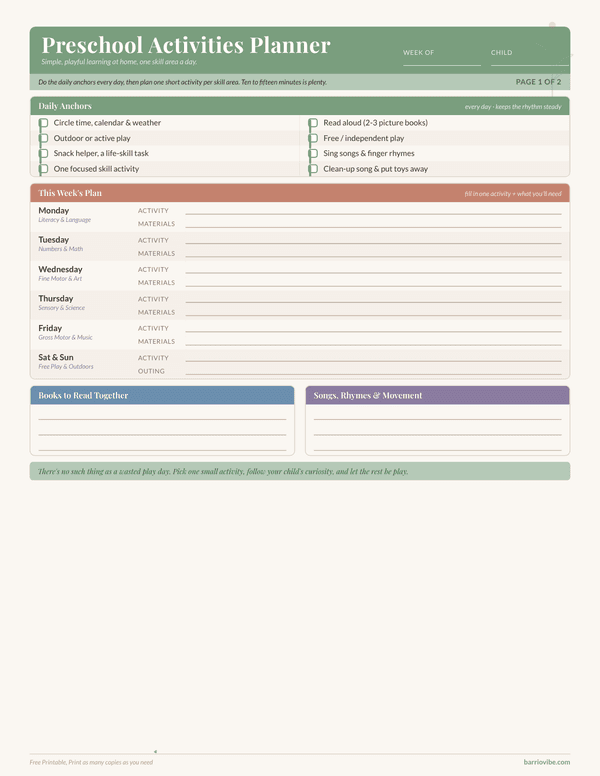
Preschool Activities Planner, Free Printable
A free printable preschool activities planner for learning at home, with a weekly plan organized by skill area plus a no-prep activity idea bank you can check off as you go.
How do you keep a preschool activity book reusable and low-prep?
Keep the book reusable by making every page wipeable, so a single printable lasts for months instead of one sitting. The easiest way is to slide each activity into a dry-erase pocket or a plain sheet protector and hand your child a washable dry-erase marker, tracing, counting, and matching pages can be wiped clean and done again the very next day. A set of reusable dry-erase pockets is inexpensive, dramatically cuts how much you reprint, and clears out the paper clutter that made the loose-stack system so frustrating in the first place. Store the markers in a small zip pouch clipped inside the binder so supplies never wander off mid-activity. Keep prep genuinely low by refreshing the book in small batches, swap two or three pages each week rather than rebuilding the whole thing. For more hands-on, no-print ideas to mix in between pages, our 20 preschool activities to do at home list pairs perfectly with the wipeable book.
How much time should preschool activities take each day?
Aim for short, focused sessions, about ten to twenty minutes a day is plenty for most preschoolers. Little ones learn in bursts, and a calm ten minutes with a tracing page they genuinely enjoy beats a forced half-hour that ends in tears and a shoved-away binder. The goal of a daily activity is not to fill time; it is to build a gentle, repeatable habit around one or two skills. Follow your child's lead: on high-energy days, lean on fine-motor and movement-friendly pages; on quieter afternoons, reach for coloring or counting work. If attention fades early, simply stop, the book will still be there tomorrow, and ending on a good note keeps them wanting to come back. Building strength in little hands pays off across every other skill, so it helps to weave in dedicated fine motor activities for little hands alongside the printed pages, then track it all on the weekly planner. Consistency, not length, is what turns these short daily sessions into real, lasting progress.
Preschool Activities Planner, Free Printable
A free printable preschool activities planner for learning at home, with a weekly plan organized by skill area plus a no-prep activity idea bank you can check off as you go.
Organize the pages once, plan the week on a single sheet, and your preschooler gets a steady rhythm of play-based learning, without you deciding what to do every single morning. Keep the planner on the fridge, check off each day you manage, and let the book carry the routine so you don't have to. A few good pages, sorted by skill and protected for reuse, will always outlast a pile of loose worksheets, and they give your preschooler exactly the kind of calm, predictable, low-pressure learning time that little ones grow on best. You build the system once; after that, it simply runs.
Frequently Asked Questions
What should be in a preschool activity book?
A good preschool activity book covers four skill areas: fine motor (tracing, cutting, lacing), early literacy (letters, sounds, name practice), early math (counting, shapes, patterns), and creativity (drawing, mazes, matching). Include two or three pages per area plus a weekly planner, and rotate favorites so the book stays fresh.
What age is a preschool activity book best for?
Preschool activity books work best for children roughly three to five years old, though many pages suit curious two-year-olds and pre-kindergarten kids too. Choose pages that match your child's current stage, simple tracing and counting for younger preschoolers, early letters and patterns as they grow, and adjust the mix as skills develop.
How do I make preschool printables reusable?
Slide each printable into a dry-erase pocket or a plain sheet protector and use a washable dry-erase marker, so tracing, counting, and matching pages wipe clean and can be repeated daily. Laminating works too. This turns one printed page into months of practice and cuts down on both reprinting and paper clutter.
How long should preschool learning activities last each day?
Aim for about ten to twenty minutes a day. Preschoolers learn in short bursts, so a calm ten minutes with a page they enjoy beats a forced half-hour. Follow your child's lead, stop when attention fades, and let consistency, not length, drive real, lasting progress over time.
Are printable activities good for preschoolers?
Yes, when used in short, play-based sessions. Printable activities build fine-motor control, letter and number recognition, and problem-solving while giving your day a predictable rhythm. Balance them with hands-on play and movement, keep sessions brief and pressure-free, and rotate pages by skill area so learning stays varied and engaging.