Some links in this guide are affiliate links, if you buy through them we may earn a small commission at no extra cost to you. Here’s our disclosure.
Quick Answer
A Christmas dinner meal plan maps out your menu by course, guest count, a make-ahead timeline, a shopping list, and a day-of oven schedule. Start about three weeks ahead, prep sauces and sides early, and use a written oven plan so every dish stays hot at the same time.
Every year it sneaks up the same way. You mean to plan Christmas dinner early, and then suddenly it's December 23rd, the fridge is full but nothing is actually a meal, and you're standing in the kitchen doing oven math in your head, trying to figure out how a turkey, a casserole, and a tray of rolls are all supposed to bake at three different temperatures at the same time. The sides go cold while the bird finishes. Someone asks when you're eating and you genuinely don't know. You spend the one day you hoped to enjoy sweating over timing instead of sitting down with the people you cooked for. It isn't that you can't cook a beautiful meal, you clearly can. The problem is that the whole thing lives in your head, unwritten, until the pressure hits all at once. There is a calmer way to do this.
What should a Christmas dinner meal plan include?
A complete Christmas dinner meal plan includes five things: your full menu organized by course, a firm guest count, a make-ahead timeline, a consolidated shopping list, and an hour-by-hour oven schedule for the day itself. Most holiday stress comes from keeping all five of those in your head at once, where they compete for attention and nothing feels finished. Writing them down turns a vague sense of "so much to do" into a short list of specific, checkable tasks. The menu tells you what you're making. The guest count tells you how much. The timeline tells you when to start each item so nothing is left until Christmas morning. The shopping list keeps you from three separate store trips. And the oven schedule, the piece people skip, is what keeps every dish hot at the same moment. Together they turn hosting from an anxious scramble into something that runs on paper. Think of the plan less as a to-do list and more as a set of decisions you make once, calmly, in November, so the version of you standing in a hot kitchen on the 25th doesn't have to make a single one of them under pressure.
How far ahead should you start planning Christmas dinner?
Start your Christmas dinner meal plan about three weeks out, then work backward in small stages so nothing lands all at once. Three weeks is enough time to lock the menu and order anything special, a fresh turkey, a ham, a specific roast, before stores sell out. From there, the work spreads into calm, bite-sized steps instead of one frantic weekend. Here's the countdown this free printable follows:
| When | What to do |
|---|---|
| 3 weeks out | Finalize the menu and guest count; order the turkey or roast |
| 2 weeks out | Build the full shopping list; buy non-perishables and freezer items |
| 1 week out | Buy fresh produce and dairy; prep a written oven schedule |
| 2 days out | Make sauces, doughs, and anything that keeps; thaw the turkey |
| Christmas Eve | Set the table, chop vegetables, assemble make-ahead casseroles |
| Christmas Day | Cook to the oven schedule; reheat make-aheads; relax |
Spreading the work across three weeks means Christmas Day itself is mostly assembly and timing, not cooking everything from scratch while guests arrive. Each stage is short enough to fit around normal life, so you're never sacrificing a full day, and nothing critical gets left until it's too late to fix.
What's the ideal Christmas dinner menu, course by course?
The ideal Christmas dinner menu is built course by course so you can balance effort and avoid five dishes that all need the oven at once. A classic, crowd-pleasing structure looks like this:
- Appetizers: something light that holds, a cheese board, marinated olives, or a warm dip guests can graze on while the main cooks.
- The centerpiece: one showstopper protein, roast turkey, glazed ham, or a beef roast, that anchors the meal.
- Starchy sides: mashed potatoes, stuffing or dressing, and dinner rolls; these are the make-ahead-friendly heavy hitters.
- Vegetable sides: roasted Brussels sprouts, green beans, or honey-glazed carrots for color and freshness.
- Sauces: gravy and cranberry sauce, both of which keep beautifully when made in advance.
- Dessert: pie, a trifle, or cookies, ideally made a day ahead so the oven is free.
Aim for one centerpiece, two or three starches, two vegetables, and one or two desserts. Resist the urge to add a dish for every request; a tight menu you can execute calmly beats a sprawling one that leaves you frazzled. Writing the menu down first is what makes every later step, shopping, timing, prep, fall into place.
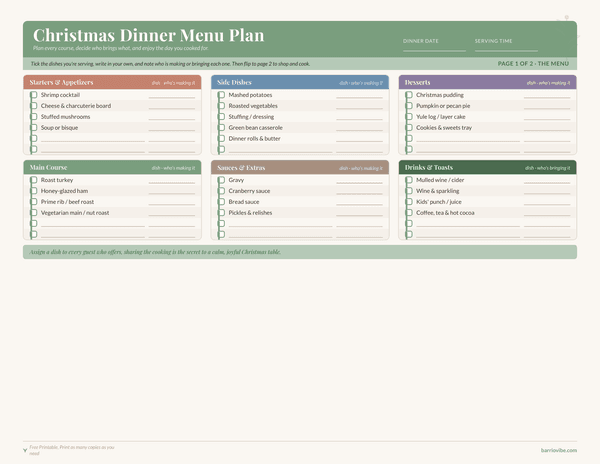
Christmas Dinner Meal Plan, Free Printable
A free printable Christmas dinner meal plan to organize your holiday menu by course, track your guest count, build a by-section shopping list, and follow a make-ahead cooking timeline so nothing is left to the last minute.
How much food should you make per guest?
Plan for roughly one to one-and-a-half pounds of turkey per person, and about a cup of each side dish per guest, then round up so no one leaves hungry and you have leftovers you'll actually want. Portioning is where a guest count earns its keep: without it, you either run short mid-meal or cook double what anyone eats. Use these simple per-person benchmarks as a starting point:
- Turkey or ham: 1 to 1.5 lbs per person (bone-in weight)
- Mashed potatoes: about 1/2 to 3/4 cup per person
- Stuffing: roughly 3/4 cup per person
- Vegetables: about 1/2 cup of each per person
- Gravy: 1/4 to 1/3 cup per person
- Dessert: plan 1.5 slices per person across all desserts
Add a small buffer if your crowd includes big eaters, teenagers, or you want deliberate leftovers for turkey sandwiches the next day. If kids make up part of the count, plan them at roughly half an adult portion. Note the final numbers on your plan so your shopping list scales straight from the guest count instead of guesswork.
How do you cook everything and still enjoy the day?
The secret to a relaxed Christmas Day is making the oven schedule before you cook anything, and moving as much as possible off the day itself. Write out every dish with its temperature, cook time, and the clock time it needs to go in, working backward from when you want to eat. You'll immediately spot the traffic jams: three dishes wanting 375°F at 2 p.m. Solve them by staggering, using the stovetop or slow cooker for a side, or serving something at room temperature. Make-ahead is your best friend: sauces, doughs, and assembled casseroles done two days early free up both the oven and your attention. Keeping finished sides warm and organized is easier with a set of oven-to-table serving dishes with lids, they go from oven to table to fridge without repotting. Delegate too: assign a side or the drinks to a guest who offers, and let the appetizers be things nobody has to cook. If you meal plan the rest of your week too, our guide on how to meal plan for the week uses the same write-it-down-first approach.
What should go on your Christmas dinner shopping list?
Build your Christmas dinner shopping list straight from the finished menu, organized by store section so you shop once and buy everything in a single pass. Go dish by dish and list every ingredient, then group them: produce, meat and seafood, dairy and eggs, baking and pantry, frozen, and drinks. This grouping is what prevents the classic holiday mistake, getting home, starting to cook, and realizing you're out of butter or short one can of broth. Split the buying across two trips: non-perishables and frozen items two weeks out while stores are calmer, then fresh produce, dairy, and bread in the final few days. Don't forget the easy-to-miss extras that derail a meal when they run out: foil, parchment, butter, food storage containers for leftovers, coffee and cream for after dinner, and ice. Keep a running "already have it" column so you don't rebuy staples you're actually stocked on. For a reusable by-aisle format that makes this even faster, pair this plan with our free grocery list template. A written list is the difference between one calm trip and three frantic ones.
Christmas Dinner Meal Plan, Free Printable
A free printable Christmas dinner meal plan to organize your holiday menu by course, track your guest count, build a by-section shopping list, and follow a make-ahead cooking timeline so nothing is left to the last minute.
Print the plan, fill in your menu and guest count, and let the timeline carry you from three weeks out to a Christmas dinner you actually get to sit down and enjoy.
Frequently Asked Questions
How far in advance should I plan Christmas dinner?
Start about three weeks out. That gives you time to lock the menu and order a turkey or roast before stores sell out, then spread shopping, prep, and make-ahead cooking across smaller stages so Christmas Day is mostly assembly and timing rather than cooking everything at once.
How much turkey do I need per person for Christmas dinner?
Plan for roughly 1 to 1.5 pounds of bone-in turkey per person. Round up if your crowd has big eaters or you want leftovers for sandwiches. For a boneless roast, about half a pound per person is plenty since there is no bone weight.
What can I make ahead for Christmas dinner?
Make sauces, gravy, cranberry sauce, doughs, and assembled casseroles up to two days ahead, and bake most desserts the day before. Chopping vegetables and setting the table on Christmas Eve frees the oven and your attention for the centerpiece on the day itself.
How do I keep everything hot at the same time?
Write an oven schedule before you cook: list each dish with its temperature, cook time, and the clock time it goes in, working backward from your serving time. Stagger dishes, use the stovetop or slow cooker for sides, and keep finished dishes warm in a low oven.
Do I have to print a new Christmas dinner plan every year?
No. Print one copy and slip it into a sheet protector to reuse with a dry-erase marker, or save your filled-in plan and reprint it next year with small tweaks. Keeping last year's plan makes portions and timing even easier the second time around.