Some links in this guide are affiliate links, if you buy through them we may earn a small commission at no extra cost to you. Here’s our disclosure.
Quick Answer
The best fridge organizer ideas group food into fixed zones and use clear, labeled bins so nothing gets lost. Put leftovers and ready-to-eat foods up top, dairy in the middle, raw meat on the coldest bottom shelf, produce in humidity-controlled drawers, and condiments in the door. Download the free printable labels to make it stick.
You open the fridge to put away groceries and there is nowhere for anything to go. Yogurt cups are wedged behind a forgotten jar of salsa, the produce drawer is a graveyard of slimy greens, and last night's leftovers have vanished into the back where they will quietly turn into a science project. Every trip becomes a small excavation, and somehow you keep buying things you already own because you cannot see them. It is not that you are messy. A fridge is one of the only storage spaces in your home with no shelves you chose, no labels, and a cold, humming pressure to just shove things in and shut the door. Without a system, it drifts back to chaos within a week no matter how good your intentions are. The good news: a fridge is small, contained, and fixable in a single afternoon, once you stop organizing by habit and start organizing by zone. You do not need a bigger refrigerator or a cart full of matching containers. You need a plan for where each kind of food belongs and a way to make that plan visible to everyone who opens the door.
What are the best fridge organizer ideas that actually last?
The best fridge organizer ideas group foods into fixed zones and use clear bins so everything has a home you can actually see. Start by giving each type of food a dedicated spot: a bin for dairy, one for produce, one for leftovers, and one for grab-and-go snacks. Clear containers matter because visibility is what prevents forgotten food and duplicate buys, if you can see the strawberries, you eat the strawberries. Add labels so the system survives other people in the house, not just you. Then follow one rule that makes the whole thing stick: the temperature map. Cold air pools at the bottom and near the back, so raw meat goes low, ready-to-eat foods go up top, and condiments live in the door where it is warmest. Zones plus bins plus labels is the trio that turns a one-time cleanout into a system that holds for months, not days.
How should you zone a refrigerator so nothing gets lost?
Zone a refrigerator by temperature and by how you actually use each food, top shelf down to the drawers. The upper shelves hold the steadiest temperature, so they suit leftovers, drinks, and ready-to-eat foods. Middle shelves are ideal for dairy and eggs. The bottom shelf is the coldest zone and the safest spot for raw meat, where drips cannot contaminate anything below. Drawers control humidity for produce, and the door, the warmest area, is for condiments and other shelf-stable-ish items, never milk. Here is the zone map this free printable follows:
| Zone | What lives here | Why |
|---|---|---|
| Top shelf | Leftovers, drinks, ready-to-eat | Most stable temperature |
| Middle shelf | Dairy, eggs, spreads | Consistent cold, easy reach |
| Bottom shelf | Raw meat, thawing items | Coldest; drips stay contained |
| Crisper drawers | Fruits and vegetables | Adjustable humidity |
| Door | Condiments, juice, butter | Warmest; only for hardy items |
Assign a bin or a labeled section to each zone and the guesswork disappears, everyone in the house knows where things go and where to find them.
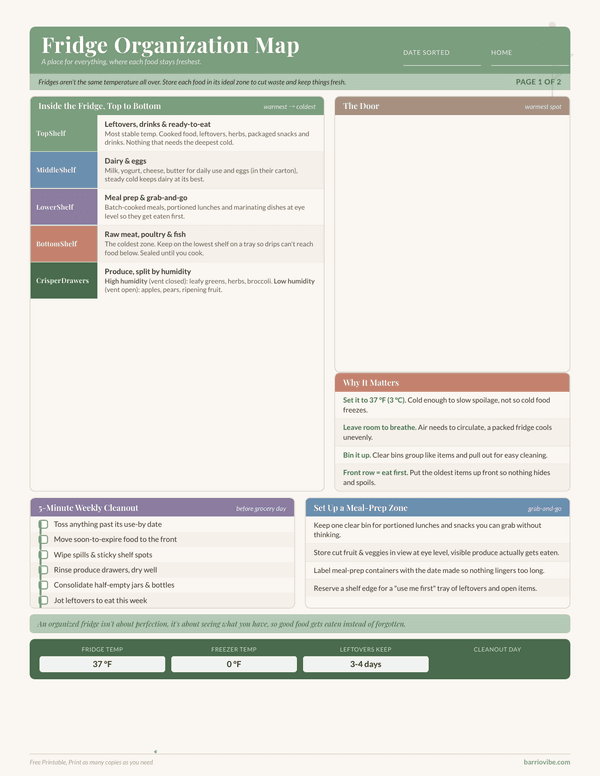
Fridge Organization Labels + Map, Free Printable
A free printable fridge organization set with a shelf-by-shelf zone map showing where each food stays freshest, plus cut-out bin labels for dairy, produce, leftovers, meal prep and more. Includes a leftovers tracker so nothing gets forgotten.
Which bins and containers actually work for fridge organization?
Clear, stackable bins are the single most effective tool for fridge organization because they turn loose, tumbling items into tidy, pull-out sections. Look for a set of clear plastic or acrylic fridge storage bins in a few sizes: narrow ones for cans and bottles, wide shallow ones for packaged deli meats and cheese, and a tall one for tumble-prone produce like peppers. A small lazy Susan tames the condiment corner and spins tall bottles into reach instead of knocking them over. Bins with handles let you pull the whole zone out to grab what is buried in back, the number-one cause of forgotten food. A starter set that covers most fridges looks like this:
- 2 wide, shallow bins, deli meats, cheese, and packaged snacks
- 2 tall bins with handles, yogurt cups, condiment refills, tumble-prone produce
- 1 narrow bin, cans and bottled drinks lined up single-file
- 1 lazy Susan, the condiment or sauce corner
Measure your shelf depth and height before you buy, because a bin that does not fit is just a new form of clutter. You do not need a matching designer set to start; even a few inexpensive clear bins from a dollar store will transform how a shelf functions.
How do you organize the fridge door and crisper drawers?
Organize the door for hardy, frequently grabbed items and the crisper drawers by humidity, since these two zones spoil the most food when misused. The door is the warmest part of the fridge, so it is the wrong place for milk and eggs despite the molded shelves many models include, reserve it for condiments, juice, butter, and dressings that tolerate temperature swings. Group like with like: all the mustards together, salad dressings in one row, so you stop buying a third bottle of the same thing. For crisper drawers, use the humidity slider deliberately: high humidity (vents closed) keeps leafy greens and herbs crisp, while low humidity (vents open) suits fruits and anything that rots fast, like berries and mushrooms. Line drawers with a paper towel or a reusable liner to wick moisture and slow spoilage. Label one drawer "eat first" for produce on its last days so nothing quietly dies in the back.
How do you keep a fridge organized so it doesn't slide back into chaos?
Keep a fridge organized by building two small habits: a weekly "eat first" sweep and a fixed home for every category. Before each grocery trip, pull anything nearing its end to a labeled front-and-center bin, and plan a meal or two around it, this alone erases most household food waste and frees the space you are about to fill. Then honor the zones every time you unload groceries instead of shoving items into the first gap. Labels do the heavy lifting here, especially in a shared kitchen: when the bins are marked, other people put things back correctly without being told. Wipe spills the day they happen so nothing crusts on. When you do restock, run the same five-minute reset every time:
- Pull expired and questionable items and toss them.
- Move soon-to-expire food to the front "eat first" bin.
- Wipe the one shelf that needs it.
- Slot new groceries into their labeled zones, oldest in front.
- Note anything running low for the next list.
If you want the same low-effort system extended to a tiny kitchen, our guide to small fridge organization with bins shows how to zone a compact fridge without wasting an inch. Ten seconds of putting-away discipline per item is what keeps the whole thing from unraveling.
How often should you reset and clean out your fridge?
Do a quick edit weekly and a full reset monthly to keep your fridge organizer ideas working long-term. The weekly edit is fast: toss anything expired, wipe the shelf where the inevitable spill happened, and move soon-to-expire food to the "eat first" zone before you restock. The monthly reset is the deeper one, pull everything out, wash the shelves and bins with warm soapy water, check expiration dates across the board, and re-sort each item back into its labeled zone. This is also the moment to notice patterns: if the leftovers bin is always overflowing, you are cooking too much; if greens keep dying, your crisper humidity is wrong. A clean, zoned fridge is not a once-a-year deep-clean project, it is a fifteen-minute rhythm that rides along with your grocery routine. If you want to fold this into a broader budget-friendly refresh, these fridge organization ideas on a dollar-store budget show how far a few labels and bins really go.
Fridge Organization Labels + Map, Free Printable
A free printable fridge organization set with a shelf-by-shelf zone map showing where each food stays freshest, plus cut-out bin labels for dairy, produce, leftovers, meal prep and more. Includes a leftovers tracker so nothing gets forgotten.
Print the labels, zone your shelves once, and let the map do the deciding every time you unload groceries. A fridge you can actually see into is a fridge that wastes less food, costs less at the store, and stops eating your time one drawer at a time.
Frequently Asked Questions
How do I organize my fridge by zone?
Organize by temperature: keep leftovers and ready-to-eat foods on the top shelf, dairy and eggs in the middle, and raw meat on the coldest bottom shelf. Store produce in the humidity-controlled crisper drawers and put condiments in the warmer door, never milk.
Where should milk go in the fridge?
Store milk on a middle or lower shelf toward the back, where the temperature is coldest and most stable. Avoid the door despite the molded shelf many fridges have there, because the door is the warmest zone and milk spoils faster in the temperature swings from opening it.
What are the best bins for fridge organization?
Clear, stackable bins in a few sizes work best: wide shallow bins for deli meats and cheese, tall handled bins for tumble-prone produce, narrow bins for cans, and a lazy Susan for condiments. Measure your shelf depth and height first so every bin actually fits.
How do I stop wasting food in the fridge?
Create a labeled 'eat first' bin and move soon-to-expire items there before every grocery trip, then plan a meal or two around them. Using clear bins so you can see what you have, and keeping food in consistent zones, prevents both forgotten leftovers and duplicate purchases.
How often should I clean out my fridge?
Do a quick weekly edit, tossing expired items and wiping spills, plus a deeper monthly reset. For the monthly reset, remove everything, wash shelves and bins in warm soapy water, check all expiration dates, and re-sort each item back into its labeled zone.