Some links in this guide are affiliate links, if you buy through them we may earn a small commission at no extra cost to you. Here’s our disclosure.
Quick Answer
The best storage ideas for a small space use vertical and hidden room before floor space: go up with shelves, hooks, and over-door racks, claim under-bed and above-toilet gaps, and choose furniture that stores. Declutter first, then contain what's left in clear, labeled, stackable bins. Download the free printable plan to work zone by zone.
You've measured the closet twice, stood in the middle of the room holding a full laundry basket with nowhere to set it down, and wondered where all of it is supposed to go. In a small home, every purchase, every gift, and every "I'll deal with it later" pile competes for the same few square feet, and there is no spare room to absorb the overflow. The frustrating part is that you are not messy. You simply own more than the space was built to hold, and the usual advice ("just add a shelf!") assumes a bare wall you do not have to spare. So the clutter creeps back onto the counter, the floor of the closet, and the top of the dresser, the same three spots, over and over. Before you buy one more bin or bookcase, it helps to see where the hidden capacity in your home actually is, and how to claim it without shrinking the room.
What are the best storage ideas for small spaces?
The best storage ideas for small spaces share one principle: use vertical and hidden space before you ever touch the floor. Floor space is what makes a room feel cramped, so the goal is to lift storage up and tuck it out of the walking path. Start by going vertical, tall shelving, over-door racks, and wall hooks turn empty wall height into real, usable capacity. Then claim the dead zones most people ignore: under the bed, above the toilet, inside cabinet doors, and the gap on top of the fridge or wardrobe. Finally, make your furniture do double duty with storage ottomans, beds with built-in drawers, and benches that open. The reason these storage ideas for small space work so reliably is that they add capacity without stealing your walkable floor, which is the thing that actually makes a room feel bigger. A studio apartment and a three-bedroom house with tiny closets follow the exact same rule: build up and back, not out, and edit before you add.
Where can you find hidden storage in a small home?
Look up, under, and behind, most small homes hold far more unused space than they appear to. The eye reads a room as "full" the moment the floor and countertops are covered, but the vertical cubic footage above waist height is usually wide open and wasted. Above door frames, mount a slim shelf for books or baskets. On the backs of doors, hang over-the-door organizers for shoes, cleaning supplies, or pantry goods. Under the bed, low rolling bins swallow off-season clothes and spare linens. Inside cabinet and closet doors, adhesive racks hold foil, pot lids, or hair tools. Even the stair risers, the side of a nightstand, and the wall above the washer can carry a rail or a narrow shelf. A good rule is to store the things you reach for least in the spots that are hardest to reach, high shelves, deep under-bed bins, and keep everyday items at eye level. The point is never to cram every square inch; it's to move your rarely-used belongings into this recovered space so your daily-use zones stay clear, open, and calm.
Which rooms should you tackle first in a small space?
Start with the room where clutter costs you the most time each day, usually the kitchen, bathroom, or entryway, then work outward one zone at a time. Tackling a single zone from start to finish keeps a small-space project from stalling, because you get a visible, finished win before moving on, and that win fuels the next one. Here's a simple order and the highest-impact storage move for each zone:
| Zone | Start here | High-impact storage move |
|---|---|---|
| Kitchen | Counters | Wall rail for utensils; shelf risers inside cabinets |
| Bathroom | Under the sink | Stacking bins plus an over-the-toilet shelf |
| Entryway | Floor by the door | Wall hooks and a shoe bench that opens |
| Bedroom | Under the bed | Rolling under-bed bins for off-season clothes |
| Closet | Shelf above the rod | A second rod and slim shelf dividers |
| Living room | Surfaces | Storage ottoman and lidded baskets on a shelf |
Check off each zone as you finish so your progress stays visible and the momentum carries you all the way through the house.
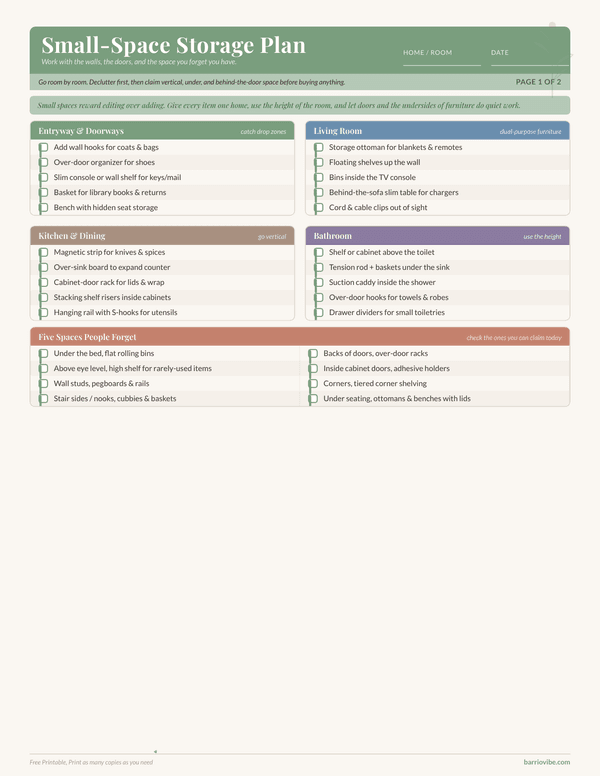
Small-Space Storage Plan, Free Printable
A free printable small-space storage plan with a room-by-room storage checklist for every part of a compact home, plus a shelf-by-shelf linen closet zone map to organize towels, sheets, and toiletries.
What storage furniture and containers actually work in tight spaces?
In tight spaces, the containers that work are the ones you can see into, stack, and label, clarity beats sheer capacity every time. A cabinet crammed with opaque bags hides what you own, so you re-buy and overflow; the fix is to make contents visible at a glance. A set of clear stackable storage bins is the single most useful thing you can buy for a small home: they turn a deep, awkward shelf into pull-out drawers, they stack to use vertical height, and they let you spot the last roll of paper towels without unpacking the whole tower. Add a few risers to double up cabinet shelves, drawer dividers to stop the junk-drawer slide, and slim uniform hangers to reclaim rod space. Choose furniture that secretly stores, an ottoman that opens, a bed frame with drawers, nesting tables that slide away when you don't need them. And label everything, because in a small home a lost item has nowhere to hide except the counter you just cleared. When you can see and reach what you own, you stop buying duplicates, which is half the battle in a tight space.
How do you keep a small space organized so it stays that way?
Match every new item with something that leaves, the one-in-one-out rule is what keeps a small space from quietly refilling. Small homes have zero slack, so organization here is not a one-time project but a flow you maintain. Give every category a defined home, and keep that home slightly under capacity so there is always room to put things away without cramming. Do a two-minute reset each night, clear the main surfaces and return the three or four stray items to their zones, so clutter never gets a foothold overnight. Once a month, walk each zone and pull anything you haven't actually used, then donate it before it settles back in. It also helps to shop with your square footage in mind: before you buy anything, decide exactly where it will live. If you can't name the spot, you don't have room for it. Keep the printable plan nearby so the daily and monthly resets stay on autopilot.
Should you buy more storage or declutter first?
Declutter first, buying storage before you edit your belongings just organizes clutter you shouldn't be keeping. In a small space, storage products are a tool, not a cure; a bin full of things you never touch still costs you the same precious square footage. Before you spend a dollar, pull everything out of the problem zone, sort ruthlessly into keep, donate, and toss, and only then measure for containers around what actually remains. You'll almost always need less storage than you assumed, and what you do buy will genuinely fit. If choosing containers feels overwhelming, our room-by-room guide to the best bins and baskets for organizing helps you pick the right size for what's left, and our free printable linen-closet organization plan shows the zone-by-zone method applied to one of the tightest storage spots in the house. Edit first, contain second, that order is what finally makes small-space storage hold.
Small-Space Storage Plan, Free Printable
A free printable small-space storage plan with a room-by-room storage checklist for every part of a compact home, plus a shelf-by-shelf linen closet zone map to organize towels, sheets, and toiletries.
Keep the plan somewhere you'll see it, work one zone at a time, and let the vertical and hidden space do the heavy lifting. A small home that finally feels roomy is built one recovered corner at a time.
Frequently Asked Questions
How do you store a lot of stuff in a small space?
Go vertical and hidden before using floor space. Add tall shelves, wall hooks, and over-door racks, then claim under-bed, above-toilet, and inside-cabinet-door zones. Decide what to keep first, then contain it in clear, labeled, stackable bins so nothing gets lost or re-bought.
How do I maximize storage in a small room?
Lift storage off the floor and let furniture do double duty. Use the wall height with shelving and hooks, add under-bed bins, and pick a storage ottoman or bed with drawers. Keep each item's home slightly under capacity so putting things away stays easy.
Should I declutter or buy storage first?
Declutter first, always. Buying bins before you edit just organizes clutter you shouldn't keep and wastes square footage. Pull everything out, sort into keep, donate, and toss, then measure and buy containers around only what remains, you'll need far less than you expected.
What is the best storage for a small apartment?
Clear stackable bins, over-door organizers, and furniture that stores. Clear bins turn deep shelves into visible pull-out drawers and use vertical height, over-door racks recover wasted door space, and a storage ottoman or bed with drawers hides bulk without adding footprint. Label everything you store.
How do I keep a small space organized long term?
Use the one-in-one-out rule and a two-minute nightly reset. Match every new item with one that leaves, give each category a defined home kept slightly under capacity, clear surfaces each night, and do a monthly zone walk to donate anything unused before it settles back in.