Some links in this guide are affiliate links, if you buy through them we may earn a small commission at no extra cost to you. Here’s our disclosure.
Quick Answer
To organize a small fridge with bins, use clear, narrow, stackable bins that turn deep shelves into pull-out drawers. Assign each zone a job, leftovers up top, dairy in the middle, meat on the bottom, produce in crispers, condiments in the door, then label each bin so items always go back home.
You open the fridge, and there it is again: the yogurt shoved behind the milk, a soft cucumber you forgot you bought, three half-jars of the same sauce, and somehow no room for the groceries you just carried in. In a small or apartment-size fridge, every inch counts, and without a system the shelves turn into a stacked-up pile where things get lost, squished, and quietly wasted. You wipe it down, reload it, and within a week it looks exactly the same. The frustrating part is that it is rarely about having too much food, it is that nothing has a home, so everything ends up wherever it fits. When items float freely on deep shelves, the back becomes a black hole and the front becomes a wall. There is a simpler way to reclaim the space you already have.
What are the best bins for organizing a small fridge?
The best bins for a small fridge are clear, narrow, and stackable, because fridge organization bins work by turning deep, hard-to-see shelves into pull-out drawers you can actually reach into. Clear plastic or acrylic bins let you see what is inside without excavating, so nothing disappears in the back. Look for bins with handles or a lip you can grip, being able to slide the whole bin out is what makes the back of the shelf usable instead of dead space. Narrow bins that group like items (yogurts in one, cheese in another, condiments in a third) stop things from tipping and spreading. Avoid oversized bins that waste the vertical gaps between shelves; in a compact fridge, several small containers almost always beat one big one. Stackable and freezer-safe options give you the most flexibility as your needs change week to week.
How do you organize a small fridge with bins, zone by zone?
Assign every shelf a job, then give each job a bin. Zoning is what keeps a small fridge from sliding back into chaos, because when categories have fixed homes you reload on autopilot instead of guessing. The trick in a compact fridge is to respect the temperature differences: the top and door are the warmest spots, the back and bottom are the coldest. Here is a simple zone-by-zone layout the free printable labels follow:
| Zone | What goes there | Bin type |
|---|---|---|
| Top shelf | Leftovers, ready-to-eat, drinks | Wide clear bin |
| Middle shelf | Dairy, eggs, yogurt | Narrow handled bins |
| Bottom shelf | Raw meat (coldest, no drips) | Deep bin with lip |
| Crisper drawers | Fruit vs. vegetables, separated | Divider or two bins |
| Door | Condiments, sauces, butter | Slim door caddies |
Match your bins to each zone and the whole fridge gets a logical flow you never have to think about again.
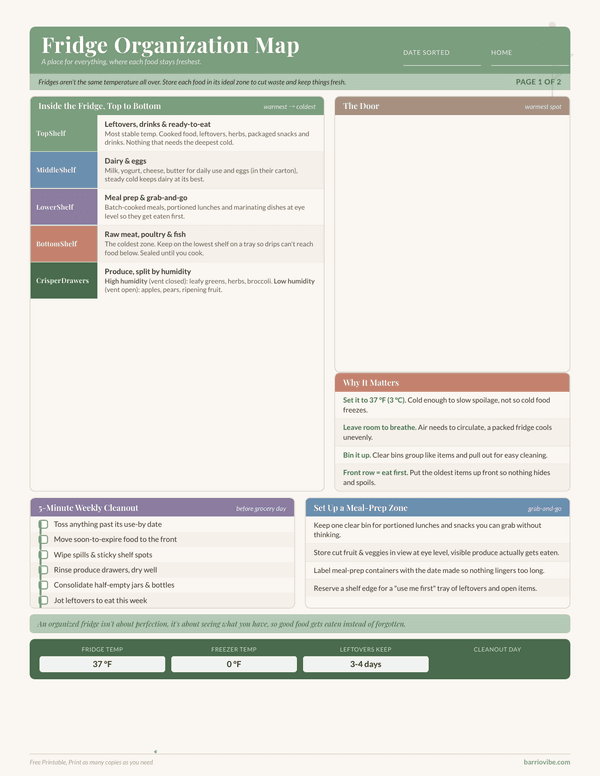
Fridge Organization Labels + Map, Free Printable
A free printable fridge organization set with a shelf-by-shelf zone map showing where each food stays freshest, plus cut-out bin labels for dairy, produce, leftovers, meal prep and more. Includes a leftovers tracker so nothing gets forgotten.
What size bins actually fit in an apartment or small fridge?
Measure before you buy, this one step prevents the most common small-fridge mistake. Compact and apartment refrigerators have shorter shelf spacing and shallower depth than standard models, so a bin that looks perfect online can leave the door unable to close or block the shelf above. Pull out a tape measure and record three numbers for each shelf: the depth (front to back), the width you want the bin to occupy, and the clear height to the shelf above. As a rule of thumb, fridge organization bins around 4 to 6 inches wide and no taller than about two-thirds of the gap above them stack and slide best in tight fridges. Choose a few different sizes rather than a matching set: a couple of narrow bins for the door and dairy, one wide bin for leftovers, and a deep bin for the bottom shelf. Mixed sizes fill awkward gaps far better than uniform boxes.
How do bins actually cut down on food waste?
Bins reduce food waste by making everything visible and giving perishables a front-and-center home, so you eat what you have before it turns. Most spoilage in a small fridge happens out of sight, the produce that rots in the back of a crowded shelf, the leftovers pushed behind a jar. A clear "eat me first" bin at the front of the top shelf gathers items nearing their date into one spot you check before cooking or ordering out. Grouping produce in a dedicated crisper bin (and keeping fruits and vegetables separate, since fruit gives off ripening gases) keeps things crisp longer. When each category has a defined amount of space, you also see at a glance when you already own three mustards, which curbs duplicate buying. Less lost food means less money thrown away, a big deal in a small kitchen. For more ways to stretch a tight budget, see our budget fridge organization guide.
What's the fastest way to set up your fridge bins?
Empty, wipe, sort, and load, in that order, and it takes about thirty minutes. Start by pulling everything out onto the counter so you are working with a clean, empty fridge; toss anything expired and wipe the shelves while you can reach them. Next, sort the food into categories on the counter: dairy, produce, leftovers, condiments, drinks. Assign each category to a bin and a zone using the layout above, then load the bins in. The step most people skip is labeling, and it is what makes the system stick for everyone in the house, when a bin says "Yogurt" or "Snacks," items get put back correctly without anyone thinking. A dedicated label maker or the free printable labels below both work; the point is that the bins announce their own purpose. For the full walkthrough with photos and product picks, our complete fridge organization ideas post covers every zone in depth.
How do you keep a bin-organized fridge from falling apart?
Keep it going with a two-minute reset tied to a habit you already have, right before grocery day works best, because the fridge is at its emptiest. Pull the front bins forward, move older items to the front, wipe any spills, and note what to use up this week. Because everything already has a home, resetting is fast: you are straightening, not reorganizing. A few habits protect the system long-term. Put groceries away by bin, not by shelf, so nothing drifts, and keep the fridge organization bins grouped by zone the way you first set them up. Do not overfill, bins need a little slack to slide, and a jammed fridge blocks airflow. Once a season, take the bins to the sink for a proper wash; clear acrylic and a pack of extra clear bins from the storage aisle make swaps easy as your groceries change. A small fridge stays organized not because you clean it more, but because the structure makes the tidy choice the easy one.
Fridge Organization Labels + Map, Free Printable
A free printable fridge organization set with a shelf-by-shelf zone map showing where each food stays freshest, plus cut-out bin labels for dairy, produce, leftovers, meal prep and more. Includes a leftovers tracker so nothing gets forgotten.
Print the labels, measure your shelves, and let fridge organization bins give every category a home. A small fridge does not need to feel cramped, it just needs a system that puts the food you have where you can actually see it.
Frequently Asked Questions
What size bins are best for a small or apartment fridge?
Measure each shelf's depth, width, and clear height first. Bins around 4 to 6 inches wide and no taller than two-thirds of the gap above stack and slide best. Choose mixed sizes, narrow bins for the door and dairy, wider bins for leftovers, rather than one uniform set.
Should fridge bins be clear or opaque?
Clear is better for a small fridge. Transparent plastic or acrylic bins let you see what is inside without pulling everything out, so nothing gets lost in the back. Opaque bins hide food and lead to more waste. Clear bins with handles let you slide the whole bin out like a drawer.
How do bins keep a small fridge organized?
Bins turn deep, hard-to-reach shelves into pull-out drawers and give every food category a fixed home. When dairy, produce, leftovers, and condiments each have a labeled bin, items get put back correctly on autopilot, the back of the shelf stays usable, and the fridge stops sliding back into chaos.
Do fridge bins really reduce food waste?
Yes. Bins make food visible and give perishables a front-and-center spot, so you eat what you have before it spoils. An 'eat me first' bin gathers items nearing their date, and grouping produce in a crisper bin keeps it fresh longer. Defined space also stops duplicate buying.
How do I keep my fridge organized after setting up bins?
Do a two-minute reset before grocery day: pull front bins forward, move older items up front, and wipe spills. Put groceries away by bin, not by shelf, and avoid overfilling so bins still slide. Because everything has a home, upkeep is straightening, not reorganizing.