Some links in this guide are affiliate links, if you buy through them we may earn a small commission at no extra cost to you. Here’s our disclosure.
Quick Answer
You can organize a fridge on a dollar-store budget for under $15: empty and wipe it out, group food into categories, then buy clear bins, a turntable, and an egg tray to fit. Zone by temperature, label each bin, and use a printable map so the whole family keeps the system running.
You bought the bins. Or you almost did, you watched the fifteen-second reels where everything lands in matching clear containers with hand-lettered labels, priced a single set of those trendy fridge organizers, and quietly closed the tab, because one bundle costs more than a week of groceries. Meanwhile your actual fridge is a graveyard of half-used condiments, a produce drawer you're a little scared of, and leftovers pushed so far back they've turned into science experiments. Every time you open the door you lose thirty seconds hunting for the thing you know is in there somewhere, and twice a month you toss food you forgot you owned. It starts to feel like getting organized means spending a fortune you don't have on a problem that already keeps costing you money. It doesn't have to. You do not need designer acrylic or a big-box shopping spree to fix this. You need a plan and about fifteen dollars.
How do you organize a fridge on a dollar-store budget?
Start with a plan, then shop, not the other way around. You can pull off a full fridge organization dollar store makeover for under $15 by emptying the fridge, wiping it down, and grouping what's left into categories before you buy a single bin. Most people overspend because they buy containers first and force their food to fit; do it in reverse and you'll know exactly how many bins you need and what size. A dollar store carries almost everything the expensive brands sell, clear plastic bins, turntables, egg trays, and can organizers, for a dollar or two apiece instead of ten or twelve. The one trick that saves a second trip is buying with measurements in hand: note the width of each shelf and the height of the gap above it, so nothing you carry home turns out to be an inch too tall to slide into place. Plan first, measure once, buy once.
Beyond the dollar store itself, the same cheap wins hide in plain sight at discount and thrift shops: shoe boxes, take-out containers, and small baskets you already own can stand in for half your bins. Save the actual dollars for the two or three clear pieces that earn their keep, the ones you'll open every day, and improvise the rest. A budget makeover isn't about buying the least; it's about buying only what genuinely fixes the mess.
What dollar-store items actually work for fridge organization?
The real workhorses are clear bins, turntables, and a couple of dividers, skip anything decorative. Clarity matters far more than looks: a set of clear plastic fridge bins lets you see what's inside without pulling everything out, which is the entire point of organizing in the first place. Here's what's genuinely worth grabbing on a budget run:
- Clear rectangular bins for grouping snacks, cheese, or meal-prep, the single best dollar you'll spend.
- A small turntable (lazy Susan) for condiments and jars so nothing disappears into the back corners.
- A can dispenser or shoe-box bin for soda, sparkling water, or yogurt cups.
- An egg holder and a butter keeper to reclaim door and shelf space.
- Binder clips or clothespins to seal open bags and clip on labels.
Avoid deep, opaque bins and anything too tall for your shelves, they just hide food in a new way. Buy two or three bins first, live with the layout for a week, then go back for more once you know what's actually working.
One more low-cost upgrade worth mentioning: cheap non-slip shelf liner or a couple of washable placemats cut to size will catch spills before they become the sticky ring you scrub for twenty minutes later. Pull the liner out, rinse it, and drop it back in, no more emptying an entire shelf to clean up one leaked jar. Little touches like that are what make a budget system feel as polished as the expensive ones.
How should you zone a fridge so food stays fresh?
Zone your fridge by temperature, because where food sits determines how long it lasts. Cold air pools at the bottom and near the back, while the door is the warmest spot in the whole fridge, which is exactly why condiments belong there and milk does not. Giving every category a fixed home also ends the daily hunt and makes it obvious at a glance when you're running low. Here's a simple, fridge-wide zone plan you can copy today:
| Zone | What goes there | Why |
|---|---|---|
| Top shelf | Leftovers, drinks, ready-to-eat | Most even temperature |
| Middle shelf | Dairy, eggs, meal-prep | Steady and easy to reach |
| Bottom shelf | Raw meat (in a bin) | Coldest spot; catches drips |
| Crisper drawers | Produce, split high/low humidity | Controlled moisture |
| Door | Condiments, juice, butter | Warmest; sturdy items only |
Label each bin so the whole family keeps the system running instead of just you. The free printable below gives you a ready-made fridge zone map plus labels for dairy, produce, leftovers, and meal-prep, print it, tape the map inside the door, and stick a label on every bin.
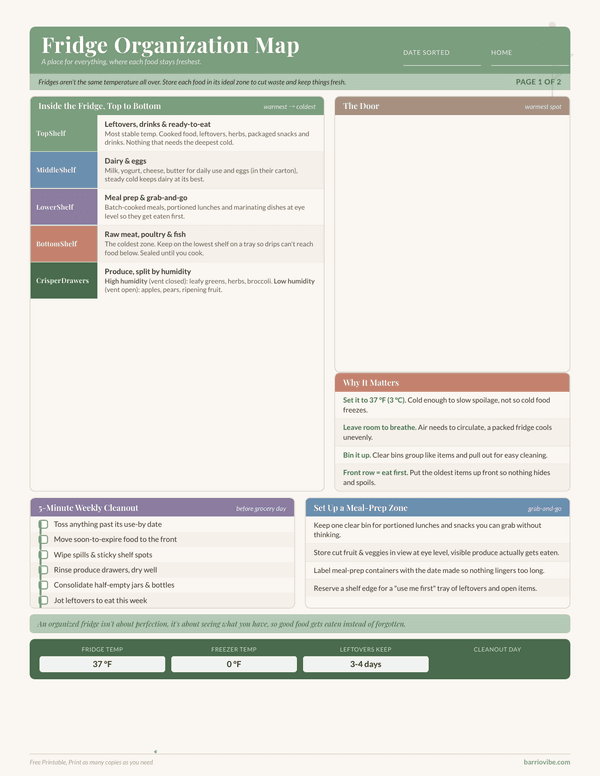
Fridge Organization Labels + Map, Free Printable
A free printable fridge organization set with a shelf-by-shelf zone map showing where each food stays freshest, plus cut-out bin labels for dairy, produce, leftovers, meal prep and more. Includes a leftovers tracker so nothing gets forgotten.
How do you keep produce from going bad in the fridge?
Separate your produce by humidity and give it a bin you'll actually see. Most crisper drawers have a small sliding vent: keep it closed (high humidity) for leafy greens and anything that wilts, and open (low humidity) for fruit and anything that rots, which lets ethylene gas escape instead of speeding up spoilage. The bigger budget win, though, is visibility, food you can't see is food you'll forget and eventually throw out. Move a small clear bin of washed, ready-to-eat produce up to eye level on the top shelf so it gets eaten before it turns. Keep berries dry until you're ready for them, store fresh herbs upright in a jar with a little water, and never seal greens in an airtight bag without a paper towel to absorb moisture. A dollar-store colander bin or two clear containers turn the crisper from a mystery drawer into a system, and cutting produce waste is where a $15 fridge makeover pays for itself inside a single month.
The average household throws away hundreds of dollars of food a year, and forgotten produce is the biggest culprit. That's the quiet math behind budget fridge organization: the point isn't just a tidier drawer, it's that a system you can see stops you from re-buying spinach you already have or letting a bag of carrots liquefy in the back. Spend fifteen dollars once, waste a little less every week, and the bins have paid for themselves many times over by the end of the month.
How do you keep a budget fridge system going week to week?
Build a fifteen-minute weekly reset around the day before you grocery shop. An organized fridge drifts back toward chaos not because the system failed but because nothing maintains it, so give it a standing appointment on the calendar. Right before your shopping trip, pull anything expired, wipe one shelf, rinse the empty bins, and slide older items to the front so they get used first. Keep a small "eat me first" bin, or a dry-erase note on the door, for anything on its last day. Labels quietly do most of the maintenance for you: when every bin has a home, family members put things back where they belong instead of shoving them wherever there's a gap. Reset the produce bin at the same moment you plan the week's meals, so whatever you buy already has a place to land. None of this means re-buying anything, the dollar-store bins you already own do the work. The habit, not the haul, keeps a fridge organized.
Should you organize the fridge before tackling the whole kitchen?
Start with the fridge, it's the fastest, cheapest win, and it changes your daily habits immediately. The fridge is a small, contained space you can completely transform in an afternoon for a few dollars, which makes it the perfect first project before you take on cabinets, the pantry, or a full kitchen overhaul. Momentum matters here: one organized zone you open twenty times a day proves the system works and pulls you toward the rest of the room. Once the fridge basically runs itself, roll the same bins-and-labels approach outward. If you want the complete shelf-by-shelf version, our full guide to fridge organization ideas walks through every shelf and the door, and if counter and interior space is your real constraint, these tips for small fridge organization with bins show how to fit a whole system into a compact fridge. Both use the same low-cost bins, so nothing you buy for one project goes to waste on the next.
You don't need a designer fridge or a big-box budget, you need a plan, a handful of clear bins, and labels that keep everyone honest. Grab the free printable, map your zones, and let the system do the remembering for you.
Fridge Organization Labels + Map, Free Printable
A free printable fridge organization set with a shelf-by-shelf zone map showing where each food stays freshest, plus cut-out bin labels for dairy, produce, leftovers, meal prep and more. Includes a leftovers tracker so nothing gets forgotten.
Frequently Asked Questions
How much does it cost to organize a fridge from the dollar store?
Most fridges can be fully organized for about $10 to $15 at a dollar store. Two or three clear bins, a turntable, an egg tray, and a can organizer usually cover it. Measure your shelves first and buy only what your food actually needs so nothing goes unused.
What dollar-store items are best for fridge organization?
Clear rectangular bins are the top pick because you can see what's inside without pulling everything out. Add a small turntable for condiments, a can or bottle dispenser for drinks, an egg holder, a butter keeper, and binder clips to seal open bags and hold labels.
How do you zone a fridge so food lasts longer?
Zone by temperature: leftovers and ready-to-eat food on the top shelf, dairy and eggs in the middle, raw meat on the coldest bottom shelf in a bin, produce split by humidity in the crispers, and only sturdy condiments in the warm door. Label each zone to keep it consistent.
How do you keep produce from going bad in the fridge?
Split the crisper by humidity: closed vent for leafy greens, open vent for fruit that releases ethylene. Move a clear bin of washed, ready-to-eat produce to eye level so it gets eaten first, keep berries dry, and store herbs upright in water. Visibility cuts the most waste.
How do you keep a fridge organized after you set it up?
Do a 15-minute reset the day before you grocery shop: toss expired items, wipe a shelf, rinse bins, and pull older food to the front. Keep an "eat me first" bin and rely on labels so everyone returns items to the right spot instead of reorganizing weekly.