Some links in this guide are affiliate links, if you buy through them we may earn a small commission at no extra cost to you. Here’s our disclosure.
Quick Answer
To build a grocery list on a budget for family meals, set a weekly spending ceiling, plan five or six dinners first, then write down only what those meals and your staples require. Shop your own pantry before the store, group the list by aisle, and star optional items so you know what to cut if you hit your limit.
Feeding a family gets more expensive every time you walk into the store. You go in for "just a few things," and somehow the total creeps past a hundred dollars again, half of it snacks the kids begged for, a rotisserie chicken because you forgot to plan dinner, and three items you already had two of at home. By the end of the week the fridge is somehow both overfull and empty of anything you can actually turn into a meal, and the produce you bought with good intentions is wilting in the drawer. It is not that you are careless with money. It is that shopping for a whole family without a plan means every trip becomes a series of small, in-the-moment decisions, and small decisions add up fast when there are more mouths, more preferences, and more impulse buys in the cart. You cannot out-coupon a shopping trip that had no plan behind it. The good news is that the fix costs nothing and starts before you leave the house: the list is where the savings actually begin.
How do you make a grocery list on a budget for a family?
Building a grocery list on a budget for family meals comes down to four steps: start with a set weekly number, plan your meals first, then build the list backward from those meals. Decide what your household can spend, say $150 or $200, and treat it as the ceiling, not a suggestion. Next, plan five or six dinners plus breakfasts and lunches, leaning on ingredients that repeat across meals so nothing goes to waste. Then write down only what those meals require, plus your staple restocks. Finally, "shop" your own pantry and fridge first, crossing off anything you already own. This four-step order, budget, meals, list, pantry check, is what keeps a family grocery list realistic instead of aspirational. A list built this way is short, purposeful, and priced in your head before you ever reach the register, which is exactly why it holds the line at the store.
How much should a family spend on groceries each week?
A typical family of four spends roughly $200 to $300 a week on groceries, but a budget-conscious plan can land closer to $150 to $200 without anyone feeling deprived. The right number depends on your family's size, ages, and where you live, teenagers eat far more than toddlers, and prices vary a lot by region. Rather than chasing a national average, set your own target by looking at what you actually spent over the last month, then trimming ten to fifteen percent. That trim is achievable through planning alone: fewer impulse buys, less spoiled produce, and more meals built from overlapping ingredients. Write your weekly ceiling at the top of your list so it stays visible the whole time you shop, and keep a rough running total in your head as you add items. When that total approaches your number, you stop adding, and because you planned your meals first, you already have everything the week needs before you hit the limit. Over a month, holding that ceiling four weeks in a row is where the real savings show up.
What foods stretch a family grocery budget the furthest?
The foods that stretch a family grocery budget furthest are versatile, filling staples that anchor multiple meals for a low cost per serving. Think dried and canned beans, rice, pasta, oats, eggs, frozen vegetables, and whole chickens, ingredients that show up in several dinners and rarely spoil before you use them. Building your list around these "workhorse" items lowers your cost per meal dramatically. Here is a rough guide to where a budget-minded family list should lean:
| Category | Budget-stretching picks | Why it works |
|---|---|---|
| Proteins | Eggs, dried/canned beans, whole chicken, ground turkey | Low cost per serving, freezes well |
| Grains | Rice, pasta, oats, tortillas | Cheap, filling, long shelf life |
| Produce | Frozen veg, carrots, cabbage, bananas, in-season fruit | Affordable, low waste |
| Pantry | Canned tomatoes, broth, peanut butter, oil | Turns cheap staples into full meals |
Fill your cart mostly from these rows and reserve a smaller slice of the budget for the flavor extras, a good cheese, fresh herbs, a sauce, that make the staples feel like real meals instead of survival food. The trick is proportion: when workhorse ingredients make up the bulk of the cart and treats fill the margins, your cost per serving stays low and the meals still feel generous. Buy proteins and produce that freeze well in slightly larger quantities when they are on sale, portion them at home, and you turn one shopping trip into two or three weeks of dinners.
How do you build a family grocery list that keeps you from overspending?
Build the list by aisle or category, price it in your head as you go, and separate true needs from nice-to-haves before you leave home. Overspending almost always happens in the store, in the moment, so the fix is to move those decisions to the kitchen table, where the pressure is off. Group your list into sections (produce, dairy, proteins, pantry, frozen, household) so you shop in one efficient loop and never backtrack past the cookie aisle twice. Jot an estimated price next to bigger items and keep a running subtotal; seeing the number climb is the single most effective brake on impulse buys. Mark anything optional with a small star so that if you hit your ceiling, you know exactly what to drop first. Shopping with a full stomach helps too, since hunger is what turns a starred "maybe" into an unplanned "definitely." A list organized this way does the discipline for you, you simply follow it, check items off, and leave when it is done, instead of relying on willpower against a store designed to make you wander.
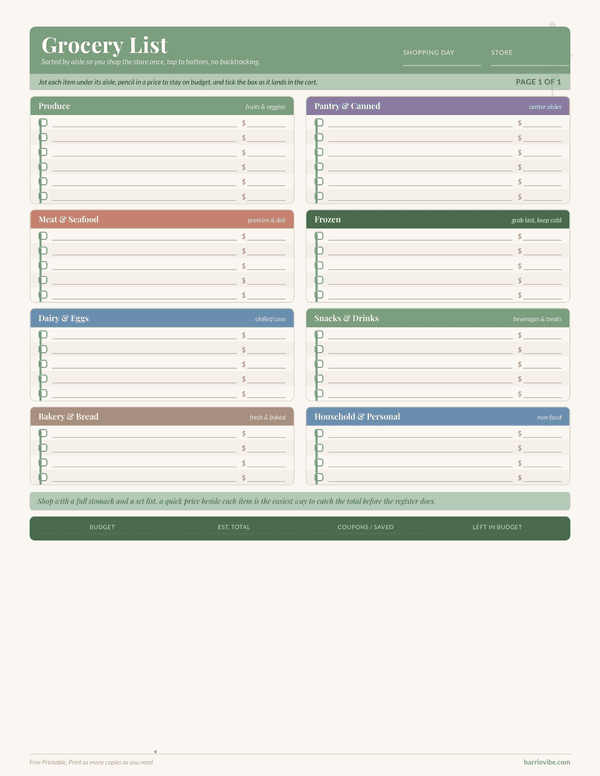
Grocery List Template (By Aisle), Free Printable
A free printable grocery list template organized by store aisle, produce, meat, dairy, pantry, frozen, and more, with a price column and budget tracker so you shop faster and spend less.
How do you handle kids' favorites without blowing the budget?
Give kids' favorites a defined, limited place on the list instead of letting them appear item by item at the store. Set a small "snack and treat" allowance within your weekly ceiling, a fixed dollar amount or a set number of items, and let your kids help choose within it. That turns endless in-aisle negotiations into one calm decision made at home, and it teaches budgeting in the process. Buy the favorites that pull double duty: yogurt for breakfast and lunchboxes, cheese for snacks and dinners, fruit that works as both. A few smart storage habits stretch these further, too, a set of clear stackable pantry bins keeps snacks visible and portioned, so a week's worth does not vanish in two days and you can see at a glance what still needs restocking. When kids feel some ownership over the list, the begging drops and so does the impulse spending, and the treats you did plan for feel more like a choice than a constant battle.
Should you use a grocery list or a meal plan to save money?
Use both, a meal plan decides what you will eat, and the grocery list turns that plan into exactly what you buy. They are two halves of the same money-saving system, and using one without the other leaves savings on the table. A meal plan without a list means you still wander the store guessing; a list without a plan means you buy ingredients that never become actual dinners. The most effective approach pairs them: plan the week's meals, then translate each recipe into list items, consolidating anything that repeats. If you want a deeper walkthrough of pricing and building the list itself, our guide on how to make a grocery list on a budget breaks the process down step by step. And to build the meals side of the system, meal planning on a budget shows how to plan a week of dinners around cheap, overlapping ingredients. Together they cover both halves of the plan.
Grocery List Template (By Aisle), Free Printable
A free printable grocery list template organized by store aisle, produce, meat, dairy, pantry, frozen, and more, with a price column and budget tracker so you shop faster and spend less.
Keep your family grocery list somewhere everyone can add to it during the week, set your ceiling before you shop, and let the plan, not the aisle, decide what goes in the cart. A budget that works is built one organized trip at a time.
Frequently Asked Questions
How much should a family of four spend on groceries per week?
A family of four typically spends about $200 to $300 a week, but a planned, budget-conscious approach can bring that closer to $150 to $200. Set your own target by trimming ten to fifteen percent off what you actually spent last month, then hold that ceiling.
How can I lower my family's grocery bill without coupons?
Plan your meals before you shop, build the list around cheap staples like beans, rice, eggs, and frozen vegetables, and shop your pantry first to avoid duplicates. Planning cuts impulse buys and waste, which saves more than most coupons on a whole week of family groceries.
What is the cheapest way to feed a family of four?
Anchor meals to versatile, filling staples, dried beans, rice, pasta, oats, eggs, whole chickens, and frozen produce, that repeat across several dinners. Buy freezer-friendly proteins on sale, portion them at home, and reserve a small slice of the budget for flavor extras that make the staples feel like real meals.
How do I stop overspending on groceries with kids?
Give kids' favorites a fixed allowance within your weekly ceiling and let kids choose within it, so treats become one calm decision at home instead of endless in-aisle negotiations. Shop from a list organized by aisle, keep a running total, and star optional items to drop first.
Do I need a meal plan and a grocery list, or just one?
Use both. A meal plan decides what you will eat and the grocery list turns that plan into exactly what you buy. A plan without a list means guessing at the store; a list without a plan means buying ingredients that never become dinners. Together they close the loop and save the most money.