Some links in this guide are affiliate links, if you buy through them we may earn a small commission at no extra cost to you. Here’s our disclosure.
Quick Answer
To make a grocery list on a budget, shop your fridge and pantry first, plan three or four meals around cheap staples like rice, beans, eggs, and in-season produce, then list only those ingredients, grouped by store section. Set a spending cap at the top and cut extras before you check out.
You clip the coupons, you tell yourself this is the week you'll finally stick to the number, and somehow you still walk out with a cart that rings up thirty or forty dollars over what you planned. The impulse buys sneak in near the register. The "we're almost out" items you grabbed just in case pile up. By the time you unload the bags at home, half of it won't get eaten before it goes bad, so next week you buy it all over again. If your grocery bill keeps creeping up no matter how careful you feel, the frustrating part is that it rarely feels like overspending in the moment. Each little extra seems reasonable on its own. The problem isn't willpower, and it isn't only that groceries are expensive right now. It's that most of us shop without a plan the store can't talk us out of.
How do you make a grocery list on a budget?
To make a grocery list on a budget, start with what you already have, plan a few meals around it, and set a spending cap before you write a single item down. Open your fridge, freezer, and pantry and note what needs using up, those ingredients become the backbone of the week's meals, so you buy less. Next, sketch three or four dinners plus breakfasts and lunches, then list only the ingredients those specific meals require. Group the list by store section, produce, proteins, dairy, pantry, so you shop in one efficient loop instead of doubling back and grabbing extras along the way. Finally, write your target number at the top of the page and tally as you add items, cutting the least essential ones the moment you go over. A budget grocery list isn't about deprivation, it's a filter that lets the planned items through and keeps the impulse buys out before they ever reach the cart.
What should be on a budget grocery list?
A budget grocery list should be organized by category and anchored by cheap, filling staples that stretch across several meals. Building the list around versatile basics keeps your cost per meal low and cuts the waste that quietly inflates every receipt. Here's a simple framework for what to include:
| Category | Budget-friendly picks |
|---|---|
| Proteins | Eggs, dried beans, canned tuna, whole chicken, ground turkey |
| Grains & starches | Rice, oats, pasta, potatoes, tortillas |
| Produce | In-season vegetables, bananas, cabbage, carrots, frozen mixed veg |
| Pantry & flavor | Broth, canned tomatoes, cooking oil, spices you already own |
| Dairy & extras | Milk, block cheese, plain yogurt |
Fill your cart mostly from the first two rows, proteins and starches deliver the most calories and staying power per dollar, and they form the base of nearly every cheap meal. Treat everything below as supporting cast that adds flavor and variety without driving up the total. Buy produce in season, when it's cheapest and best, and lean on the freezer aisle for vegetables that won't spoil before you use them. Anything that isn't tied to a planned meal or a genuine restock simply doesn't earn a spot on the list this week.
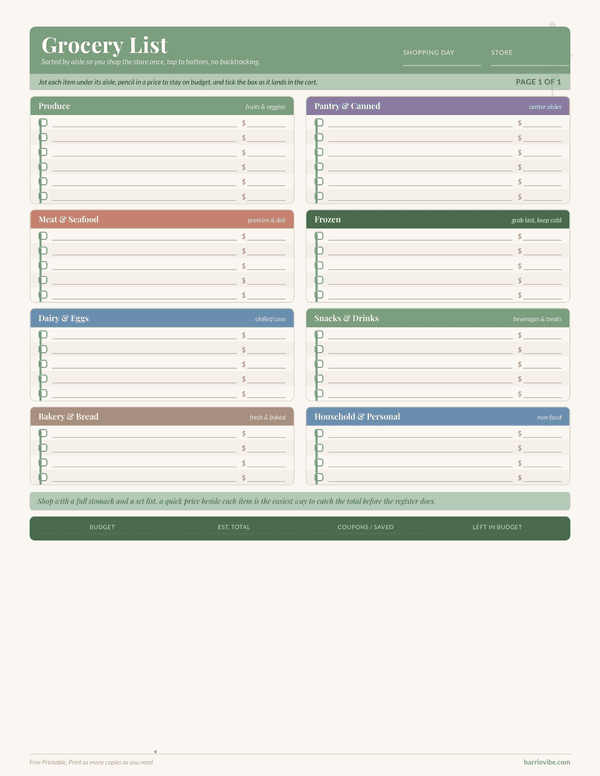
Grocery List Template (By Aisle), Free Printable
A free printable grocery list template organized by store aisle, produce, meat, dairy, pantry, frozen, and more, with a price column and budget tracker so you shop faster and spend less.
How do you plan meals to keep your grocery list cheap?
Plan meals around a few cheap "hero" ingredients and reuse them across the week so nothing gets bought once and then forgotten in the back of the fridge. Pick two or three inexpensive proteins and starches, a whole chicken, a bag of rice, dried beans, then build every dinner from that shared pool. The chicken becomes roast night, then tacos, then soup from the carcass; the beans stretch across a chili and a burrito bowl. Cooking once and repurposing twice slashes both cost and effort. Anchor one "planned leftovers" night and one pantry-clean-out meal each week to use up stragglers before they spoil. Keeping the recipe list short and repetitive is a feature, not a failure, the same eight or ten cheap dinners on rotation make the grocery run predictable. For a full framework, our guide to meal planning on a budget walks through building an entire week of cheap dinners. The tighter your meal plan, the shorter and cheaper your grocery list becomes.
How much should you budget for groceries each week?
A realistic weekly grocery budget for most US households runs roughly $75 to $100 per person, though where you land depends on your family size, region, and how much you cook from scratch. The USDA's monthly "thrifty" food plan is a common baseline many families start from and then trim. Rather than chasing someone else's number, track your own: save two or three recent receipts, find your current weekly average, and aim to shave it by ten to fifteen percent at first, a target small enough that you'll actually hit it. Divide the weekly figure by the number of dinners you plan to cook to get a rough per-meal ceiling, which makes trade-offs concrete at the shelf. When one recipe blows past that ceiling, swap in a cheaper night to balance the week. A budget you set from your real spending sticks far better than an aspirational number pulled from an article. Start where you actually are, then shave from there a little at a time.
What are the best ways to save money at the grocery store?
The biggest grocery savings come from buying store brands, shopping the unit price instead of the sticker price, and never shopping hungry. Store-brand staples are often made in the same plants as name brands for 20 to 30 percent less. Check the small unit-price tag on the shelf edge to compare true cost per ounce, because the bigger package isn't always cheaper. Buy in bulk only when you'll realistically use it before it expires. It also helps to keep your pantry visible: a few clear stackable bins let you see your rice, beans, and canned goods at a glance, so you stop buying a fourth jar of something you already have three of. Shop the store perimeter for whole foods first, and treat the center aisles as a targeted list run, not a browse. Sign up for the store's free loyalty program too, since most reserve their best prices for members. Small, repeatable habits like these save more over a year than any single coupon ever will.
How do you stick to your grocery budget once you're in the store?
Sticking to your budget in the store comes down to removing in-the-moment decisions before you ever grab a cart. Bring your list, on paper or your phone, and treat it as a closed set: if it isn't written down, it doesn't go in the cart this trip. Keep a rough running total in your head or a budgeting app so you feel the number climb before checkout surprises you. Eat first, shop the perimeter, and skip the aisles you don't actually need. Give yourself one small "flex" item so the plan feels generous rather than punishing, deprivation is what makes budgets collapse. If a genuine need surfaces mid-trip, add it to next week's list instead of the cart. If you want a reusable format to build from each week, this free grocery list printable gives you a ready-made template to fill in.
A printed list you actually carry is the most powerful tool here, because the decision was already made at your kitchen table, calm, unhurried, instead of under fluorescent lights with a hungry toddler in the seat. Keep a grocery list on a budget within arm's reach, plan around what you already own, and let the page do the deciding for you.
Grocery List Template (By Aisle), Free Printable
A free printable grocery list template organized by store aisle, produce, meat, dairy, pantry, frozen, and more, with a price column and budget tracker so you shop faster and spend less.
Frequently Asked Questions
How do I make a cheap grocery list?
Start by checking what you already have, then plan three or four meals around inexpensive staples like rice, beans, eggs, pasta, and in-season produce. List only the ingredients those meals need, group them by store section, and set a dollar cap at the top to shop against.
What is the cheapest food to buy on a tight budget?
The cheapest filling foods per dollar are dried beans, rice, oats, eggs, potatoes, pasta, canned tuna, bananas, cabbage, and frozen vegetables. These staples store well, stretch across several meals, and give you the most calories and protein for the lowest cost.
How much should I spend on groceries per week?
Most US households spend roughly $75 to $100 per person each week, but the right number depends on family size and how much you cook. Instead of a fixed target, average two or three recent receipts and aim to trim that by ten to fifteen percent.
How do I stop overspending at the grocery store?
Shop with a written list and treat it as a closed set, never shop hungry, and keep a running total as you go. Buy store brands, check unit prices, and give yourself one small flex item so the plan feels doable instead of punishing.
Does meal planning actually save money on groceries?
Yes. Meal planning cuts spending because you buy only what your planned meals require, reuse cheap hero ingredients across the week, and waste far less food. A tighter meal plan directly produces a shorter, cheaper grocery list, since the two work as a single tool.