Some links in this guide are affiliate links, if you buy through them we may earn a small commission at no extra cost to you. Here’s our disclosure.
Quick Answer
A grocery list organizer groups your shopping list by store section, produce, dairy, meat, pantry, frozen, household, instead of a random scramble. Because the list mirrors the aisles, you shop in one efficient loop, spot forgotten items fast, and curb impulse buys, cutting both your time in the store and your total at the register.
You get to the store with a list, and somehow it still doesn't work. The list is written in the order things popped into your head, milk, then batteries, then apples, then bread, so you crisscross the whole store, doubling back for the yogurt you passed twenty minutes ago. Halfway down every aisle you're squinting at a wall of text, unsure if you already grabbed the thing three lines down. You forget the one item you actually came for, buy two you already had at home, and still somehow spend more than you planned. By the time you're unloading bags in the driveway, the trip feels like it took twice as long as it should have, and you're already dreading doing it again next week. The problem isn't you, and it isn't the list itself. It's that the list has no structure, nothing to match the way the store is actually laid out, and nothing to keep your budget or your memory in check while you shop.
What is a grocery list organizer and how does it work?
A grocery list organizer is a pre-categorized shopping list that groups every item by store section, produce, dairy, meat, pantry, frozen, household, instead of one long scramble of whatever you thought of first. Rather than writing items in random order, you drop each one under its category, so by the time you reach the store your list already mirrors the aisles. You shop in a single loop, top to bottom, checking off a whole section before moving on. That structure does three things at once: it stops the back-and-forth walking, it makes forgotten items obvious because empty categories jump out, and it curbs impulse buys because you're moving with purpose instead of wandering. The free printable below gives you those sections pre-labeled with a budget column on the side, so all you do each week is fill in the blanks.
How do you organize a grocery list by aisle?
Group your items to match the path you already walk through the store, starting with the perimeter and finishing in the center aisles and freezer. Most supermarkets follow the same rough layout, so a by-aisle grocery list works almost anywhere. Here's the section order the printable uses:
| Section | What goes here |
|---|---|
| Produce | Fruit, vegetables, fresh herbs |
| Bakery | Bread, rolls, tortillas, buns |
| Meat & Seafood | Chicken, beef, fish, deli |
| Dairy & Eggs | Milk, cheese, yogurt, butter, eggs |
| Pantry & Dry Goods | Pasta, rice, canned goods, spices |
| Snacks & Breakfast | Cereal, crackers, granola bars |
| Frozen | Vegetables, meals, ice cream |
| Household & Personal | Paper goods, cleaning, toiletries |
Because the categories track the store's natural flow, you clear one zone before entering the next and never double back for the yogurt you walked past. Miss an item? The gap in its section is easy to spot before you check out. If your store places frozen foods near the entrance, just move that block to the top, the goal is that your list reads in the same order your feet actually travel. Print it, keep a copy on the fridge, and add to it all week.
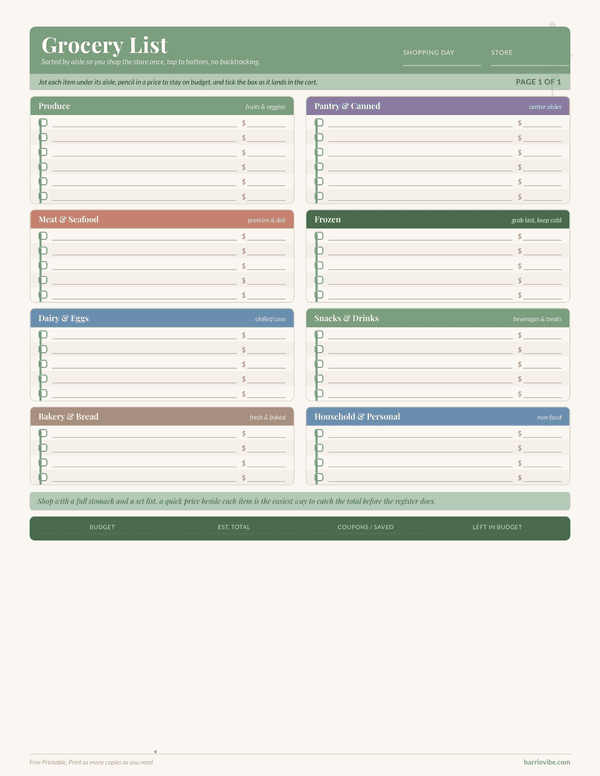
Grocery List Template (By Aisle), Free Printable
A free printable grocery list template organized by store aisle, produce, meat, dairy, pantry, frozen, and more, with a price column and budget tracker so you shop faster and spend less.
Why does shopping by aisle save money and time?
Shopping from an organized, by-aisle list cuts both your time in the store and your total at the register, because structure removes the two things that cost you most: wandering and impulse. When your list is grouped by section, you move in one efficient loop instead of crisscrossing, which can shave ten or fifteen minutes off a typical trip. The bigger savings are financial. Every extra minute you linger and every aisle you re-enter is another chance to toss something unplanned into the cart, and those unplanned grabs are where budgets quietly break. A categorized list keeps you moving with a clear purpose, so you're far less likely to browse the end-caps or the snack aisle you never meant to enter. Pair it with the budget column down the side, jotting a rough price beside each item, and you can tally the trip before you reach the checkout. Seeing the number climb in real time makes it easy to swap the pricier brand or drop the item you weren't sure about, instead of discovering the damage at the register. That running total is often the single change that keeps a grocery run from creeping over what you meant to spend.
What's the best way to build a list that matches your store?
Walk your usual store once with the layout in mind and note the order you actually pass each section, then arrange your categories to match. No two stores are laid out identically, so a five-minute mental map of your regular shop makes any grocery list organizer far more powerful. Keep the running list somewhere central, the fridge is ideal, and add items to the right category the moment you notice you're low, instead of scrambling to remember at the door. To make the printable last, slide it into a dry-erase pocket sleeve so you can check items off with a marker and wipe it clean for next week, saving both paper and ink. Do a quick pantry and fridge scan before you finalize the list to avoid rebuying what you already have, a thirty-second look inside usually cancels two or three items. Keep the categories in the same order every week so your brain learns the rhythm and filling the list becomes automatic. A list built around your real store and your real shelves is one you'll actually trust.
How do you pair a grocery list organizer with your meal plan?
Build your meal plan first, then let it fill your grocery list, the two work as one system, not two separate chores. Decide what you're cooking for the week, then read each recipe and drop its ingredients straight into the matching categories on your list. This way you buy exactly what your meals require and skip the guesswork that leads to a fridge full of odds and ends that never become dinner. Anything you already have on hand gets crossed off before you leave, and any half-used ingredient becomes a reason to plan one more meal instead of letting it spoil. If you want a step-by-step routine for connecting the two, our guide on how to pair a grocery list with meal planning walks through the exact order to work in. And if your meal plan itself needs a home, this weekly meal planner printable gives you a Monday-through-Sunday grid that feeds your grocery list directly. Planned meals plus a categorized list is what turns scattered shopping into a calm, repeatable habit.
How do you make the grocery list a weekly habit that sticks?
Attach the list to a routine you already have so it fills itself gradually instead of all at once. Pick a fixed home for the printable, the fridge or the inside of a cabinet door, and add items to the right section the instant you use the last of something, rather than trying to reconstruct the week from memory on shopping day. Anchor your planning to an existing anchor, like Sunday coffee, when you glance at the week ahead, jot your meals, and finalize the categories. Keep a pen clipped nearby so there's zero friction to writing an item down. When a week gets away from you and the list is half-empty, don't start over, just shop what's on it and keep going. It's also worth keeping a short "staples" line for the things you buy almost every trip, like milk, eggs, and bread, so they're never the item you forget. A grocery list organizer is a tool that bends to your week, not a system you can fall behind on. Consistency, not perfection, is what keeps the trips short and the budget intact.
Grocery List Template (By Aisle), Free Printable
A free printable grocery list template organized by store aisle, produce, meat, dairy, pantry, frozen, and more, with a price column and budget tracker so you shop faster and spend less.
Keep the printable somewhere you'll pass it every day, fill in each section as you run low, and let the store's own layout guide the trip. You don't need a perfect week or a fancy app, just a list that's grouped the way you shop. A shorter, cheaper, less stressful grocery run is really just a better-organized list.
Frequently Asked Questions
What is the best way to organize a grocery list?
Group items by store section, produce, bakery, meat, dairy, pantry, frozen, and household, in the order you walk the aisles. This by-aisle structure lets you shop in one loop without backtracking, makes forgotten items easy to spot, and keeps impulse buys down because you move with purpose.
How do I organize my grocery list by aisle?
Walk your usual store once and note the order you pass each section, then arrange your list categories to match. Most stores start with perimeter produce and dairy, then center pantry aisles, and end at frozen. Reorder the printable's sections so the list reads in the same order your feet travel.
Does a categorized grocery list actually save money?
Yes. A by-aisle list keeps you moving in one loop instead of wandering, which reduces impulse buys, the main way budgets break. Adding a budget column to jot rough prices lets you tally the trip before checkout, so you can swap or drop items before the total creeps over your limit.
Should I make my grocery list before or after meal planning?
Plan your meals first, then build the grocery list from them. Read each recipe and drop its ingredients into the matching categories, crossing off anything you already have. This way you buy exactly what your meals need and avoid random items that never turn into dinner.
Can I reuse a printable grocery list instead of reprinting it?
Yes. Slide one copy into a dry-erase pocket sleeve or sheet protector and check items off with a marker, then wipe it clean for the next trip. This saves paper and ink, though many people still like reprinting weekly for a fresh, blank list.